In a landmark achievement that bridges the gap between natural phenomena and the cutting edge of subatomic physics, an international team of researchers has successfully demonstrated that sunlight can be used to generate quantum entanglement between photons. This discovery, a collaborative effort between the University of Ottawa in Canada and the Max Planck Institute for the Science of Light (MPL) in Germany, challenges decades of scientific assumptions regarding the necessity of high-power, coherent laser sources for quantum applications. By tapping into the most abundant light source in our solar system, the researchers have paved a new pathway for energy-efficient quantum communication, ultra-precise sensing, and scalable quantum computing.
The study, published in the prestigious journal Optica, marks a significant shift in how scientists approach the "energy burden" of quantum technologies. As quantum systems transition from small-scale laboratory experiments to global infrastructure—such as quantum-encrypted satellite networks—the electricity required to power the arrays of lasers typically used to drive these systems has become a growing concern. The ability to substitute these artificial light sources with passive, natural sunlight could fundamentally alter the economic and environmental footprint of the next generation of information technology.
The Quantum Energy Crisis and the Need for Alternatives
Modern quantum technologies are notoriously energy-intensive. To maintain the delicate quantum states required for computation and communication, systems often require massive cooling units to reach near-absolute zero temperatures, alongside high-precision lasers that consume significant wattage. These lasers are used to "pump" nonlinear materials, triggering the processes that create entangled particles.
Quantum entanglement is a phenomenon where two or more particles become linked in such a way that the state of one instantly influences the state of the other, regardless of the distance separating them. This "spooky action at a distance," as Albert Einstein famously called it, is the backbone of Quantum Key Distribution (QKD), which allows for unhackable communication. However, generating these states consistently has traditionally required coherent light—light where the waves are perfectly synchronized in phase and frequency.
"Quantum entanglement is crucial for applications such as secure communication, ultra-precise sensing and high-performance computation," explained Cheng Li, a recent graduate of the University of Ottawa and the lead author of the study. "Our work shows that abundant natural light sources can be used for quantum entanglement, opening the possibility of more energy-efficient and accessible quantum technologies."
Challenging the Dogma of Coherent Light
For years, the consensus within the physics community was that the high degree of disorder in sunlight—its incoherence—made it unsuitable for generating the strong correlations required for entanglement. Sunlight is both spatially and temporally incoherent; it consists of a wide spectrum of colors (frequencies) and travels in myriad directions simultaneously. In contrast, lasers provide a "clean" source of light that is monochromatic and unidirectional, making it easy to manipulate at the quantum level.
The journey toward this breakthrough began in the laboratory of Robert Boyd at the University of Ottawa. The team started by questioning the absolute necessity of coherence. Through theoretical modeling, they predicted that if certain properties of light, such as polarization, remained orderly, other chaotic properties like color or direction would not necessarily prevent the formation of entangled pairs.
To test this theory, the team first conducted experiments using Light Emitting Diodes (LEDs). While LEDs are more orderly than sunlight, they are still considered incoherent sources compared to lasers. After successfully demonstrating that LEDs could produce polarization-entangled photons, the researchers set their sights on the ultimate challenge: the sun.
Engineering the Solar Solution: The All-Glass Concentrator
While the theory suggested sunlight could work, the practical application faced a massive hurdle: intensity. The process used to create entangled photons, known as Spontaneous Parametric Down-Conversion (SPDC), requires a high density of photons to be focused onto a nonlinear crystal. These crystals are often no larger than a millimeter, making it incredibly difficult to harvest enough sunlight to trigger the reaction.
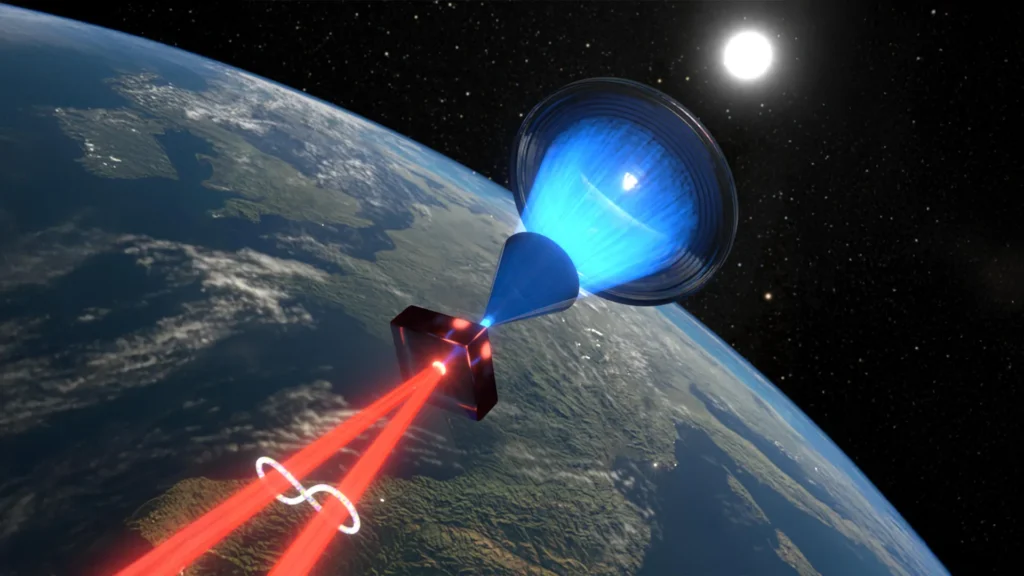
To solve this, Hanieh Fattahi’s team at the Max Planck Institute for the Science of Light developed a bespoke solar concentrator. The device utilized a Fresnel lens—a compact lens originally designed for lighthouses—roughly the size of a standard household window. This lens collected a large area of sunlight and funneled it into a cone-shaped glass system.
The engineering feat culminated in the light being squeezed into an optical fiber only as wide as a human hair. This concentrated beam was then directed onto the tiny nonlinear crystal. Despite the massive concentration of energy, the researchers had to ensure the light remained "clean" in its polarization, even as it was being physically manipulated through the lenses and fibers.
The Experiment: Validation Under the Open Sky
The definitive test took place in an outdoor setting at the MPL facilities. The researchers used the concentrated sunlight to pump the nonlinear crystal, which then split individual high-energy solar photons into pairs of lower-energy entangled photons.
To verify the results, the team employed quantum state tomography, a process akin to a medical CT scan but for quantum states. The data revealed that the photons generated by the sunlight had a 94% similarity (fidelity) to a theoretically perfect entangled state. This level of performance is comparable to results typically achieved with high-end laboratory lasers.
Furthermore, the team successfully demonstrated a violation of Bell’s inequality. In the world of quantum mechanics, Bell’s inequality is a mathematical litmus test used to prove that the correlations between particles are truly quantum in nature and cannot be explained by classical physics. By violating this inequality, the researchers proved beyond doubt that they had generated genuine quantum entanglement using nothing but filtered, concentrated sunlight.
Overcoming Scientific Skepticism
The success of the project is a testament to the researchers’ persistence in the face of widespread doubt. During the early stages of the project, many prominent figures in the field expressed skepticism that sunlight could ever provide the necessary conditions for nonlinear optical processes at the quantum level.
"Since the inception of this project, our idea has met with repeated doubt and pushback," said Li. "Some world-renowned researchers in the field even questioned whether it would be possible to detect any photons—not to mention entangled photons—from sunlight-driven nonlinear optical processes. However, we trusted our calculations, continued improving the experimental setup, and eventually showed that it was possible."
This validation is expected to encourage further exploration into "natural" quantum sources, potentially leading to a diversification of the materials and light sources used in quantum research.
Implications for Global and Space-Based Infrastructure
The most immediate application for this technology lies in the aerospace sector. Currently, satellites designed for quantum communication must carry heavy, power-hungry laser systems to generate entangled photons for secure key distribution. These components add significant weight, complexity, and cost to space missions.
By utilizing sunlight-driven entanglement, future satellites could potentially shed these bulky laser systems. Since sunlight is already abundant in the vacuum of space, a passive collection system could generate the necessary quantum states for secure encryption keys, significantly extending the operational lifespan of quantum satellites and reducing the cost of global secure networks.
On Earth, this technology offers a blueprint for "Green Quantum Computing." As data centers and quantum processors scale up, the energy required to maintain them is projected to skyrocket. Integrating solar-driven components could provide a sustainable method for interconnecting quantum processors in a "quantum internet" without adding to the global carbon footprint.
Future Research and Scaling
With the proof-of-concept established, the University of Ottawa and MPL teams are now focusing on refining the system for commercial and industrial use. Current goals include:
- Increasing Brightness: While the experiment proved entanglement is possible, the rate of photon generation (brightness) needs to be increased to match the speeds required for high-speed data transmission.
- Exploring Other Techniques: The researchers believe their "incoherent pump" approach can be applied to other nonlinear processes, such as four-wave mixing, which could expand the types of quantum states that can be generated from sunlight.
- Miniaturization: Future iterations will look to shrink the solar concentrator technology, making it easier to integrate into existing satellite and telecommunications hardware.
The achievement represents a rare moment where the complexity of quantum physics meets the simplicity of the natural world. By proving that the chaotic, multi-colored light of our sun can be harnessed to create the most delicate and orderly connections known to science, the researchers have opened a new chapter in the quest for a quantum-ready future. As the world looks for ways to innovate without exhausting the planet’s resources, sunlight-driven quantum technology stands as a beacon of sustainable progress.