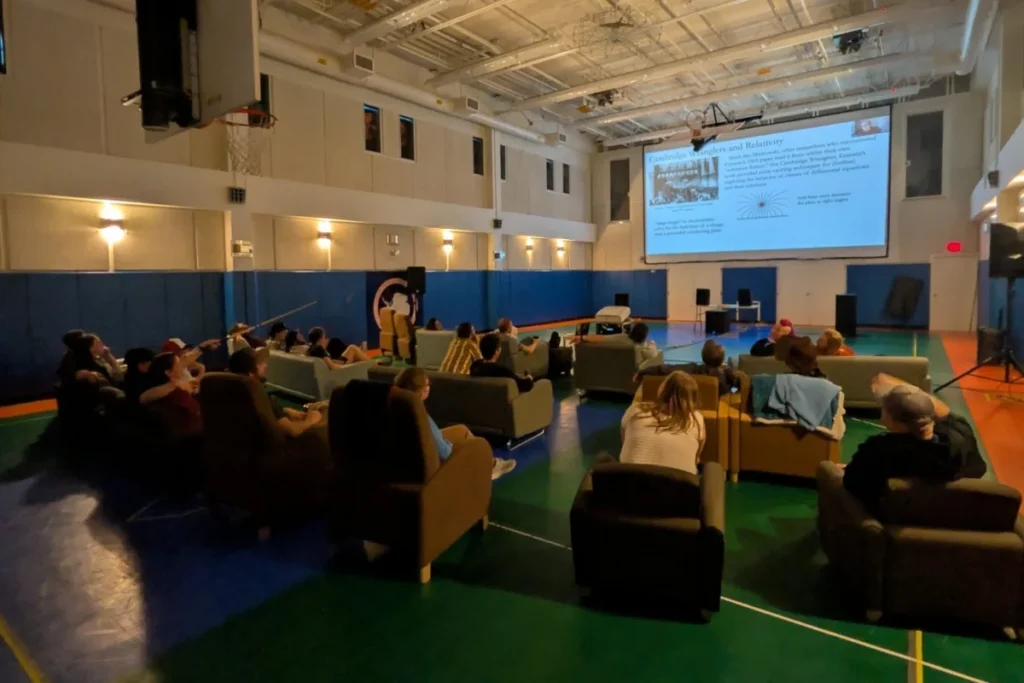
In the desolate, wind-swept expanse of the Amundsen-Scott South Pole Station, where temperatures routinely plunge below minus 60 degrees Celsius and the sun vanishes for six months at a time, a small community of scientists is bridging the gap between the edge of the world and the origins of the universe. John Della Costa, a researcher dedicated to the Background Imaging of Cosmic Extragalactic Polarization (BICEP) project, has transformed his winter-over assignment into a unique educational forum. Utilizing MIT OpenCourseWare (OCW), Della Costa and his colleagues have launched "Fysics Fridays," a weekly seminar series centered on the MIT course STS.042/8.225, titled "Einstein, Oppenheimer, Feynman: Physics in the 20th Century." This initiative highlights the profound reach of open-access education, demonstrating how digital resources can sustain intellectual community even in the most isolated environments on Earth.
The connection between the South Pole and the Massachusetts Institute of Technology was solidified when Della Costa reached out to Professor David Kaiser, who teaches the course. Kaiser, a renowned physicist and historian of science, is accustomed to receiving feedback from global learners, yet the correspondence from the Antarctic interior represented a unique milestone for the program. The BICEP project, which Della Costa supports, is a cornerstone of modern observational cosmology, making the academic content of Kaiser’s course particularly resonant for the team stationed at the pole.
The Science of the South Pole: BICEP and Cosmic Inflation
The BICEP collaboration represents one of the most ambitious efforts in modern astrophysics. Operating a series of highly sensitive radio telescopes at the South Pole, the team monitors the Cosmic Microwave Background (CMB)—the thermal radiation left over from the "recombination" era of the universe, roughly 380,000 years after the Big Bang. The primary objective of the BICEP experiments is to detect primordial gravitational waves. These ripples in spacetime are a predicted consequence of cosmic inflation, a theory pioneered by MIT Professor Alan Guth.
Cosmic inflation posits that in the fleeting fractions of a second following the Big Bang, the universe underwent an exponential expansion, growing by a factor of at least 10^26. This rapid stretching would have smoothed out the universe and created the large-scale structures observed today. If inflation occurred, it would have left a distinct "fingerprint" in the polarization of the CMB, known as B-mode polarization.
"Inflation is really important in making sense of our observations of our universe," Della Costa explains. "We have yet to discover the evidence for inflation that definitively proves that it did happen, and BICEP’s main role here at the South Pole is to discover gravitational waves from the very early universe."
The South Pole is the ideal location for this research due to its unique atmospheric conditions. The high altitude (nearly 3,000 meters) and extreme cold result in an exceptionally dry atmosphere with very little water vapor, which would otherwise absorb the millimeter-wave signals the telescopes are designed to detect. However, the same conditions that make the pole a premier site for astronomy also make it one of the most challenging places for human habitation.
Navigating Absolute Isolation: The Logistics of the Winter-Over
Della Costa’s tenure at the South Pole spans a grueling 13-month deployment, beginning in November 2025 and scheduled to conclude in December 2026. This period includes the "winter-over" phase, a time when the station becomes entirely inaccessible to the outside world.
The logistical reality of the South Pole is dictated by the weather. Between mid-February and late October, the cold is so intense that aircraft fuel would freeze, making flights impossible. The station officially "closed" on February 14, marking the beginning of several months of total physical isolation for the 45-person crew. During this time, the team must rely entirely on the supplies and resources brought in during the brief summer window.
Communication and data access are similarly constrained. While the station has satellite links, internet bandwidth is severely limited and only available during specific windows when satellites are visible above the horizon. This scarcity of real-time connectivity makes traditional streaming or interactive online learning nearly impossible. Recognizing these hurdles, Della Costa prepared for his mission by downloading several MIT OpenCourseWare classes in their entirety before departing for Antarctica. His digital library included foundational physics sequences such as 8.02 (Electricity and Magnetism) and 8.03 (Vibrations and Waves), as well as Professor Guth’s own course, 8.286 (The Early Universe).
Fysics Fridays: Building Intellectual Community
The "Fysics Fridays" series emerged as a solution to both the intellectual and social challenges of the winter-over. In an environment characterized by perpetual darkness and extreme confinement, maintaining mental health and a sense of community is paramount. Della Costa noted that the 45-person crew is a tight-knit group of researchers, engineers, and support staff who must look out for one another’s well-being.
"It’s very important to have community activities here," says Della Costa. The series began with documentaries on the development of the atomic bomb, which garnered significant interest across the station. This success led Della Costa to introduce Kaiser’s course, "Einstein, Oppenheimer, Feynman: Physics in the 20th Century," as the primary curriculum for the group.
The course is uniquely suited for a diverse audience. While some members of the South Pole crew are PhD physicists, others are specialists in mechanical engineering, logistics, or maintenance. Kaiser’s curriculum blends the technical evolution of modern physics—covering relativity, quantum mechanics, and nuclear physics—with the historical, philosophical, and sociological contexts of these discoveries. This multidisciplinary approach ensures the content is "meaty" enough for specialists while remaining accessible to those without advanced degrees in the field.
To supplement the lectures, the group has engaged in hands-on physics demonstrations. They have performed the classic double-slit experiment to observe the wave-particle duality of light and have plans to construct a cloud chamber. A cloud chamber allows observers to see the tracks of ionizing radiation, such as cosmic rays, passing through a supersaturated vapor—a tangible connection to the high-energy particles they study through their telescopes.
The Pedagogy of Open Learning
The course at the center of this Antarctic seminar, STS.042/8.225, has its own history of adaptation. Professor David Kaiser originally taught the course in person, but the COVID-19 pandemic necessitated a shift to a fully remote format in the fall of 2020. Kaiser adapted the curriculum for Zoom, creating a digital-first experience for a global cohort of students. These materials were later refined and officially launched on the MIT OpenCourseWare platform in August 2022.
MIT OpenCourseWare is a pioneer in the "Open Educational Resources" (OER) movement. Since its inception in 2001, it has published materials from over 2,500 MIT courses, reaching an estimated 500 million visitors worldwide. The platform operates on the philosophy that knowledge is a public good, and by making high-level academic content available for free, it empowers individuals to pursue education regardless of their geographic or financial constraints.
For Kaiser, the news that his lectures were being screened at the South Pole was a profound validation of the OCW mission. "Hearing that John and his team are spending a part of their time with this course was just the best message to receive," Kaiser remarked. He noted the irony and inspiration in the fact that material he developed during a period of global lockdown is now serving a team in a different kind of "lockdown" at the bottom of the world.
Impact and Implications: Knowledge Beyond Borders
The intersection of Antarctic research and open education highlights several key themes in modern science and society. First, it underscores the democratization of information. Della Costa’s journey began as a graduate student at San Diego State University during the pandemic, where he used OCW to supplement his nuclear physics studies. This self-directed learning eventually supported his transition into high-level research at one of the world’s most prestigious observatory sites.
Second, the "Fysics Fridays" initiative demonstrates the role of education in psychological resilience. In extreme environments, the pursuit of knowledge provides a structured, meaningful way to occupy time and foster social cohesion. By engaging with the history of their own field, the BICEP researchers are placing their current work into a broader historical narrative, connecting their daily tasks to the legacy of 20th-century giants like Einstein and Feynman.
Finally, the collaboration between Della Costa and Kaiser has opened new doors for communication. Kaiser has expressed plans to host a special Zoom colloquium for the South Pole community when satellite windows permit. This direct interaction between an MIT professor and a remote field team exemplifies the "global classroom" that open learning aims to create.
As the BICEP telescopes continue to scan the heavens for the faint whispers of the Big Bang, the researchers operating them remain tethered to the world of ideas through the efforts of MIT Open Learning. The project serves as a reminder that even in the coldest, darkest reaches of the planet, the human drive to understand the universe remains undiminished, fueled by the free exchange of knowledge across every latitude.