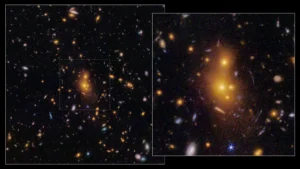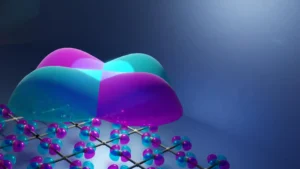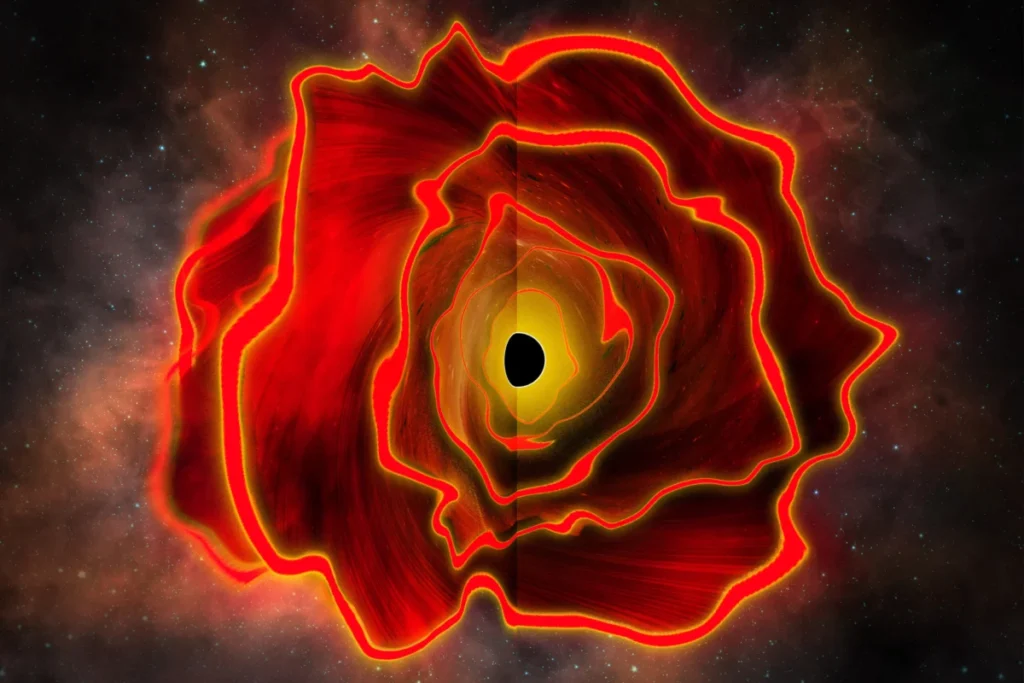
The James Webb Space Telescope (JWST) has fundamentally altered the landscape of modern cosmology by peering into the deep reaches of the early universe, revealing objects that defy traditional astrophysical models. Among the most perplexing of these findings are the "little red dots"—compact, crimson-hued sources that appear in almost every deep-field image captured by the telescope. A recent study led by researchers at the Massachusetts Institute of Technology (MIT) and NASA suggests that at least one of these mysterious objects, designated MoM-BH*-1, is not a standard galaxy but a "black hole star." This hybrid entity consists of a central black hole roughly 100,000 times the mass of the sun, encased within a gargantuan envelope of hydrogen gas the size of our solar system.
Lead author Rohan Naidu, a NASA Hubble Fellow and Pappalardo Fellow at MIT’s Kavli Institute for Astrophysics and Space Research (MKI), characterizes the discovery as a rapid evolution in our understanding of the early cosmos. The object represents a possible "missing link" in the evolution of supermassive black holes, providing a mechanism for how these gravitational giants grew so rapidly in the first billion years after the Big Bang. The research team, which includes MKI Director Robert Simcoe and Wendy Sun, utilized the unprecedented sensitivity of the JWST to look back to a time when the universe was only a few hundred million years old.
The Mirage or Miracle Survey and the Discovery of MoM-BH*-1
The discovery emerged from a comprehensive survey titled "Mirage or Miracle" (MoM). The survey was designed to address a growing tension in astronomy: the JWST was detecting far more bright galaxies in the early universe than theoretical models predicted. Astronomers were faced with two possibilities: either the early universe was far more efficient at producing massive galaxies (the "miracle" scenario), or these bright objects were not what they appeared to be (the "mirage" scenario).
During the survey, Naidu and his colleagues identified a specific source that stood out due to its extreme brightness and intense red color. While redness in space is often attributed to the presence of cosmic dust—much like how smoke from terrestrial wildfires can turn the sun a deep orange—the spectral data for MoM-BH*-1 did not align with the signatures of "soot or ash." Instead, the team observed a "Balmer break," a specific pattern in the light spectrum where brightness drops off sharply below certain wavelengths. This phenomenon is typically seen in the atmospheres of stars like Vega, where dense gas absorbs specific photons.
However, the Balmer break in MoM-BH*-1 was significantly deeper than any ever recorded in a standard star. This suggested that the researchers were witnessing a stellar atmosphere on a scale never before documented. Furthermore, the light from the object showed an almost complete absence of metals, consisting primarily of primordial hydrogen and helium. This lack of chemical enrichment indicates that the object formed in a very pristine environment, likely before multiple generations of stars had exploded as supernovae to seed the universe with heavier elements.
Modeling the Black Hole Star
To understand the physics behind MoM-BH*-1, the MIT team conducted a series of sophisticated simulations. They sought to determine if a source could appear that red using only hydrogen, without the presence of dust. The results indicated that an extremely dense "screen" of hydrogen could produce the observed color, provided the gas was so concentrated that it functioned like the surface of a star rather than a diffuse nebula.
While this explained the color and the Balmer break, it created a new problem: the object was 100 billion times brighter than a typical star. This level of luminosity is impossible to achieve through nuclear fusion, the process that powers the sun and other standard stars. The only known mechanism capable of generating such immense energy in a compact space is the accretion of matter into a black hole.
By integrating an active, accreting black hole into their hydrogen-envelope model, the researchers found a match for the JWST observations. The resulting picture of MoM-BH*-1 is that of a "quasistar"—a theoretical class of objects hypothesized to exist in the early universe. In this model, the energy released by matter falling into the central black hole provides the outward pressure necessary to support a massive, cool envelope of hydrogen gas. This prevents the envelope from collapsing into the black hole immediately, creating a temporary, ultra-bright hybrid that mimics the appearance of a star on a solar-system scale.
Solving the Little Red Dot Mystery
The identification of MoM-BH*-1 has profound implications for the thousands of other "little red dots" identified by the JWST. Since the telescope’s launch, these objects have been a subject of intense debate. Some researchers argued they were compact galaxies filled with old stars, while others suggested they were obscured quasars (active black holes hidden by dust).
Naidu’s team suggests that many, if not all, of these dots could be black hole stars. MoM-BH*-1 is unique because it is so luminous that it completely outshines its host galaxy, allowing astronomers to see "pure black hole star light." In other cases, where the dots are dimmer, the black hole star may be embedded within a nascent galaxy, contributing to the overall red hue observed by the JWST.
This finding helps reconcile the "mirage" versus "miracle" debate. Some of the "miraculously" bright galaxies seen in the early universe may actually be "mirages" created by individual black hole stars. Because these objects are so much brighter than ordinary stars, they can make a small, young galaxy appear far more massive and mature than it actually is.
Chronology of Early Universe Evolution
The discovery of MoM-BH*-1 fits into a broader timeline of cosmic history that astronomers are currently piecing together.
- The Dark Ages (0–380,000 years post-Big Bang): The universe is a hot, dense plasma. Eventually, it cools enough for atoms to form, but no stars yet exist.
- The Cosmic Dawn (100–400 million years post-Big Bang): The first stars (Population III stars) begin to form from pure hydrogen and helium. These stars are massive and short-lived.
- The Formation of Black Hole Seeds: Theoretical models suggest that in dense regions of gas, "Direct Collapse Black Holes" could form, bypassing the star stage entirely, or forming "quasistars" like MoM-BH*-1.
- The Era of Little Red Dots (500 million – 1 billion years post-Big Bang): JWST observes a proliferation of these objects. MoM-BH*-1 exists during this period, acting as a precursor to the supermassive black holes found at the centers of modern galaxies.
- The Present Day: These objects have long since disappeared. The hydrogen envelopes have been consumed or blown away, leaving behind the massive black holes that now reside in the hearts of galaxies like our own Milky Way.
Technical Data and Astrophysical Analysis
The scale of MoM-BH*-1 is difficult to grasp using conventional astronomical units. The central black hole, at 100,000 solar masses, is significantly larger than the black holes created by the collapse of individual stars today, which typically range from 5 to 100 solar masses. This suggests that the early universe had unique conditions—higher gas densities and lower chemical "pollution"—that allowed for the formation of these massive seeds.
The hydrogen envelope surrounding the black hole is estimated to be roughly the size of our solar system (approximately 100 to 200 Astronomical Units in diameter). For comparison, the sun’s diameter is about 0.01 AU. This makes MoM-BH*-1 one of the largest "stellar" structures ever theorized or observed.
The "Balmer break" observed in the spectrum occurs when electrons in hydrogen atoms transition from the second energy level. In the extremely dense environment of a black hole star’s envelope, this transition becomes a dominant feature, absorbing light and creating the distinct spectral "cliff" that Naidu and his team identified. The depth of this break in MoM-BH*-1 is the primary evidence that the object is surrounded by a dense, opaque shell of gas rather than being a collection of disparate stars.
Implications for Future Research
The discovery of MoM-BH*-1 provides a new framework for interpreting JWST data. It suggests that the early universe was populated by exotic objects that do not exist in the local cosmos. This "pure light" from a black hole star offers a rare opportunity to study the growth of black holes in real-time, billions of years in the past.
The research also raises questions about the transition from these hybrid objects to the quasars and galaxies we see later in cosmic history. Astronomers will now look for "transition objects"—black hole stars that are beginning to lose their hydrogen envelopes, revealing the bright accretion disks of quasars beneath.
As the JWST continues its mission, the MoM survey and similar initiatives will likely identify more candidates for black hole stars. Each new detection will refine the parameters of the simulations, helping scientists understand the temperature, density, and lifespan of these cosmic titans. The study of MoM-BH*-1, supported by NASA and the Space Telescope Science Institute, marks a pivotal moment in the "JWST era," turning a mysterious "mirage" into a scientifically grounded reality that explains how the universe’s most massive structures began their journey.