In a landmark study published in the journal Nature Materials, a research team spearheaded by Professor Kaifeng Wu from the Dalian Institute of Chemical Physics (DICP) of the Chinese Academy of Sciences has unveiled a sophisticated energy transfer mechanism that could redefine the development of advanced materials for energy conversion. The discovery, termed proton shuttle-assisted triplet energy transfer (PS-TET), highlights a previously unrecognized synergy between proton movement and the migration of spin-triplet energy. This research marks a significant departure from established models of energy transfer, offering a new blueprint for controlling the behavior of excited states in complex molecular and nanocrystal systems.
The Evolution of Proton-Coupled Processes
To understand the significance of the PS-TET discovery, it is essential to look at the scientific lineage of proton-coupled dynamics. For decades, the cornerstone of this field has been proton-coupled electron transfer (PCET). In PCET, the movement of an electron and a proton are linked, a phenomenon that is ubiquitous in biological systems. It is the fundamental mechanism behind cellular respiration, the water-splitting process in photosynthesis, and the complex enzymatic reactions involved in nitrogen fixation. By coupling the movement of these two particles, nature circumvents high-energy intermediates, allowing for efficient charge transport across biological membranes.
In recent years, the scientific community began to explore whether similar coupling could exist for energy transfer rather than just charge transfer. This led to the identification of proton-coupled singlet energy transfer (PCEnT). While PCEnT provided insights into how protons influence short-lived singlet states, the behavior of long-lived triplet states remained largely unexplored. Triplet states are particularly valuable in the context of photocatalysis and optoelectronics because their longer lifetimes—resulting from "forbidden" transitions back to the ground state—allow more time for chemical reactions to occur. However, the mechanism by which protons might facilitate the transfer of these triplet states had remained a mystery until Professor Wu’s team initiated their investigation.
Experimental Design and the PS-TET Mechanism
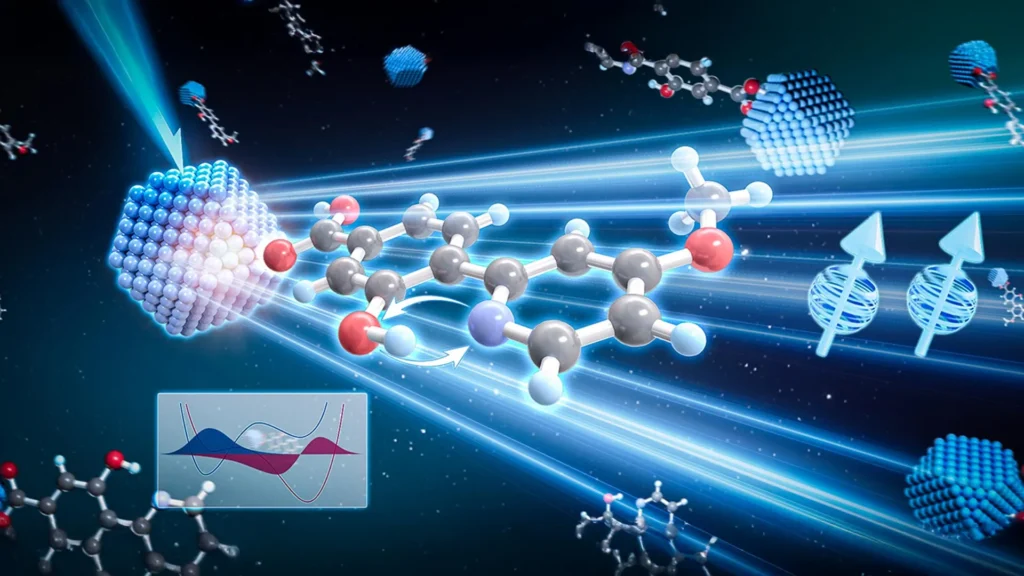
The research conducted at the Dalian Institute of Chemical Physics focused on a hybrid system consisting of inorganic semiconductor nanocrystals and organic molecular acceptors. Specifically, the team utilized ZnSe (Zinc Selenide) colloidal quantum dots (QDs) as the energy donors. These quantum dots were functionalized with phenol-pyridine dyadic acceptors attached to their surfaces.
The choice of materials was strategic. ZnSe quantum dots are well-known for their tunable optoelectronic properties, while the phenol-pyridine dyad serves as a classic model for studying proton-coupled dynamics due to the hydrogen-bonding interaction between the hydroxyl group of the phenol and the nitrogen atom of the pyridine.
The PS-TET process begins when the ZnSe quantum dots are excited by light. Upon absorption, the QD enters an excited state, creating an electron-hole pair. The subsequent "shuttle" mechanism operates in a carefully orchestrated two-step sequence:
- Initial Hole and Proton Shift: A hole moves from the valence band of the ZnSe quantum dot to the phenol molecule. Simultaneously, a proton shifts from the phenol’s hydroxyl group to the adjacent pyridine nitrogen. This step creates a phenoxyl radical and a pyridinium cation.
- Electron Transfer and Proton Return: Following the hole transfer, an electron is transferred from the ZnSe quantum dot to the phenoxyl radical. Critically, as the electron moves, the proton "shuttles" back from the pyridinium to its original location on the phenol.
The net result of this synchronized dance is the transfer of a spin-triplet exciton from the quantum dot to the molecular dyad. Remarkably, the proton ends the process exactly where it started, acting as a true "shuttle" that facilitates the energy transfer without being consumed or permanently relocated.
Comparative Data and Experimental Validation
The research team employed transient absorption spectroscopy to track these ultra-fast movements with femtosecond precision. To prove that the proton shuttle was indeed the catalyst for the observed energy transfer, the researchers compared the PS-TET system against a control group.
The control involved a methylated analog of the acceptor where the transferable proton was replaced by a methyl group (–CH3). Because the methyl group cannot "shuttle" between the phenol and pyridine, the proton-coupled pathway was effectively blocked. The data revealed a stark contrast: the speed and efficiency of triplet energy transfer in the PS-TET system were orders of magnitude higher than in the methylated version.
In the PS-TET-enabled system, energy transfer occurred with near-unity efficiency and at a rate that suggests a significant reduction in the activation energy barrier. This comparison provided definitive evidence that the temporary movement of the proton is the key driver in unlocking high-efficiency triplet migration.
Quantum Tunneling at Room Temperature
One of the most striking findings of the study relates to the temperature dependence of the PS-TET process. In classical chemistry, reaction rates typically follow the Arrhenius equation, meaning they slow down as temperature decreases because fewer molecules have the kinetic energy to clear the activation barrier.
However, Professor Wu’s team observed that the rate of PS-TET remained remarkably constant across a wide range of temperatures. This lack of temperature dependence is a "smoking gun" for quantum mechanical tunneling. In this context, the proton does not climb over the energy barrier; instead, it "tunnels" through it.
To verify this, the researchers performed complex calculations involving proton vibrational wavefunction overlap integrals. These integrals measure the degree of overlap between the initial and final states of the proton. The calculations confirmed that the system was optimized for tunneling, even at room temperature. This insight is profound because it demonstrates that quantum effects, which are often associated with extremely cold environments, can be harnessed to control energy flow in materials operating under ambient conditions.
Structural Tuning and Chemical Control
The team further explored the versatility of the PS-TET mechanism by introducing chemical modifications to the pyridine ring. By adding a trifluoromethyl (–CF3) group—a strongly electron-withdrawing substituent—they were able to manipulate the electronic environment of the acceptor.
The researchers discovered that this chemical "tuning" could actually change the order of the steps in the proton-coupled process. By altering the electron density, they could dictate whether the hole transfer or the electron transfer occurred first, or if they occurred in a more concerted fashion. This level of control suggests that PS-TET is not a rigid process but a flexible framework that can be engineered to suit specific technological needs.
Official Responses and Scientific Analysis
The discovery has been met with significant interest from the international scientific community. Professor Kaifeng Wu, in discussing the implications of the work, emphasized the transformative potential of understanding these sub-atomic interactions. "The discovery of the PS-TET mechanism has profound implications for many modern molecular technologies involving the spin-triplet excited states of molecules," Wu stated.
Internal reviewers at the Chinese Academy of Sciences noted that this research bridges the gap between semiconductor physics and molecular chemistry. By showing how inorganic quantum dots can interface with organic proton-shuttle dyads, the study provides a roadmap for creating hybrid materials that combine the best properties of both worlds.
Independent analysts suggest that the ability to "turn on" or "turn off" triplet energy transfer by including or excluding a proton shuttle could lead to a new class of "smart" materials. These materials could change their energy-handling characteristics in response to environmental triggers or chemical signals.
Broader Implications for Energy and Technology
The potential applications of the PS-TET mechanism span several critical sectors of green technology and advanced manufacturing:
1. Enhanced Photocatalysis and Environmental Remediation
In photoredox catalysis, the efficiency of a chemical reaction is often limited by how quickly energy can be moved to the catalyst’s active site. By utilizing PS-TET, scientists could design catalysts that generate triplet states more efficiently, leading to faster rates for hydrogen production, carbon dioxide reduction, and the breakdown of organic pollutants in water.
2. Improving Solar Cell Longevity and Performance
While triplet states are useful in some contexts, they can be detrimental in others. In organic photovoltaics (OPVs), unwanted triplet states can lead to energy loss and material degradation. The insights from the PS-TET study could allow engineers to design materials that suppress triplet formation by removing potential proton-shuttle pathways, thereby extending the operational lifespan and efficiency of solar panels.
3. Advancements in Laser Technology
Organic semiconductor lasers require precise control over exciton populations. The ability to tune the transition between singlet and triplet states using proton-coupled mechanisms could lead to lower-threshold lasers and more stable organic light-emitting diodes (OLEDs).
4. Quantum Information Science
The observation of room-temperature quantum tunneling in a complex material system opens new doors for quantum information science. Understanding how to maintain coherence and control tunneling in molecular systems is a vital step toward developing molecular-scale quantum gates or sensors.
Conclusion: A New Paradigm in Energy Migration
The research led by Professor Kaifeng Wu and his team at the Dalian Institute of Chemical Physics represents a significant milestone in the study of molecular dynamics. By identifying and characterizing the proton shuttle-assisted triplet energy transfer mechanism, they have added a vital new chapter to the story of proton-coupled electron and energy transfer.
The study not only clarifies a long-standing mystery regarding triplet energy movement but also provides a practical toolkit for material scientists. Whether the goal is to harness triplet states for powerful new catalytic reactions or to suppress them to improve the stability of electronic devices, the "proton shuttle" offers a precise lever for control. As the world moves toward more efficient and sustainable energy technologies, the ability to manipulate energy at the quantum level—one proton and one electron at a time—will undoubtedly play a central role in the next generation of scientific breakthroughs.