Europe witnessed a spectacular total solar eclipse on August 12, 2026, a phenomenon that captivated millions. However, hours before the Moon’s shadow gracefully swept across the continent, the European Space Agency’s (ESA) Proba-3 mission accomplished a remarkable feat of its own: an artificial eclipse, generated for the 65th time, entirely independent of lunar intervention. This achievement underscores the precision and innovative capabilities of the Proba-3 mission, designed to study the Sun’s elusive corona.
The Art of the Artificial Eclipse
The Proba-3 mission, a twin-satellite constellation, operates with an extraordinary level of precision. Positioned approximately 60,000 kilometers above Earth, the two spacecraft meticulously align themselves at a separation of just 150 meters. One satellite, designated the "Occulter," acts as an artificial Moon. By strategically positioning itself between the Sun and its companion, the Occulter effectively eclipses the Sun, casting a shadow that allows the second satellite, equipped with the Advanced Spaceborne Particle Image Instrument (ASPIICS) coronagraph, an unobstructed and prolonged view of the Sun’s corona.
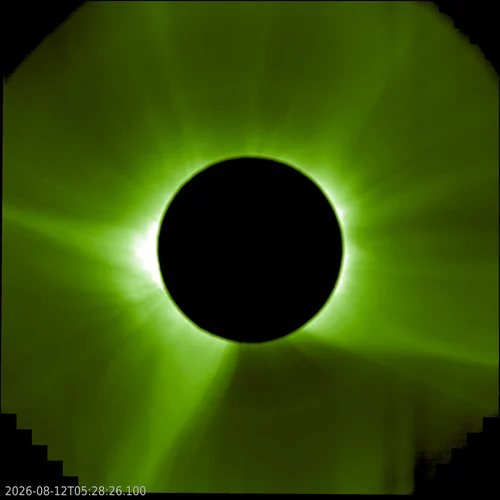
The image captured by ASPIICS on the morning of August 12, 2026, showcases the Sun’s inner corona in its characteristic greenish hue. This view, as described by ESA, closely mimics what ground observers would experience through a green filter during the natural solar eclipse occurring later that day. The ASPIICS instrument is specifically designed to block the Sun’s blindingly bright disc, enabling the observation of the faint outer atmosphere – the corona – which is typically obscured by the Sun’s direct light. This allows scientists to study phenomena such as solar flares, coronal mass ejections, and the solar wind, which have profound impacts on Earth’s technological infrastructure and space exploration endeavors.
A Cosmic Coincidence: The Double Eclipse
Remarkably, on August 12, 2026, the natural celestial body that Proba-3 so expertly imitates decided to make an appearance. Shortly after the artificial eclipse observation, the Moon itself traversed Proba-3’s field of view, creating a rare and captivating "double eclipse." This celestial alignment, while coincidental to Proba-3’s operational schedule, provided a unique opportunity for comparative observation and likely generated considerable excitement among the mission’s science team. The ESA even highlighted this extraordinary event in a video titled "A double eclipse for Proba-3," emphasizing the serendipitous confluence of artificial and natural celestial events.
Predictive Power of Proba-3
The Proba-3 mission’s capabilities extend beyond mere observation; they possess a predictive dimension. Approximately two weeks prior to the August 12th event, Proba-3 was positioned on the opposite side of the Sun relative to its Earth-facing observation period. The Sun completes a half-rotation on its axis in roughly two weeks. By observing the Sun from this alternative vantage point, the mission’s coronagraphy images served as a remarkably accurate forecast of what the solar corona would look like on August 12th, both for Proba-3 itself and for ground-based observers. This predictive power is invaluable for anticipating solar activity and its potential effects.
Context of the 2026 Total Solar Eclipse
The natural solar eclipse of August 12, 2026, was a significant astronomical event for Europe. The path of totality, where the Sun is completely obscured by the Moon, stretched across several countries, offering a breathtaking spectacle. Millions of people across the affected regions, as well as numerous space missions observing Earth and the solar system, were positioned to witness this celestial alignment. ESA itself acknowledged the widespread interest, compiling a selection of notable observations from the 2026 total solar eclipse on its website, highlighting the collective fascination with this recurring cosmic dance.
Supporting Data and Mission Objectives
The Proba-3 mission is a testament to ESA’s commitment to solar physics research. The ASPIICS instrument, a key component, is designed to achieve an unprecedented level of precision in coronagraphy. Its ability to maintain a stable, precise formation with the Occulter satellite allows for the suppression of stray light and the observation of the corona down to very close to the Sun’s limb. This level of detail is crucial for understanding the fundamental processes driving solar activity.
The mission’s primary objectives include:
- Studying the inner corona: Investigating the temperature, density, and magnetic field structure of the solar corona at unprecedented resolution.
- Understanding solar wind acceleration: Gaining insights into how the solar wind, a stream of charged particles emanating from the Sun, is accelerated to escape the Sun’s gravity.
- Monitoring solar flares and coronal mass ejections (CMEs): Providing crucial data for predicting and understanding these powerful solar events, which can impact satellites, power grids, and communication systems on Earth.
- Validating solar models: Providing empirical data to refine and improve theoretical models of solar physics.
The sustained operation of Proba-3, achieving its 65th artificial eclipse on this particular day, demonstrates the robustness and reliability of its sophisticated control systems and the precision of its orbital maneuvering. Each successful artificial eclipse represents a data-rich opportunity for scientists.
Implications and Broader Impact
The Proba-3 mission’s ability to create artificial eclipses has far-reaching implications for solar physics and space weather forecasting.
- Enhanced Understanding of Solar Phenomena: By providing continuous, high-resolution data of the solar corona, Proba-3 contributes to a deeper understanding of the Sun’s complex magnetic field and its influence on space weather. This knowledge is vital for protecting our increasingly technology-dependent society.
- Improved Space Weather Prediction: Accurate prediction of solar flares and CMEs is crucial for mitigating their disruptive effects. Proba-3’s observations help scientists to better identify the precursors of these events, allowing for more timely warnings. This is particularly important for astronauts in orbit, satellite operators, and even airlines that may need to reroute flights to avoid radiation belts.
- Technological Advancement: The mission pushes the boundaries of spacecraft formation flying and precision pointing technology. The ability of two independent spacecraft to maintain such close proximity and alignment over extended periods is a significant engineering achievement with potential applications in other space missions.
- Scientific Collaboration: Proba-3’s data is shared with the global scientific community, fostering international collaboration and accelerating research in solar physics. The mission’s findings contribute to a collective effort to understand our star and its impact on the heliosphere.
The coincidence of Proba-3’s artificial eclipse with the natural event of August 12, 2026, served as a powerful reminder of humanity’s growing ability to observe and understand the cosmos, both through the direct observation of celestial phenomena and through the ingenious application of technology to replicate and study them. The mission’s continued success promises further groundbreaking discoveries about our Sun.