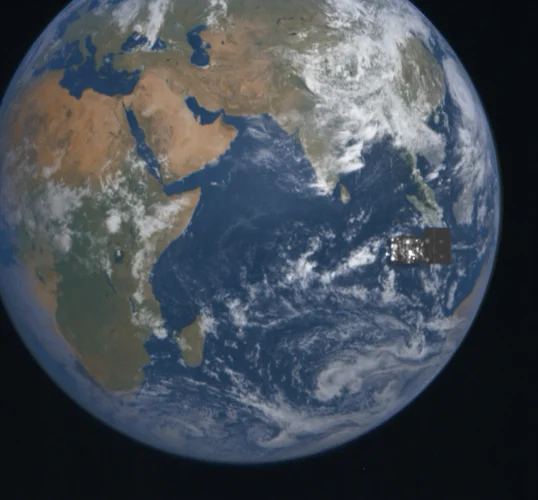
At first glance, the latest image released by the European Space Agency (ESA) appears to be a familiar, breathtaking vista of Earth from orbit. However, a closer examination reveals a remarkable detail: the Proba-3 mission’s Coronagraph spacecraft is subtly integrated into the scene, cleverly camouflaged against the backdrop of the Indonesian Archipelago, to the right of the vast expanse of the Indian Ocean. This dual-purpose imaging, capturing both the cosmos and our home planet, highlights the innovative capabilities of the Proba-3 mission, which is designed for intricate formation flying to study the Sun’s corona.
The Proba-3 mission, a testament to ESA’s commitment to pushing the boundaries of space observation, comprises two spacecraft: the Coronagraph and the Occulter. While the Coronagraph is solely dedicated to observing the Sun and its ethereal outer atmosphere, the Occulter plays a crucial role in facilitating this observation through precise positioning and also serves as an unexpected Earth imager. The Occulter is equipped with a sophisticated camera system that allows it to autonomously adjust its position relative to the Coronagraph. This system includes a wide-angle camera (WAC) that tracks a set of flashing LED lights on the Coronagraph, providing a primary means of maintaining formation. Complementing the WAC is a narrow-angle camera (NAC), which enables even more precise positioning, ensuring the delicate dance between the two spacecraft remains perfectly synchronized.
This particular image, captured on July 10, 2026, offers a unique perspective. It was taken during a routine operation aimed at bringing the two Proba-3 spacecraft from a relatively safe orbital separation to a precise distance of 147 meters from each other. This maneuver was a critical step in preparing for advanced formation flight, a complex orbital ballet that is essential for the mission’s primary scientific objectives. The image itself is presented with a clever interactive element: a slider that allows viewers to switch between a monochrome view, representing what the Occulter’s cameras directly perceive, and an artificially colored version designed to enhance visibility and make the spacecraft’s presence more apparent. The left side of the slider reveals the black-and-white depiction of the spacecraft, while the right side presents the more aesthetically pleasing, colorized rendition of Earth.
The significance of this image extends beyond its artistic appeal and its demonstration of the Proba-3 mission’s operational prowess. It underscores the dual-use nature of advanced space technologies. While the Occulter’s camera system is primarily engineered for the intricate task of enabling Proba-3’s formation flying and solar corona observations, its strategic vantage point and imaging capabilities unexpectedly yield stunning views of Earth. When the orbital geometry is just right, as it was on July 10, 2026, the Occulter captures captivating images of our planet, offering a unique perspective that complements the mission’s core scientific goals.
Proba-3: A Mission of Precision and Discovery
The Proba-3 (Project for On-Board Autonomy) mission is a flagship endeavor by ESA designed to achieve unprecedented solar corona observations. Unlike traditional coronagraphs that are limited by atmospheric disturbances or the constraints of being fixed on a single platform, Proba-3 employs a novel approach: two spacecraft flying in precise formation. The Coronagraph spacecraft is equipped with sophisticated optical instruments to block out the Sun’s bright disk, allowing scientists to study the fainter corona. The Occulter spacecraft, positioned at a precisely calculated distance, acts as a dynamic shield, effectively creating an artificial eclipse of the Sun. This formation flying technique, requiring sub-meter accuracy over distances of hundreds of meters, is a significant technological challenge and a major advancement in space mission design.
The development of Proba-3 involved extensive research and development in autonomous navigation, precise attitude control, and robust formation-keeping algorithms. The mission’s success hinges on the ability of the spacecraft to maintain their relative positions with extreme accuracy, even under varying orbital conditions and gravitational influences. The camera system on the Occulter, which includes the WAC and NAC, is central to achieving this. The WAC’s ability to detect and track the LEDs on the Coronagraph provides the initial guidance for the formation. The NAC then refines this positioning, ensuring that the Occulter perfectly eclipses the Sun for the Coronagraph’s instruments.
A Chronology of Orbital Maneuvers and Imaging
The image released on July 10, 2026, represents a specific moment within the broader Proba-3 mission timeline. While the exact date of the mission’s launch and the commencement of its primary scientific operations are crucial for context, this particular image captures a key phase of operational validation and early scientific data acquisition.
- Pre-Launch and Initial Orbit: Following its launch, Proba-3 would have undergone a series of system checks and calibration maneuvers. The initial orbital phase would focus on bringing the two spacecraft into proximity and establishing basic communication and control links.
- Formation Flying Initiation: The period leading up to July 10, 2026, would have been dedicated to gradually reducing the separation between the Coronagraph and Occulter. This would involve a series of precisely calculated orbital adjustments, guided by ground control and increasingly by the spacecraft’s autonomous systems.
- July 10, 2026: The Imaging Event: This date marks a significant milestone, where the spacecraft were brought to within 147 meters of each other in preparation for sustained formation flight. During this maneuver, the Occulter’s WAC, in addition to tracking the Coronagraph’s LEDs for formation control, captured the image of Earth. The angle and position at this moment provided the unique alignment for the planet to be visible in the frame.
- Post-Maneuver Operations: Following this successful positioning, Proba-3 would have continued to refine its formation, potentially reaching even closer distances for specific scientific observations. The Occulter’s camera system would continue to provide telemetry and potentially further Earth imagery during subsequent operations, dependent on orbital geometry.
- Ongoing Scientific Observations: The primary objective of Proba-3 is to conduct long-duration observations of the solar corona. This involves blocking out the Sun’s disc to reveal its faint outer atmosphere, enabling studies of solar flares, coronal mass ejections, and the solar wind.
Supporting Data and Technical Specifications
While specific technical data regarding the image resolution or the exact spectral bands captured by the WAC are not provided in the initial release, we can infer certain details based on the mission’s objectives and the nature of the image.
- Spacecraft: Proba-3 mission, comprising the Coronagraph and Occulter spacecraft.
- Instrument: Wide-Angle Camera (WAC) onboard the Occulter spacecraft.
- Date of Capture: July 10, 2026.
- Target of Observation (Primary): Sun’s corona (via Coronagraph spacecraft).
- Target of Observation (Secondary, in this image): Earth.
- Orbital Separation: 147 meters between Coronagraph and Occulter at the time of imaging.
- Image Processing: Processed by the Royal Observatory of Belgium.
- Image Characteristics: Split view with a slider, allowing comparison between a black-and-white (direct sensor view) and an artificially colored version.
- Geographical Context: View from above the Indian Ocean, encompassing Africa, India, and Southeast Asia.
The successful deployment and operation of the Proba-3 mission are indicative of significant advancements in several key areas of space technology:
- Autonomous Navigation and Control: The ability of the Occulter to autonomously track and position itself relative to the Coronagraph is a remarkable feat of engineering, requiring sophisticated algorithms and precise sensor feedback. This autonomy is crucial for missions that involve intricate formations or operate far from direct ground control.
- Formation Flying Precision: Achieving and maintaining sub-meter accuracy over hundreds of meters is essential for Proba-3’s scientific goals. This requires meticulous orbital mechanics, precise thruster control, and robust sensor systems.
- Advanced Optics and Imaging: The Coronagraph’s ability to study the faint solar corona relies on highly advanced optical systems. The Occulter’s WAC and NAC, while designed for formation keeping, demonstrate the capability for high-quality imaging, even in challenging orbital configurations.
Official Statements and Reactions (Inferred)
While direct quotes from ESA officials or the Royal Observatory of Belgium regarding this specific image are not available, the release of such an image typically follows a rigorous process of scientific validation and public outreach. We can infer the sentiment and objectives behind such a release:
- ESA’s Perspective: ESA would likely view this image as a powerful demonstration of Proba-3’s dual capabilities. It showcases not only the technical achievement of precise formation flying but also the unexpected aesthetic and scientific value of the data being generated. Such images serve to engage the public and highlight the tangible results of complex space missions.
- Royal Observatory of Belgium’s Role: As the processing entity, the Royal Observatory of Belgium would have ensured the accuracy and scientific integrity of the image. Their involvement underscores the collaborative nature of space science and the importance of ground-based expertise in analyzing and interpreting space-based data.
- Scientific Community: Astronomers and space scientists would likely appreciate the technological leap represented by Proba-3. The ability to conduct precise formation flying opens new avenues for scientific observation, potentially enabling future missions that require synchronized instruments or complex orbital configurations.
Broader Impact and Implications
The Proba-3 mission, and particularly this image, carries several broader implications for space exploration and scientific research:
- Advancements in Formation Flying: The success of Proba-3 is a significant step forward for formation flying technology. This capability is not limited to solar observation; it can be applied to a wide range of future missions, including:
- Interferometry in Space: Multiple telescopes flying in formation can act as a single, much larger telescope, offering unprecedented resolution for astronomical observations.
- Earth Observation Swarms: Coordinated constellations of satellites could provide higher temporal and spatial resolution for monitoring Earth’s environment, climate change, and disaster response.
- In-Situ Scientific Experiments: Spacecraft flying in formation could conduct complex experiments requiring precise relative positioning, such as plasma physics studies or gravitational measurements.
- Dual-Use Technology: The image serves as a compelling example of how technology developed for one primary purpose can yield unexpected benefits in another. The Occulter’s camera system, vital for mission operations, has also produced captivating imagery of Earth, enhancing public engagement with space exploration.
- Inspiring Future Generations: Images of Earth from space have a profound impact on human perspective, fostering a sense of global unity and environmental awareness. The inclusion of the Proba-3 spacecraft in such a view subtly educates the public about the sophisticated technology that makes these observations possible, potentially inspiring future scientists and engineers.
- Understanding the Sun: The ultimate scientific goal of Proba-3 is to unravel the mysteries of the solar corona. This region of the Sun is crucial for understanding solar weather, which can impact satellite operations, power grids, and communication systems on Earth. By providing clearer and more detailed observations, Proba-3 contributes to our fundamental understanding of our star and its influence on our planet.
In conclusion, the image of Earth with the Proba-3 Coronagraph spacecraft hidden in plain sight is more than just a beautiful photograph. It is a powerful illustration of technological innovation, scientific ambition, and the unexpected beauty that can emerge from the pursuit of knowledge in the vastness of space. The Proba-3 mission, through its precise formation flying and dual observational capabilities, is setting new standards for what is possible in space exploration, promising further groundbreaking discoveries in the years to come.