In a landmark achievement for the field of quantum optics, an international team of researchers has successfully demonstrated that natural sunlight can be used to generate quantum entanglement, a phenomenon previously thought to require the precision and coherence of high-powered lasers. This breakthrough, a collaboration between the University of Ottawa in Canada and the Max Planck Institute for the Science of Light (MPL) in Germany, represents a significant shift in how quantum states can be engineered and suggests a future where quantum technologies are both more energy-efficient and more accessible.
The research, recently published in the journal Optica, addresses one of the most pressing challenges in the scaling of quantum systems: energy consumption. As quantum computers, secure communication networks, and ultra-precise sensors transition from laboratory prototypes to industrial-scale infrastructure, the electricity required to power the lasers that drive these systems has become a growing concern. By proving that the Sun—an abundant and free energy source—can perform the same fundamental tasks as a laboratory laser, the researchers have opened a new frontier in "green" quantum technology.
The Quantum Coherence Challenge
For decades, the prevailing wisdom in the scientific community was that generating entangled photons required coherent light. In a coherent light source, such as a laser, light waves are synchronized in a predictable pattern, with their peaks and valleys aligned. This orderliness allows researchers to manipulate the light with extreme precision, facilitating the complex interactions needed to produce entanglement—a state where two particles become so deeply linked that the state of one instantaneously influences the state of the other, regardless of the distance between them.
Sunlight, by contrast, is the antithesis of laser light. It is spatially and temporally incoherent, meaning it travels in many different directions simultaneously and consists of a broad spectrum of colors (wavelengths) that do not oscillate in unison. Because of this perceived "disorder," many experts believed that sunlight lacked the necessary properties to drive nonlinear optical processes like Spontaneous Parametric Down-Conversion (SPDC), the standard method for creating entangled photon pairs.
"Since the inception of this project, our idea has met with repeated doubt and pushback," said Cheng Li, a recent graduate of the University of Ottawa and the lead author of the study. "Some world-renowned researchers in the field even questioned whether it would be possible to detect any photons—not to mention entangled photons—from sunlight-driven nonlinear optical processes. However, we trusted our calculations, continued improving the experimental setup, and eventually showed that it was possible."
A Foundation of Theory and Incremental Success
The path to this discovery was paved by earlier theoretical work from the research group led by Robert Boyd at the University of Ottawa. Boyd’s team began challenging the necessity of coherence several years ago, postulating that entanglement could be generated from incoherent sources if specific properties of the light were carefully managed.
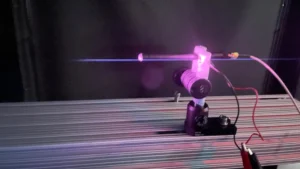
In preliminary experiments, the team demonstrated that an LED—a source of incoherent light—could indeed produce polarization-entangled photons. This established a critical principle: while a light source might be disordered in terms of its direction or its color spectrum, it can still possess enough order in its oscillation direction (polarization) to facilitate entanglement.
The move from LEDs to sunlight, however, represented a quantum leap in difficulty. Sunlight’s extreme divergence and vast spectral width required a specialized engineering solution to collect and focus enough energy onto a microscopic target.
Engineering the Solar Concentrator
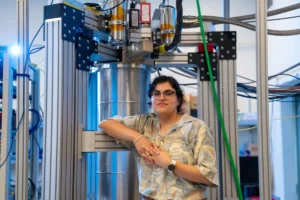
To bridge the gap between the Sun’s rays and the quantum realm, Hanieh Fattahi’s team at the Max Planck Institute for the Science of Light developed a custom-built solar concentrator. The physical constraints of the experiment were daunting; the nonlinear crystal used to generate the entanglement measures only approximately one millimeter in size. Standard solar panels or mirrors would be far too imprecise to concentrate sunlight onto such a minute surface area with the required intensity.
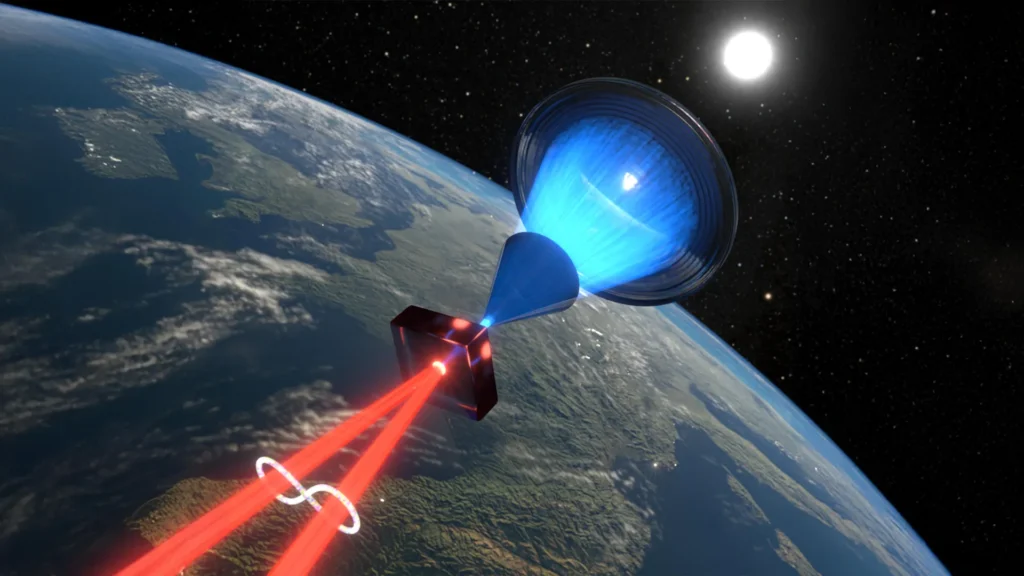
The team’s solution was an all-glass, cone-shaped solar concentrator. At its entry point, a Fresnel lens—roughly the size of a standard household window—gathers ambient sunlight. This light is then channeled through a series of optical stages into a specialized optical fiber no wider than a human hair. This fiber delivers the concentrated, high-intensity sunlight directly to the nonlinear crystal.
By focusing the sunlight into such a narrow beam, the researchers were able to achieve the power density necessary to trigger SPDC. In this process, a high-energy "pump" photon from the sunlight enters the crystal and splits into two lower-energy photons. Due to the laws of conservation of energy and momentum, these two daughter photons are born in an entangled state.
Experimental Results and Statistical Validation
The definitive test of the system took place during an outdoor experiment at the MPL facilities. To ensure the results were not merely a fluke of classical physics, the researchers utilized quantum state tomography to reconstruct the state of the emitted photons.
The data revealed that the sunlight-generated entanglement achieved a 94% fidelity—meaning it was 94% similar to a theoretically perfect entangled state. This level of quality is comparable to that produced by sophisticated laboratory lasers, proving that the incoherence of sunlight does not inherently degrade the quantum correlation, provided the experimental geometry is correctly aligned to isolate polarization.
Furthermore, the team confirmed that the photons violated Bell’s inequality. Named after physicist John Bell, this mathematical theorem provides a "litmus test" for quantum mechanics. A violation of Bell’s inequality serves as definitive proof that the correlations between the photons cannot be explained by any classical, non-quantum variables. By passing this test, the researchers silenced skeptics and confirmed that the Sun is a viable "pump" for quantum operations.
Implications for Space and Satellite Communication
One of the most immediate applications for this technology lies in the realm of satellite-based quantum communication. Currently, satellites designed for Quantum Key Distribution (QKD)—a method for ultra-secure encryption—must carry heavy, power-hungry laser systems to generate entangled photons.
"This technology could one day enable satellites to create secure encryption keys using the sunlight already abundant in space," Li explained. By utilizing the Sun as the primary light source, satellite manufacturers could significantly reduce the weight and complexity of their payloads. Removing the need for onboard lasers and their associated cooling and power systems would make quantum satellites cheaper to launch and more durable in the harsh environment of space.
Scaling the Quantum Internet Sustainably
Beyond space applications, the research addresses the long-term sustainability of the "Quantum Internet." As researchers envision a global network of quantum computers connected by fiber optics, the cumulative energy demand of thousands of laser-driven nodes becomes a significant logistical and environmental hurdle.
Sunlight-driven entanglement offers a pathway to scaling these networks without a corresponding spike in electricity usage. In regions with high solar irradiance, quantum repeaters and nodes could potentially operate using natural light, reducing the carbon footprint of future information infrastructures.
Furthermore, the researchers noted that while their experiment focused on SPDC, the underlying principles could be applied to other nonlinear optical techniques, such as four-wave mixing. This suggests that a wide array of quantum optical processes could eventually be adapted to utilize natural light sources.
Analysis: A Paradigm Shift in Quantum Photonics
The success of the University of Ottawa and Max Planck Institute collaboration highlights a shift toward "resource-efficient" quantum physics. For the past two decades, the field has been characterized by an "at any cost" approach to achieving results, often relying on liquid-helium cooling and massive energy inputs. This new research suggests that the next phase of quantum development will be defined by integration with existing natural and renewable resources.
The study also underscores the importance of theoretical persistence. The fact that the team faced significant skepticism from the scientific community serves as a reminder that fundamental assumptions—such as the requirement for coherence—are often ripe for disruption. By decoupling the "orderliness" of light’s oscillation from its spatial and temporal disorder, the team has provided a new framework for understanding light-matter interactions.
Future Directions
While the proof-of-principle experiment is complete, the researchers are now focusing on the practical hurdles of moving the technology out of the lab and into the field. Current efforts are directed toward increasing the "brightness" of the source—essentially increasing the rate at which entangled photon pairs are produced—and further refining the solar concentrator to handle varying weather conditions and solar angles.
The team is also exploring the potential for "hybrid" systems that could switch between sunlight and laser power, ensuring 24-hour operation for terrestrial quantum networks while maximizing energy savings during daylight hours.
As the global race for quantum supremacy continues, the ability to harness the Sun’s power may prove to be the "dark horse" technology that makes quantum communication a daily reality. By looking to the oldest light source in our solar system, scientists have found a new way to power the most advanced technologies of the future.