Cambridge, UK – Researchers at the University of Cambridge have unveiled a groundbreaking chemical technique that employs light, rather than traditional toxic chemicals or harsh conditions, to precisely modify complex drug molecules. This innovative approach promises to significantly accelerate the drug development timeline, making the process of designing and optimizing medicines considerably more efficient and environmentally friendly. The discovery, detailed in a study published on March 12 in the esteemed journal Nature Synthesis, introduces what its creators term an "anti-Friedel-Crafts" reaction, fundamentally reimagining a cornerstone of organic chemistry.
Challenging Traditional Paradigms in Drug Synthesis
The conventional Friedel-Crafts reaction, a foundational method for forming carbon-carbon bonds, has been a workhorse in organic chemistry for over a century. However, its widespread utility comes with significant drawbacks. It typically necessitates the use of potent, often corrosive, chemicals such as strong Lewis acids (e.g., aluminium trichloride) or heavy metal catalysts, coupled with stringent laboratory conditions like elevated temperatures or inert atmospheres. These demanding requirements dictate that Friedel-Crafts chemistry usually occurs in the very early stages of drug manufacturing. Following this initial step, a laborious sequence of many additional chemical transformations is often required to yield the final, desired therapeutic compound. This multi-step process is not only time-consuming and resource-intensive but also generates considerable waste.
The new Cambridge method meticulously inverts this traditional paradigm. By enabling researchers to introduce modifications to complex drug molecules much later in their developmental journey, it offers unprecedented flexibility and efficiency. This late-stage functionalization is a holy grail for medicinal chemists, as it allows for fine-tuning a drug candidate without having to dismantle and rebuild the entire molecular structure from scratch – a process that can otherwise consume months, if not years, of research and development effort.
LED-Activated Synthesis: A Gentle Yet Powerful Approach
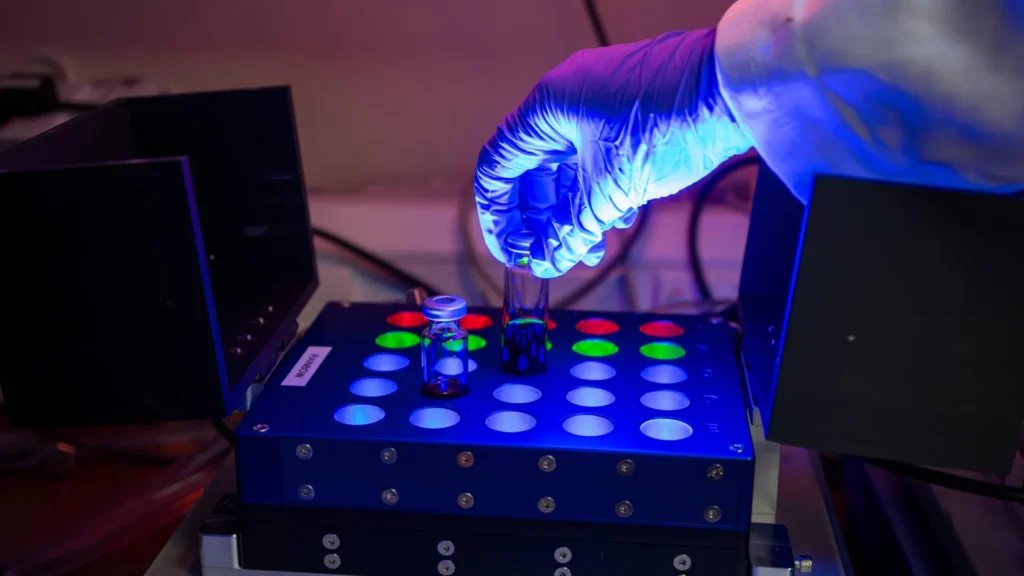
At the heart of this innovation lies a reaction activated by a simple LED lamp at ambient temperature, eschewing the reliance on heavy metal catalysts or extreme conditions. When light from the LED lamp illuminates the reaction mixture, it initiates a self-sustaining chain process that facilitates the formation of crucial carbon-carbon bonds. This occurs under remarkably mild conditions, crucially without the need for toxic or prohibitively costly reagents. The mechanism essentially harnesses light energy to drive a highly selective chemical transformation, mimicking, in a way, nature’s own reliance on light for processes like photosynthesis – a field of expertise for Professor Erwin Reisner’s group.
David Vahey, first author of the study and a PhD researcher at St John’s College, Cambridge, underscored the significance of this shift: "We’ve found a new way to make precise changes to complex drug molecules, particularly ones that have been exceptionally difficult to modify in the past. Scientists can spend months rebuilding large parts of a molecule just to test one small change. Now, instead of doing a multistep process for hundreds of molecules, scientists can start with their hit and make small modifications later on."
This ability to "tweak" a molecule rather than "reconstruct" it represents a profound leap forward. It opens up previously inaccessible chemical spaces, providing medicinal chemists with a cleaner, more efficient tool for exploring novel versions of a drug candidate. This is particularly valuable during the "lead optimization" phase of drug discovery, where subtle structural changes can dramatically influence a drug’s efficacy, bioavailability, metabolic stability, and safety profile.
Accelerating Drug Discovery and Minimizing Environmental Impact
The ramifications of this breakthrough extend far beyond mere chemical novelty. Reducing the number of synthesis steps inherently lowers the consumption of chemical reagents, significantly cuts energy usage, and consequently shrinks the overall environmental footprint of drug development. The pharmaceutical industry, like many others, is under increasing pressure to adopt greener practices and reduce its environmental impact, making such innovations critically important. Traditional drug manufacturing can be incredibly resource-intensive, often involving multiple purification steps and the generation of substantial volumes of solvent waste and byproducts. Estimates suggest that for every kilogram of active pharmaceutical ingredient (API) produced, anywhere from 25 to 100 kilograms of waste can be generated. This new method offers a tangible pathway to dramatically reduce these figures.
Moreover, the reaction exhibits remarkable selectivity, allowing chemists to target and modify one specific part of a complex molecule without inadvertently disturbing other sensitive functional groups. This precision is paramount in pharmaceutical chemistry, as even minor structural alterations can profoundly influence how a medicine interacts with biological targets in the body, its pharmacokinetic properties, or its propensity to cause unwanted side effects. The concept of "high functional-group tolerance" is a major advantage, ensuring that the desired modification can be made without collateral damage to other parts of the molecule crucial for its biological activity.
At its foundational level, the research addresses a core challenge in chemistry: the formation of carbon-carbon bonds. These bonds are the molecular scaffolding for an astonishing array of substances, from the simple hydrocarbons in fuels to the intricate architectures of plastics and the complex biological molecules essential for life. The ability to form these bonds efficiently and selectively under mild conditions is a universal benefit to chemical synthesis.
Professor Erwin Reisner, Professor of Energy and Sustainability in the Yusuf Hamied Department of Chemistry and lead author of the study, emphasized the dual significance of the work: "This is a new way to make a fundamental carbon-carbon bond and that’s why the potential impact is so great. It also means chemists can avoid an undesirable and inefficient drug modification process." He further highlighted the broader context: "Transitioning the chemical industry to a sustainable industry is arguably one of the most difficult parts of the whole energy transition."
The Serendipitous Genesis: A "Diamond in the Rough" from a Failed Experiment
The journey to this significant discovery began, somewhat fittingly, with an unexpected laboratory result – a testament to the serendipitous nature of scientific progress that has shaped numerous historical breakthroughs. David Vahey recounts the moment: "Failure after failure, then we found something we weren’t expecting in the mess – a real diamond in the rough. And it is all thanks to a failed control experiment."
Vahey had been conducting experiments involving a photocatalyst, a substance that uses light to accelerate chemical reactions. In a control experiment, he removed the photocatalyst to observe the baseline reaction without its influence. To his surprise, the reaction not only proceeded but in some instances, performed even better in its absence. Initially, the unusual product seemed like a mistake, something to be dismissed. However, instead of discarding the anomaly, the researchers chose to investigate further. This critical decision, to probe the unexpected rather than ignore it, is a hallmark of truly innovative scientific inquiry.
Professor Reisner echoed this sentiment, stating, "Recognizing the value in the unexpected is probably one of the key characteristics of a successful scientist." This philosophy aligns with the narratives of many famous accidental discoveries throughout history, from Wilhelm Conrad Röntgen’s observation of glowing screens leading to X-rays, to Alexander Fleming’s discovery of penicillin from a contaminated petri dish, or Charles Goodyear’s accidental dropping of rubber and sulfur on a hot stove leading to vulcanized rubber. These instances underscore that scientific progress often doesn’t follow a linear path but rather emerges from keen observation and the intellectual courage to pursue anomalies.
AI Augments Human Ingenuity: Predicting New Chemical Reactivity
In an era increasingly shaped by data and computation, the Cambridge team also leveraged artificial intelligence to accelerate their understanding and application of the new reaction. "We generate enormous amounts of data, and increasingly we use artificial intelligence to help analyze it. We have an algorithm that can predict reactivity," Vahey explained. AI, particularly machine learning, is transforming various aspects of chemical research, from predicting molecular properties to designing novel compounds and even guiding retrosynthetic analysis.
The collaboration with Trinity College Dublin led to the development of machine learning models that could predict where the "anti-Friedel-Crafts" reaction would occur on entirely new molecules that had not yet been tested in the laboratory. By learning patterns from known chemical reactions and their outcomes, the AI system can simulate possible reaction pathways and predict results before expensive and time-consuming physical experiments are performed. This capability drastically reduces the amount of trial and error inherent in chemical synthesis, allowing researchers to identify promising molecular structures more quickly and efficiently.
However, both Vahey and Reisner were quick to highlight the indispensable role of human intellect in this AI-augmented discovery process. "AI helps because we don’t need chemists to do endless trial and error, but an algorithm will only follow the rules it has been given. It still takes a human being to look at something that appears wrong and ask whether it might actually be something new," Vahey noted. In this particular instance, it was Vahey’s intuition and willingness to question the "failed control" that truly unlocked the discovery. "David could have dismissed it as a failed control," Reisner reflected. "Instead, he stopped and thought about what he was seeing. That moment, choosing to investigate rather than ignore it, is where discovery happens."
From Lab Bench to Industrial Scale: Collaboration with AstraZeneca
The practical applicability of the new technique was a key consideration from the outset. The researchers conducted tests on a broad spectrum of drug-like molecules, demonstrating the method’s versatility. Crucially, they also showed that the reaction could be adapted for continuous flow systems, which are widely employed in industrial chemical production due to their efficiency, safety, and scalability.
A significant collaboration with pharmaceutical giant AstraZeneca was instrumental in evaluating whether the technique could meet the rigorous practical and environmental requirements of large-scale pharmaceutical manufacturing. Such industry partnerships are vital for translating academic breakthroughs into real-world applications. By involving industrial partners early, researchers can ensure their innovations are robust, scalable, and economically viable for widespread adoption, thereby accelerating the path from lab discovery to patient benefit.
Broader Implications: Towards a More Sustainable and Efficient Pharmaceutical Future
The implications of this Cambridge breakthrough are far-reaching, touching upon scientific advancement, economic efficiency, and environmental stewardship.
Scientific Advancement: The "anti-Friedel-Crafts" reaction opens up vast new chemical space for exploration. It enables the synthesis of novel molecular structures that were previously challenging or impossible to create efficiently. This expanded chemical toolkit could lead to the discovery of entirely new classes of therapeutic agents with improved efficacy or reduced side effects. The precision of late-stage functionalization means medicinal chemists can iterate on drug candidates with unprecedented speed and accuracy, accelerating the "hit-to-lead" and "lead optimization" phases of drug discovery.
Economic Efficiency: The reduction in synthesis steps, reagent usage, and energy consumption translates directly into significant cost savings for pharmaceutical companies. The faster development cycles mean that promising drug candidates can reach clinical trials, and eventually patients, more quickly, potentially reducing the overall multi-billion-dollar cost and decade-long timeline associated with bringing a new drug to market. This efficiency could also lower manufacturing costs, potentially making life-saving medicines more affordable and accessible.
Environmental Stewardship: The shift away from heavy metal catalysts, toxic reagents, and harsh conditions aligns perfectly with the principles of green chemistry. By minimizing waste generation, reducing energy consumption, and utilizing benign conditions, the new technique offers a compelling pathway towards a more sustainable pharmaceutical industry. This is particularly important as regulatory bodies worldwide increasingly push for greener manufacturing processes. The adoption of such methods will not only benefit the environment but also improve worker safety within pharmaceutical production facilities.
The Future of Drug Innovation: This discovery underscores the continued vitality of fundamental chemical research and the power of interdisciplinary approaches, combining traditional organic synthesis with modern photocatalysis and artificial intelligence. As David Vahey succinctly put it, "What industry and other researchers do with it next – that’s where the future impact lies. For us, the lab is mostly average to bad days. The good days are very good days." Professor Reisner added a poignant note: "As a chemist, you only need one or two good days a year – and those can come from a failed experiment."
This light-powered, anti-Friedel-Crafts reaction stands as a beacon of innovation, offering a powerful new tool for drug developers and a promising step forward in the global endeavor to create medicines that are not only effective but also developed and manufactured with greater speed, efficiency, and respect for our planet.