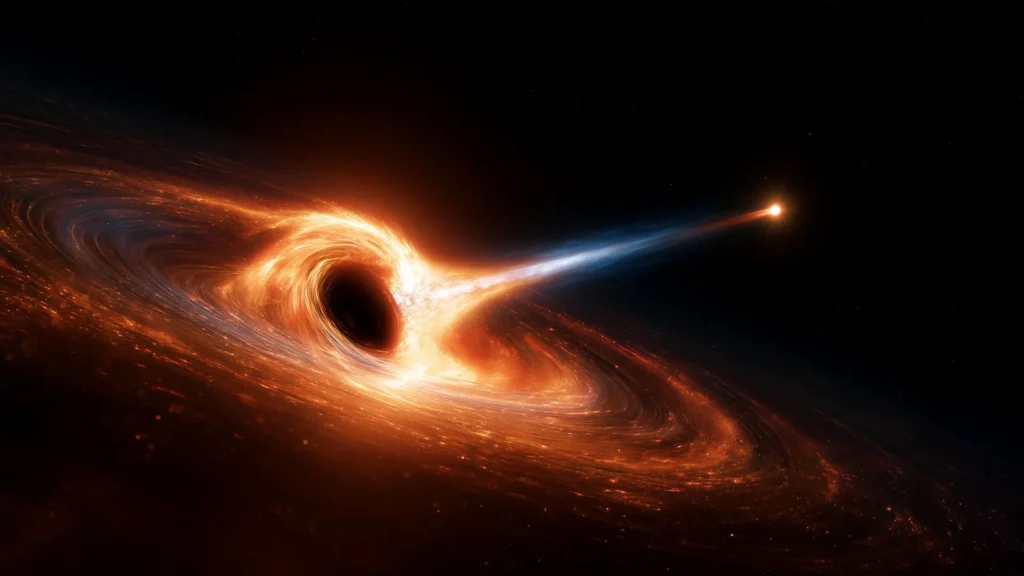
A celestial drama of colossal proportions has unfolded in the distant cosmos, with astronomers worldwide capturing the spectacular demise of a massive star as it was inexorably torn apart and consumed by a black hole. This extreme encounter, described by scientists as akin to "preparing a snack for lunch," represents one of the most energetic and visually striking cosmic events ever recorded, offering unprecedented insights into the violent interactions between stellar bodies and their insatiable gravitational predators.
The astronomical community has been abuzz following the presentation of these groundbreaking observations at the prestigious AAS conference in Phoenix, Arizona. Researchers meticulously detailed how the immense gravitational pull of a black hole systematically shredded a colossal star, piece by piece, creating a swirling disk of stellar material that then fed the ravenous void. This rare and awe-inspiring phenomenon, formally designated AT2024wpp and nicknamed "The Whippet," has pushed the boundaries of our understanding of stellar evolution and black hole dynamics.
The Anatomy of a Stellar Catastrophe
Associate Professor Daniel Perley of Liverpool John Moores University, lead author of a pivotal paper published in the Monthly Notices of the Royal Astronomical Society, articulated the profound significance of the discovery. "We have discovered what we believe to be a black hole merging with a massive companion star, shredding it into a disk that feeds the black hole," Perley stated at the conference. "It’s a rare and awe-inspiring phenomenon."
The sheer scale of this event is staggering. For a fleeting period, the energy unleashed by the black hole’s meal reached an astonishing 400 billion times the output of Earth’s Sun. This colossal energy release dwarfs even the most powerful supernovae known to astronomy, the cataclysmic explosions that mark the death of massive stars. This comparison underscores the unique and extreme nature of the observed black hole-stellar interaction.
While astronomers have previously observed events where black holes have consumed stars, these are known as Tidal Disruption Events (TDEs). However, none have been witnessed on the magnitude and ferocity of AT2024wpp. The sheer scale of this particular TDE has allowed scientists to study the process in unparalleled detail, providing a crucial observational window into these otherwise elusive cosmic occurrences.
Discovery and Initial Detection: A Swift Response
The remarkable event was first identified soon after its light reached Earth by Anna Ho, an assistant professor of astronomy at Cornell University and a co-author on the research paper. Utilizing the Zwicky Transient Facility (ZTF) at the Palomar Observatory in California, Ho detected the object, which has since been formally cataloged as AT2024wpp. The informal moniker "The Whippet" was reportedly inspired by the way the black hole seemed to rapidly pull and stretch the star.
The initial detection triggered an immediate and widespread observational campaign. Within a mere 24 hours, follow-up observations from the Liverpool Telescope in the Canary Islands and NASA’s Swift satellite provided crucial corroborating data. These observations confirmed that AT2024wpp exhibited the characteristic signatures of a Luminous Fast Blue Optical Transient (LFBOT) – a rare and not yet fully understood class of cosmic events associated with stellar destruction. The object appeared exceptionally blue and was emitting significant X-ray radiation, both hallmarks of such energetic phenomena.
Unraveling the Mystery: Supporting Data and Analysis
Further analysis, including precise distance measurements supplied by coauthors R. Michael Rich at UCLA and Yu Jing Qin at Caltech, revealed that AT2024wpp was releasing vastly more energy than a typical supernova. Combined with its exceptionally high observed temperature, these measurements solidified the researchers’ conclusion: they were witnessing a star being violently ripped apart and systematically swallowed by a black hole.
"Even though we suspected what it was, it was still extraordinary," Perley remarked, emphasizing the sheer power of the event. "This was many times more energetic than any similar event and more than any known explosion powered by the collapse of a star." This statement highlights the exceptional nature of the observed TDE, setting it apart from previous discoveries.
The significance of AT2024wpp extends beyond its sheer energy output. These events serve as invaluable cosmic signposts, helping astronomers to not only detect the presence of black holes but also to pinpoint their locations, understand their formation pathways, and unravel the complex physics governing their growth. "Not only do these events help us identify black holes, they provide a new way to identify where black holes occur and how they form and grow, and the physics of how this happens," Perley elaborated.
The Shockwave’s Journey: A Cascade of Cosmic Phenomena
Additional, in-depth studies of AT2024wpp have revealed further complexities in the aftermath of the stellar destruction. The event generated a potent shock wave that propagated outward through the dense surrounding gas at an astonishing one-fifth the speed of light. This powerful wave, a direct consequence of the violent interaction, played a significant role in the observed emissions.
However, a curious observation emerged after approximately six months: the shock wave appeared to abruptly "fizzle out." This cessation of outward propagation suggests a change in the surrounding environment or the nature of the ejected material.
The process of the black hole consuming the star involved the formation of an accretion disk. Material ripped from the star spiraled inward towards the black hole, becoming intensely heated to millions of degrees. This superheated material generated intense X-ray radiation and propelled a powerful "wind" of gas outward. This outflow then collided with pre-existing material previously shed by the doomed star. It is this collision that researchers believe generated the bright blue optical and ultraviolet emissions observed in the initial days, as well as the subsequent radio and millimeter signals detected by astronomers.
The researchers hypothesize that the shock wave’s apparent "fizzling out" occurred when it reached the outer boundary of a pre-existing bubble of gas, expelled by the star in the period leading up to its catastrophic demise. This pre-existing structure likely acted as a buffer, absorbing the shock wave’s energy and causing it to dissipate.
An Evolving Aftermath: Puzzling Signals Emerge
As the initial, violent phase of the event began to subside, a peculiar set of observational puzzles emerged. Initial spectroscopic observations from powerful instruments like the Keck Observatory, Magellan Observatory, and the Very Large Telescope revealed a surprising lack of recognizable chemical signatures in the first month following the explosion. This absence of expected spectral lines was unusual for such a massive cosmic event.
However, as the transient event began to fade, weak signatures of hydrogen and helium gas started to become detectable. The appearance of helium was particularly unexpected and has generated significant scientific interest. Further analysis indicated that this helium was traveling towards Earth at a remarkable velocity of over 6,000 kilometers per second. This high speed suggests that a densely bound structure may have survived the initial gravitational onslaught and is now rapidly moving in our direction.
The research team has put forth several speculative, yet scientifically grounded, explanations for this anomalous signal. One possibility is that the detected material originates from a "stream" of matter released from the star’s core during the intense gravitational tearing process. As the black hole’s immense gravity pulled the star apart, its inner core may have been ejected in a concentrated stream.
A more speculative, but equally intriguing, hypothesis suggests that the material could originate from a third, hitherto undetected, member of the stellar system. If such a companion star existed, it would be subjected to intense bombardment from the fast-moving wind of particles and high-energy X-ray radiation generated by the black hole as it actively feeds on the disrupted star. This intense radiation could potentially strip material from the companion, creating the observed signal.
Broader Implications: Advancing Black Hole and Astrophysics Research
The comprehensive study of AT2024wpp represents a significant leap forward in our understanding of black hole physics and the extreme dynamics of the universe. By observing such a powerful and well-documented Tidal Disruption Event, scientists are gaining invaluable data that can refine theoretical models and push the boundaries of astronomical observation.
The ability to detect and analyze TDEs provides a crucial method for identifying and characterizing black holes, especially those that are not actively accreting material from their surroundings and would otherwise remain invisible. Furthermore, the detailed analysis of the energy output, spectral characteristics, and shock wave propagation of AT2024wpp offers a unique opportunity to test and improve our understanding of fundamental physics under extreme gravitational conditions.
The discovery also highlights the collaborative nature of modern astronomical research. The coordinated efforts of multiple observatories across the globe, employing a diverse range of instruments from ground-based telescopes to space-based satellites, were essential in capturing and analyzing this complex cosmic event. This international collaboration underscores the power of shared scientific endeavors in unlocking the universe’s most profound secrets.
As astronomers continue to analyze the wealth of data collected from AT2024wpp, future research will likely focus on understanding the specific properties of the black hole involved, the nature of the disrupted star, and the precise mechanisms behind the observed shock wave dissipation and the puzzling helium signal. Each new insight gleaned from this cosmic cataclysm promises to deepen our appreciation for the violent beauty and intricate workings of the universe.