A groundbreaking advancement from MIT engineers promises to redefine the operational capabilities of small satellites by integrating the robust power of traditional chemical rockets with the precise efficiency of electric thrusters into a single, cohesive system. This innovative approach centers on a specialized fuel that can power both propulsion mechanisms, effectively eliminating the long-standing requirement for separate propellant tanks and hardware, which have historically added significant weight, complexity, and cost to spacecraft design. The implications of this development are profound, offering unprecedented flexibility for small satellites to undertake more ambitious scientific missions and commercial applications.
Historically, space propulsion has been bifurcated into two primary categories: chemical and electric. Chemical rockets, renowned for their high thrust and rapid acceleration, are indispensable for powerful maneuvers like launch, orbital insertion, rapid trajectory changes, and de-orbiting. They achieve thrust by igniting propellants that produce hot gases, expelled at high velocities. Conversely, electric thrusters, such as ion or Hall effect thrusters, generate thrust by accelerating charged particles using electric fields. While their thrust is significantly lower, they are remarkably fuel-efficient and ideal for gradual, precise adjustments over extended durations, making them suitable for long interplanetary journeys or station-keeping. The inherent incompatibility of their propellants and operational mechanisms has meant that spacecraft requiring both types of maneuvers had to carry two distinct propulsion systems, each with its own fuel supply, valves, and control systems. This redundancy imposed severe constraints, particularly on small satellites where mass and volume are at a premium.
The new technology directly addresses this challenge by identifying and validating a "green monopropellant" that can serve both functions. Amelia Bruno, a former postdoc in MIT’s Department of Aeronautics and Astronautics (AeroAstro) and lead author of a new study published in the Journal of Propulsion and Power, encapsulates the vision: "If you can have chemical and electrical propulsion in one small package, it’s the best of both worlds." She further emphasizes the transformative potential, stating, "This opens the door for small satellites to do even more science, more observations, and more interesting missions, all on a smaller and cheaper platform." This innovation represents a paradigm shift, enabling future spacecraft to execute both rapid orbital adjustments and slow, highly controlled positioning using a unified propulsion architecture.
The Evolution of Space Propulsion and the Rise of Small Satellites
The journey to this dual-mode system is rooted in decades of space propulsion development and the more recent proliferation of small satellites. For much of the space age, hydrazine has been the workhorse monopropellant for chemical thrusters due to its high performance and reliability. However, hydrazine is notoriously toxic, corrosive, and carcinogenic, requiring stringent safety protocols and specialized handling equipment, which adds significant operational costs and risks. The imperative to develop safer, more environmentally friendly alternatives, often termed "green propellants," has been a key focus for space agencies and defense organizations worldwide. The U.S. Air Force, recognizing this need, spearheaded the development of the Advanced SpaceCraft Energetic Non-Toxic propellant (ASCENT), an ionic liquid mixture designed to replace hydrazine in chemical propulsion systems.
Concurrently, the landscape of space exploration has been reshaped by the emergence of small satellites, particularly CubeSats. These compact, standardized spacecraft, ranging from lunchbox-sized to small carry-on suitcases, offer unparalleled opportunities for scientific research, technology demonstration, and commercial applications due to their significantly lower launch costs. However, their diminutive size imposes severe limitations on payload capacity and, crucially, on the size and complexity of their propulsion systems. While electric thrusters, often as small as a dime or a thumbnail, have proven highly effective for these platforms in terms of fuel efficiency and precision, they lack the raw power for rapid maneuvers or significant orbital changes. This dichotomy has largely confined small satellites to Earth orbit or limited deep-space trajectories, unable to fully capitalize on the flexibility offered by larger, dual-system spacecraft.
Unlocking Dual-Mode Functionality with Ionic Liquids
The breakthrough at MIT lies in recognizing that ASCENT, developed by the U.S. Air Force as a green chemical propellant, is inherently an ionic liquid mixture. This characteristic proved to be the critical link for its dual-mode application. Ionic liquids are salts that are liquid at room temperature, composed entirely of ions. Their unique properties, including extremely low vapor pressure, high thermal stability, and, crucially for electric propulsion, their inherent ionic nature, make them ideal propellants for electrospray thrusters. Paulo Lozano, the Miguel Alemán Velasco Professor of Aeronautics and Astronautics at MIT and a co-author of the study, leads a laboratory dedicated to developing, manufacturing, and testing electrospray propulsion systems. His team has extensively explored various ionic liquid fuels over the past decade.
As Amelia Bruno explains, "Ionic liquids are very stable and can even remain a liquid in space, which not a lot of materials can do. And it’s basically a sea of ions, which is why we base our technology around it, so we can pull those ions out into an electrospray." When the MIT researchers learned that ASCENT was an ionic liquid, the theoretical possibility of using it for electrospray thrusters became apparent. "And we said, hey, that’s the stuff we typically use. Theoretically, this should work. Let’s go figure out how," Bruno recounts. This serendipitous overlap of properties between a "green" chemical propellant and the requirements for electric propulsion laid the foundation for the dual-mode system.
Rigorous Testing Validates ASCENT’s Dual Capability
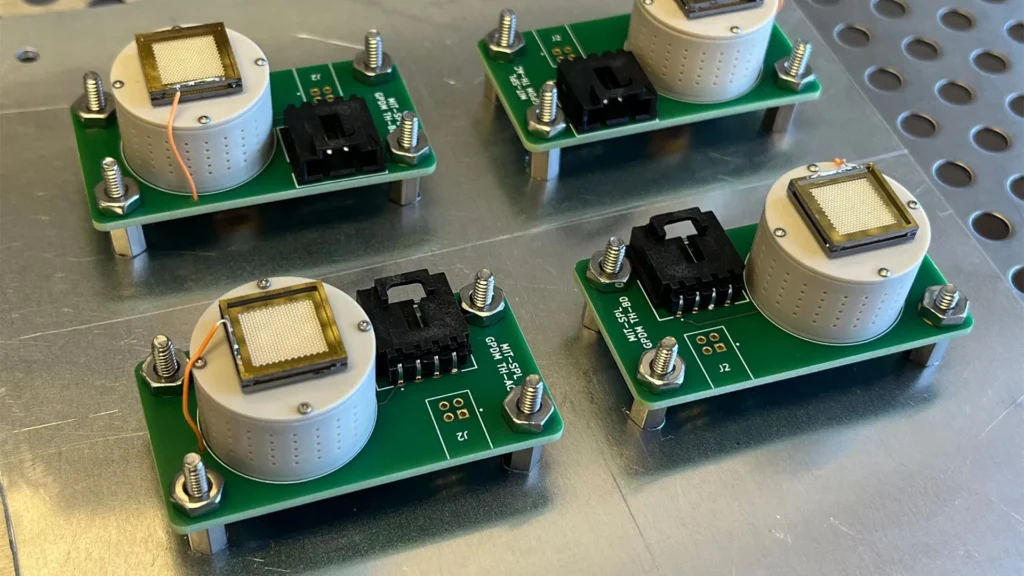
To confirm their hypothesis, Bruno, Lozano, and former MIT graduate student Matthew Corrado embarked on a series of rigorous experiments. They adapted miniature electrospray thrusters, each about the size of a thumbnail, and attached them to small, cube-shaped reservoirs designed to hold one gram of ASCENT. The propellant, described as having a viscosity similar to baby oil, was carefully loaded into these reservoirs.
The experimental setup utilized a custom magnetic levitation test platform, known as the MagLev, housed within a large vacuum chamber. This specialized environment allowed the researchers to simulate the frictionless, vacuum conditions of space with high fidelity. Thrusters were mounted on opposite sides of a representative CubeSat model positioned on the MagLev platform. During testing, the researchers remotely varied the voltage supplied to the electrospray thrusters. The resulting expulsion of charged particles generated enough force to spin the CubeSat like a floating top, demonstrating effective thrust generation.
Crucially, the team measured the generated thrust and operated the thrusters continuously for extended periods, some tests lasting up to 100 hours. This prolonged operation allowed them to assess the fuel’s long-term performance, stability, and efficiency under simulated space conditions. The results were highly encouraging: ASCENT successfully powered the electrospray thrusters, performing on par with conventional ionic liquid propellants specifically developed for electric propulsion systems. "Compared to our normal electrospray propellants, ASCENT can provide similar performance in terms of thrust," Bruno confirms. This experimental validation provided the critical proof-of-concept for the dual-mode propulsion system.
NASA Collaboration and the Green Propulsion Dual Mode Mission
With the lab results confirming ASCENT’s versatility, the focus shifted to real-world application. The MIT team is now collaborating with NASA on a pioneering mission known as the Green Propulsion Dual Mode mission. Scheduled for launch in November, this mission will be the first attempt to test a dual-mode propulsion system on a small spacecraft in space. The mission will utilize a briefcase-sized CubeSat equipped with a single chemical thruster and four electrospray thrusters, all drawing fuel from a shared propellant tank containing ASCENT.
This flight demonstration is a pivotal step. If successful, it will validate the concept of a unified propulsion system, proving that a single, non-toxic propellant can effectively power both high-thrust and high-efficiency maneuvers on a compact platform. Paulo Lozano highlights the significance: "This will be the first time that a satellite will have a shared propellant tank." The success of this mission could open the floodgates for a new era of small satellite capabilities, dramatically expanding their operational envelopes and mission profiles.
Broader Impact and Future Implications
The implications of this dual-mode propulsion system extend far beyond simply combining two technologies; it fundamentally alters the calculus for small satellite missions.
1. Deep-Space Exploration for Small Satellites: One of the most exciting prospects is enabling small satellites, particularly CubeSats, to venture far beyond Earth orbit. As Lozano envisions, "We could send CubeSats to Mars, or the asteroid belt, where they could make the journey slowly, using electrospray thrusters. You could then use your chemical thrusters to quickly move to look at interesting features. You could have a lot more flexibility to do a lot more things." This capability would democratize deep-space exploration, allowing more frequent, lower-cost missions to investigate celestial bodies, conduct astrobiological research, or scout resources, previously reserved for much larger, more expensive spacecraft.
2. Enhanced Mission Flexibility and Responsiveness: Closer to Earth, the technology offers unprecedented operational flexibility. Lozano points to weather and climate monitoring as a potential application: "Say there’s a storm coming, and you’d want to deploy your constellation of small satellites to observe over one location. You could choose to send them quickly or slowly depending on the nature of the observation. And the only way to do that is if you have two propulsion systems, which is now possible." This allows for dynamic repositioning, optimizing observation points, and responding rapidly to transient events, whether for scientific research, disaster monitoring, or national security. Satellite constellations, which are becoming increasingly prevalent, would particularly benefit from the ability to rapidly reconfigure their orbits or maintain precise formations with a single, efficient fuel source.
3. Cost Reduction and Accessibility: By reducing the need for multiple propulsion systems, separate fuel tanks, and associated plumbing, the technology inherently reduces the mass, volume, and complexity of spacecraft. This translates directly into lower manufacturing costs, simplified integration, and ultimately, reduced launch costs, as lighter satellites require less powerful and less expensive launch vehicles. This increased accessibility will enable a broader range of academic institutions, startups, and developing nations to participate in space exploration and utilization.
4. Environmental and Safety Benefits: The adoption of ASCENT as a "green" propellant has significant environmental and safety advantages. Replacing highly toxic hydrazine mitigates risks to ground personnel during satellite fueling and handling, simplifies launch site operations, and reduces the potential for environmental contamination in the event of a launch anomaly. This aligns with a global trend towards more sustainable practices in the aerospace industry.
5. Future Development and Optimization: The successful validation of ASCENT’s dual-mode capability is just the beginning. The MIT team is now focused on optimizing the thrusters to maximize performance with ASCENT, exploring different configurations, and refining control systems for seamless transitions between chemical and electric modes. Further research will undoubtedly delve into scaling the technology for various satellite sizes and mission requirements.
In conclusion, the development of a unified chemical and electric propulsion system by MIT engineers, leveraging the U.S. Air Force’s green monopropellant ASCENT, represents a pivotal moment in spacecraft engineering. By offering the "best of both worlds" in a compact, efficient package, this innovation is poised to unlock a new era of flexibility, capability, and accessibility for small satellites. From enabling deep-space expeditions for CubeSats to enhancing Earth-orbiting constellations with unprecedented maneuverability, the Green Propulsion Dual Mode mission is set to demonstrate a technology that could fundamentally reshape how we design, launch, and operate spacecraft in the decades to come. This research, supported in part by NASA, underscores the power of interdisciplinary collaboration in pushing the boundaries of what is possible in space.