Additive Manufacturing Media has featured two groundbreaking 3D printed components from Farsoon Technologies, highlighting the company’s advanced metal additive manufacturing (AM) capabilities in the critical field of thermal management for the liquid cooling industry. The showcased items, a highly complex heat dissipation cold plate and a robust finned heat sink, underscore Farsoon’s commitment to pushing the boundaries of what is possible with metal AM, particularly for applications demanding microscopic precision and superior performance. These components, produced using Farsoon’s proprietary Fine Laser Spot metal AM technology, are designed to offer significant advantages over traditionally manufactured counterparts, including enhanced structural integrity, improved thermal efficiency, and reduced manufacturing complexity.
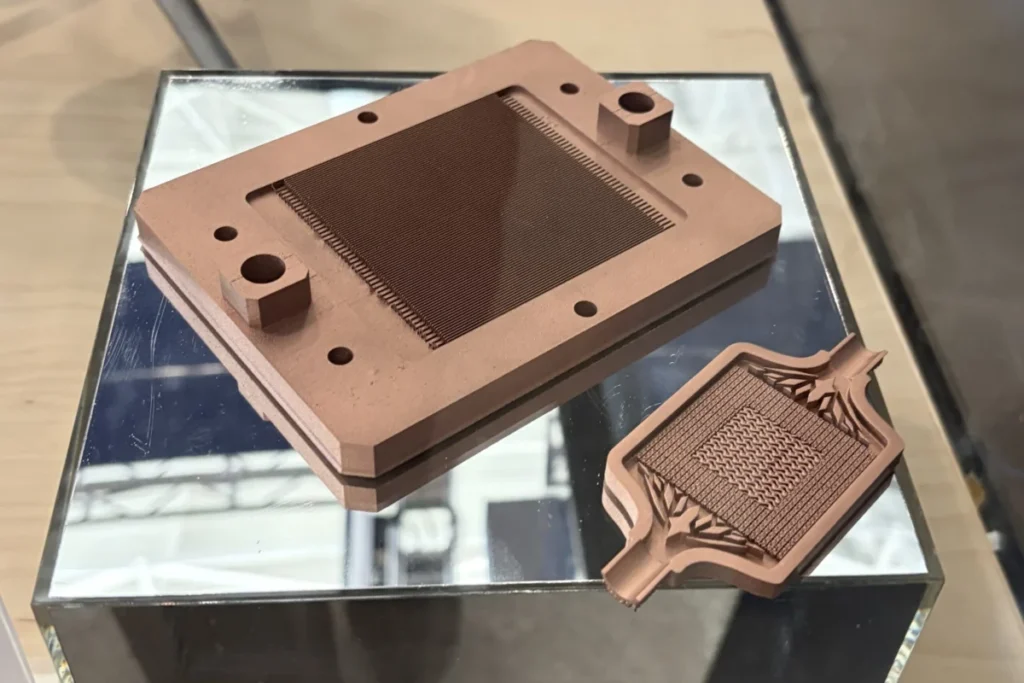
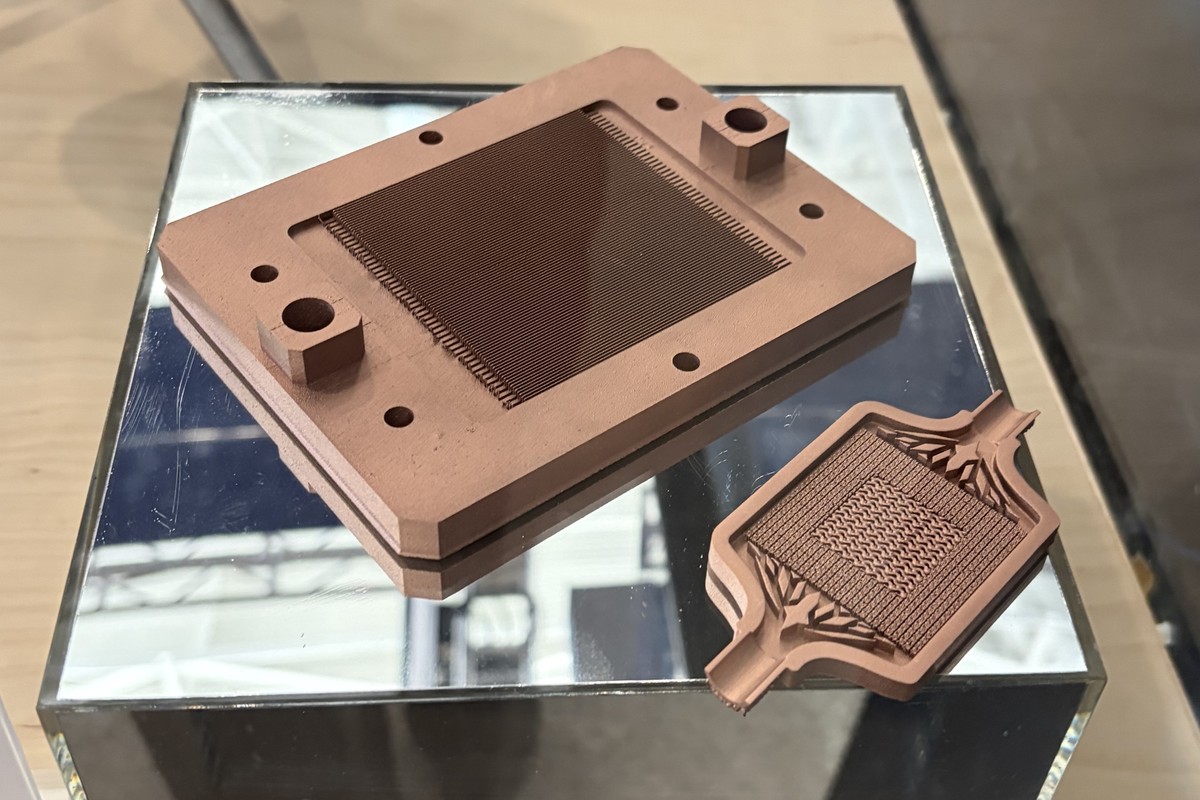
The featured cold plate, meticulously 3D printed from a CuCrZr alloy, exemplifies the power of additive manufacturing to create integrated, leak-proof solutions. By printing the entire cold plate as a single piece, Farsoon has effectively eliminated potential failure points associated with assembly and sealing in traditional designs. This monolithic approach is crucial for liquid cooling systems where even minor leaks can have catastrophic consequences. The design of this cold plate is particularly innovative, incorporating a sophisticated fusion of triply periodic minimal surface (TPMS) structures with conventional cooling channel geometries. This hybrid approach is intended to optimize both the mechanical strength and the heat transfer capabilities of the component. The internal architecture, made possible by the layer-by-layer building process of AM, allows for intricate lattice structures that significantly increase surface area, thereby enhancing the rate at which heat can be dissipated from the system.
Farsoon’s Fine Laser Spot technology, which underpins the creation of these advanced components, is specifically engineered for applications that require exceptional detail and precision. This technology leverages the Laser Powder Bed Fusion (LPBF) process, a well-established metal AM technique, but refines it with a focused laser spot size. This allows for the production of near-net-shape parts that often require minimal post-processing, translating into reduced manufacturing time and cost. The ability to produce compact parts with intricate internal geometries, as demonstrated by the TPMS structures in the cold plate, is a key advantage of this technology, opening up new possibilities for product design and performance optimization. The Fine Laser Spot solution is particularly well-suited for creating complex heat exchangers and other thermal management devices where efficiency and reliability are paramount.
The technical specifications provided for the heat dissipation cold plate further illuminate the precision achievable with Farsoon’s technology. Printed from CuCrZr, a copper chromium zirconium alloy known for its excellent thermal and electrical conductivity, as well as its high strength and resistance to softening at elevated temperatures, the component is built with a layer thickness of just 10 microns. This incredibly fine layer resolution contributes to the smooth surface finish and the intricate detail of the internal structures. The printing accuracy is stated as ±0.03 mm, a testament to the control and repeatability of the Fine Laser Spot process. Crucially, the minimal wall thickness of the TPMS structures is 0.2 mm, and the minimum diameter of cylindrical structures is 0.1 mm. These figures represent an extraordinary level of detail that is simply unattainable with conventional manufacturing methods like subtractive machining or casting. This capability allows engineers to design highly optimized internal geometries that maximize surface area for heat transfer without compromising structural integrity or exceeding material limitations.
The second component highlighted by Additive Manufacturing Media is a finned heat sink, also a product of Farsoon’s advanced AM capabilities. This heat sink was fabricated using Farsoon’s FS273M metal LPBF system, a robust platform designed for industrial-scale metal AM production. The material used for this heat sink is a copper alloy, chosen for its exceptional thermal conductivity, a critical property for effective heat dissipation. The design of this finned heat sink focuses on maximizing the surface area exposed to airflow, thereby facilitating rapid and efficient transfer of heat away from the source. The base of the heat sink is engineered to absorb heat effectively, and the intricately shaped fins then serve to disperse this heat across a much larger area, promoting consistent cooling even under demanding operational conditions.
The technical data for the finned heat sink reveals the high-quality output of the Farsoon FS273M system. The process employed is LPBF, which allows for the creation of complex geometries that are integral to the performance of the heat sink. The average density achieved during printing is an impressive 8.87 g/cm³, and the part density exceeds 99.5%. This high density indicates a fully consolidated metal part with minimal porosity, which is essential for both mechanical strength and thermal conductivity. Low porosity ensures that heat can travel efficiently through the material without being impeded by voids. The minimum fin thickness is specified as 0.25 mm, demonstrating the system’s ability to produce delicate yet functional structures. The combination of a copper alloy, precise LPBF manufacturing, and an optimized fin design results in a heat sink capable of providing reliable and consistent cooling in high-performance applications, such as those found in advanced computing, electric vehicles, and industrial machinery.
The broader context for these innovations lies in the rapidly evolving needs of the liquid cooling industry. As electronic components become more powerful and compact, the challenge of managing the heat they generate intensifies. Traditional cooling solutions, while effective to a degree, often face limitations in terms of size, weight, and thermal performance. Additive manufacturing offers a paradigm shift, enabling the creation of highly customized, intricately designed components that can achieve levels of thermal efficiency previously thought impossible. Farsoon Technologies, with its specialized LPBF systems and advanced material processing capabilities, is at the forefront of this revolution, providing solutions that directly address these critical industry demands.
The strategic advantage of using Farsoon’s Fine Laser Spot technology for these applications is multifold. Firstly, it allows for the creation of complex internal geometries that significantly enhance heat transfer. Traditional manufacturing methods are often limited by the need to create parts with simpler forms that can be easily machined or molded. AM, however, liberates designers from these constraints, enabling the exploration of novel, highly efficient internal structures. Secondly, the ability to produce near-net-shape parts reduces the need for extensive post-processing, such as welding, brazing, or complex machining, which can be time-consuming and costly. This streamlined manufacturing process contributes to faster product development cycles and lower overall production costs. Thirdly, the integration of multiple functionalities into a single printed part, as seen with the one-piece cold plate, reduces assembly complexity, minimizes potential leak paths, and improves overall system reliability.
The implications of Farsoon’s advancements extend beyond just improved thermal performance. The ability to design and manufacture highly optimized components can lead to smaller, lighter, and more energy-efficient cooling systems. This is particularly relevant in sectors like aerospace and automotive, where weight reduction and energy efficiency are critical design drivers. Furthermore, the flexibility of AM allows for on-demand production of customized cooling solutions tailored to specific application requirements, moving away from the one-size-fits-all approach often necessitated by traditional manufacturing. This can lead to optimized performance for a wider range of devices and systems.
While specific reactions from industry partners were not detailed in the initial report, it is logically inferred that companies within the liquid cooling sector, as well as manufacturers of high-performance electronics and machinery, would view these developments with significant interest. The ability to procure components that offer superior thermal management capabilities directly translates into enhanced product performance, increased longevity, and greater design freedom. Manufacturers seeking to gain a competitive edge in thermal management solutions would likely see Farsoon’s technology as a key enabler.
Looking ahead, the trajectory of metal additive manufacturing in thermal management applications appears exceptionally promising. As materials science continues to advance, and AM technologies become even more refined, we can anticipate the development of even more sophisticated and efficient cooling solutions. The integration of advanced simulation and design tools with AM processes will further empower engineers to unlock the full potential of additive manufacturing for thermal management. Farsoon Technologies’ continued investment in and development of its Fine Laser Spot and other advanced LPBF systems positions them as a significant player in shaping the future of this critical industrial sector. The showcased cold plate and heat sink are not merely examples of advanced manufacturing; they represent tangible steps towards overcoming the thermal challenges of next-generation technologies.