The additive manufacturing (AM) industry, long defined by a race for technological supremacy among its suppliers, is undergoing a profound transformation. For nearly two decades, the competitive landscape was dominated by metrics such as laser count, build volume, build rate, and sophisticated process monitoring. These technical specifications served as a reasonable proxy for the value proposition offered to customers. However, the period between 2020 and 2025 has witnessed a seismic shift in this logic, fundamentally altering the industry’s competitive structure. Emerging equipment revenue figures reveal a dramatic ascent of Chinese manufacturers and a precarious position for many Western suppliers, prompting a critical strategic re-evaluation that most have yet to fully address.
A Tale of Two Markets: Equipment Revenue Shifts Dramatically
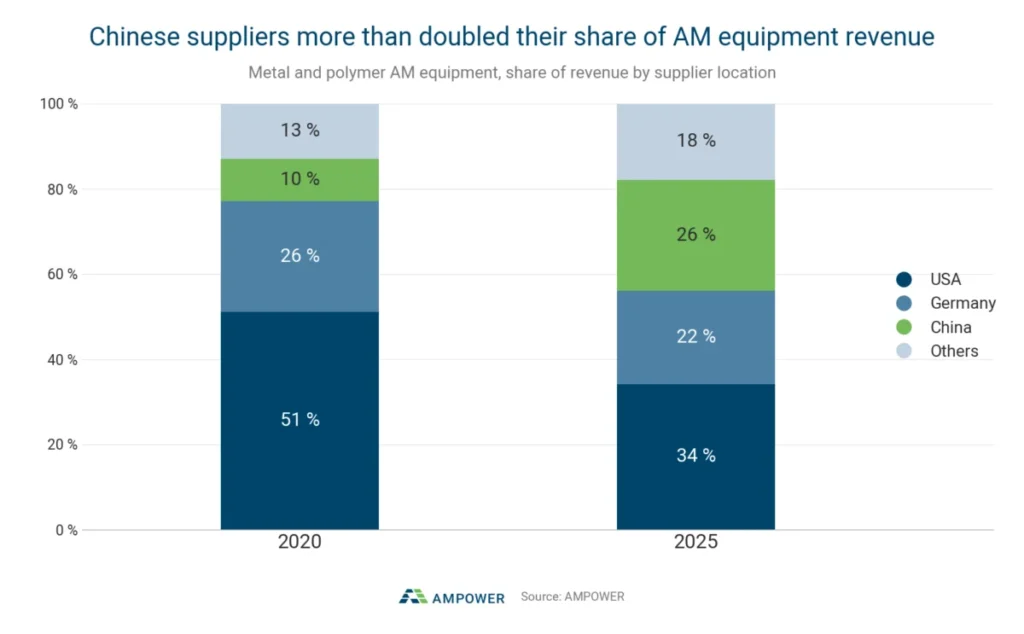
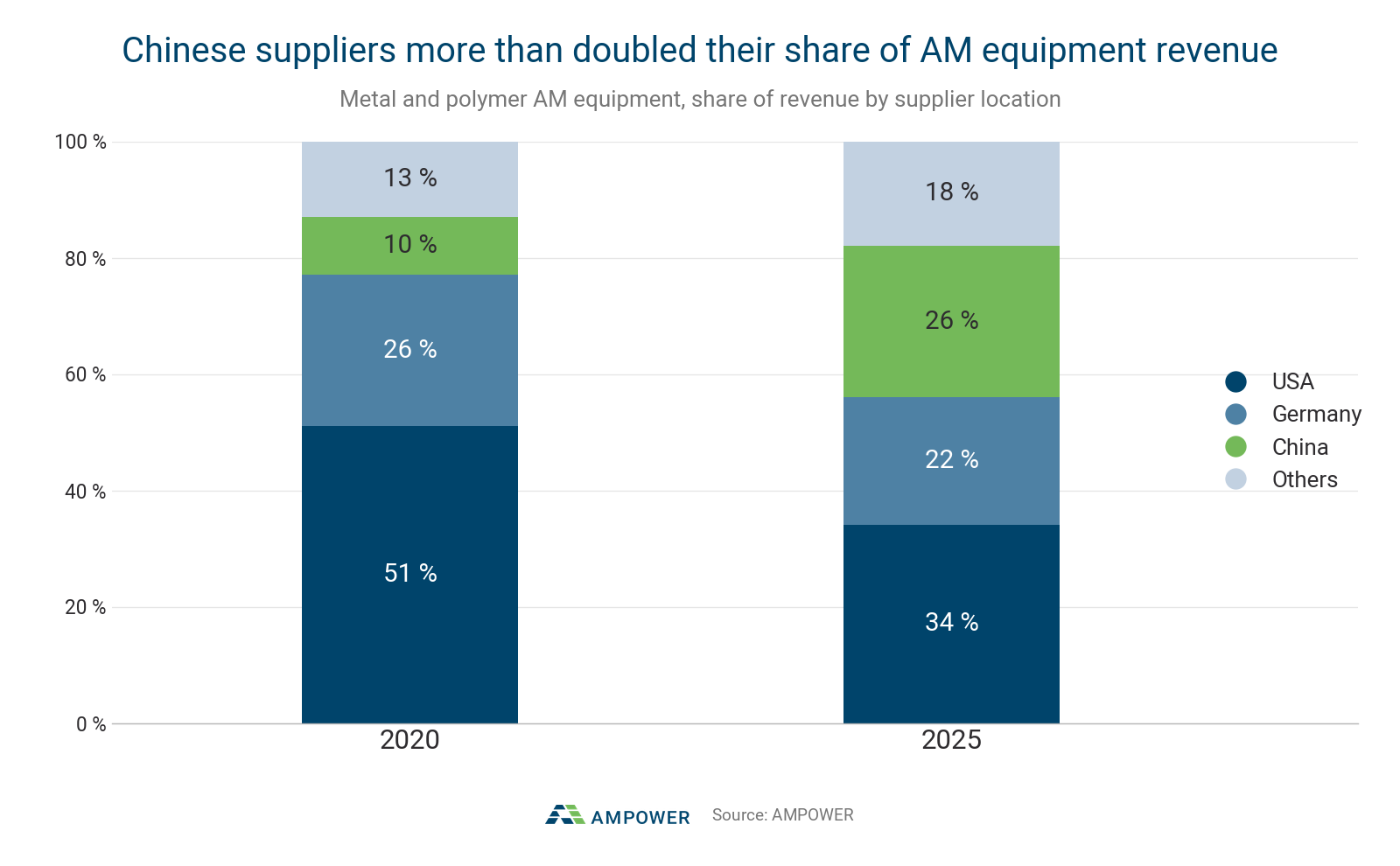
Global revenue generated by metal and polymer additive manufacturing equipment experienced robust growth, surging by 41 percent between 2020 and 2025. While this overall expansion is significant, the distribution of this growth tells a far more compelling story about the industry’s evolving dynamics. During this five-year span, Chinese suppliers dramatically increased their share of global equipment revenue, climbing from approximately 10 percent to a substantial 26 percent. Conversely, US-based suppliers saw their market share diminish, falling from 51 percent to 34 percent. Alarmingly, this decline occurred even as the overall market was expanding, meaning US companies lost revenue in absolute terms. German suppliers, while managing to grow their revenue in absolute terms, also experienced a contraction in their market share, underscoring a broader trend affecting established Western players.
The sheer magnitude of this shift is underscored by the fact that Chinese suppliers captured roughly two-thirds of all equipment revenue growth during this critical period. Prominent companies such as Bright Laser Technologies, Farsoon, Eplus3D, and HBD have been at the forefront of this surge. Their success, however, has not been primarily driven by superior technological feature sets. Instead, their competitive edge has been forged through a combination of aggressive cost structures and an unparalleled iteration speed. This rapid development cycle, coupled with a vast and supportive domestic market, has enabled them to fund extensive research, development, and production capabilities at a pace that Western system suppliers have struggled to match.
This disruption is graphically illustrated by market data. Figure 1, illustrating the share of metal and polymer equipment revenue by supplier location in 2020 versus 2025, clearly depicts the dramatic erosion of Western market dominance and the corresponding rise of Chinese manufacturers. This trend represents a fundamental challenge to the long-held assumptions about value in the AM equipment market.
Defense as a Lifeline for Western Suppliers
In the face of this global market recalibration, the defense sector has emerged as a critical, albeit potentially temporary, pillar of support for many Western AM suppliers. Two primary drivers are fueling this reliance: the substantial financial investments being channeled into additive manufacturing by the US Department of Defense and the rapid, large-scale build-out of drone production. Without the momentum generated by these initiatives, the market share held by Western suppliers in 2025 would appear considerably weaker.
The sustainability of this defense-driven spending, however, presents a pertinent strategic question. While drone programs are intrinsically linked to production volumes and a demand picture showing no signs of abatement, a significant portion of Department of War funding is directed towards capability development. This includes the arduous processes of qualifying AM technologies, establishing initial production capacity, and validating complex supply chains. Such spending is inherently front-loaded, generating immediate equipment revenue without necessarily guaranteeing a recurring stream of future business. This reliance on defense contracts, therefore, carries an inherent risk of market volatility once initial development phases are complete.
The Market Expansion Effect of Lower-Cost Machines
From the perspective of end-users, the influx of more affordable AM equipment represents a significant opportunity rather than a threat. Historically, the primary barrier to widespread AM adoption has not been the technological capabilities of the machines, but rather the prohibitive cost per part. Machine depreciation constitutes a substantial component of this overall cost. The availability of systems priced at a fraction of their Western counterparts fundamentally alters the economic viability of numerous business cases. This includes the production of series parts at industrial margins, the creation of tooling, the manufacturing of consumer goods, and the provision of spare parts at commodity price points.
This democratization of AM technology is undeniably positive for market adoption and expansion. However, it presents a stark challenge to suppliers whose business strategies remain anchored to the assumption that selling machines at premium Western price points is a sustainable core business model. The market is clearly bifurcating, with a growing segment prioritizing cost-effectiveness and rapid deployment over incremental technological advancements.
A Narrowing Strategic Landscape: The Value Disciplines Revisited
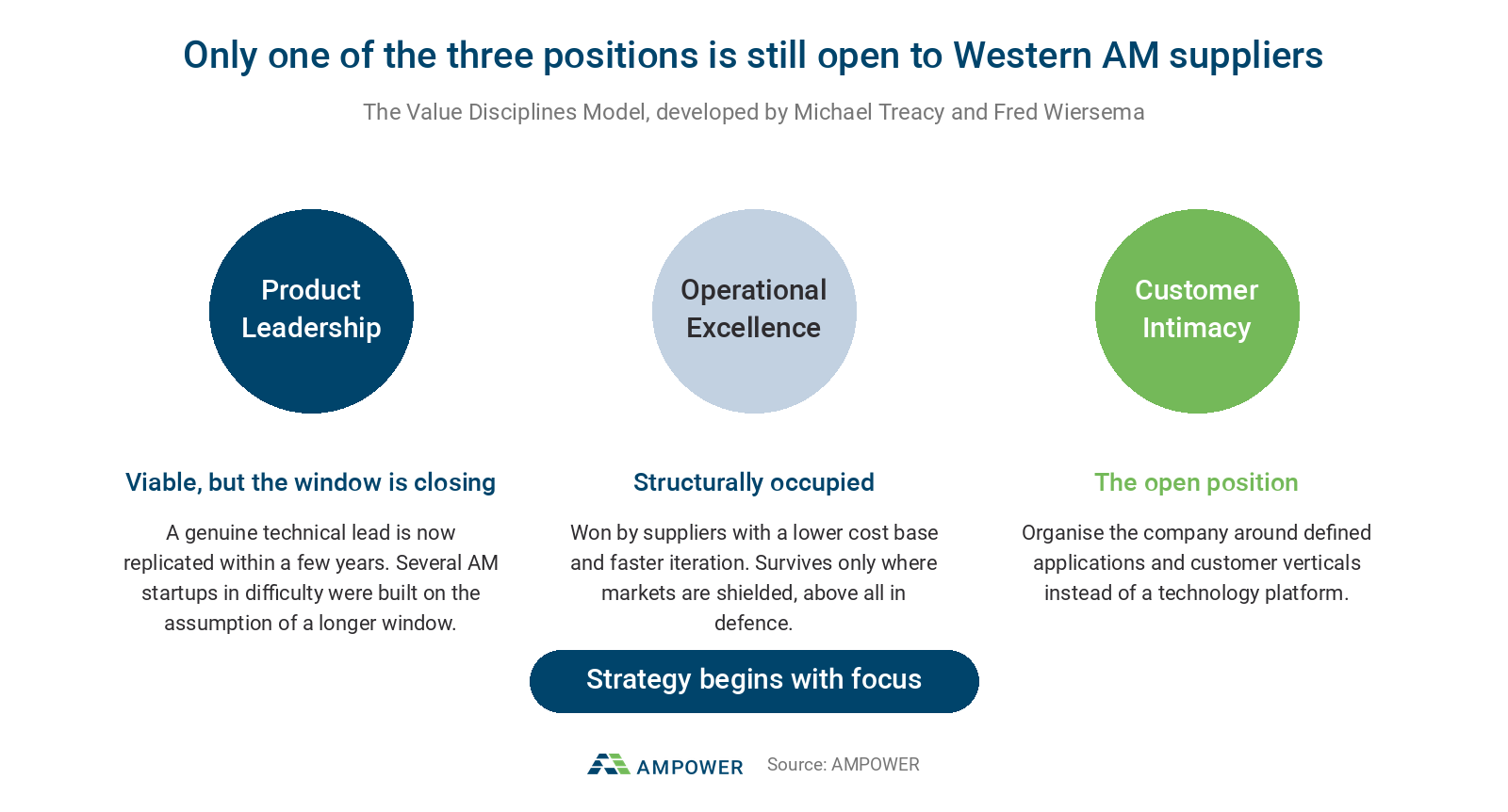
The evolving competitive dynamics in the AM industry necessitate a re-examination of established strategic frameworks. Michael Treacy and Fred Wiersema’s seminal work on value disciplines—operational excellence, product leadership, and customer intimacy—provides a valuable lens through which to analyze the current situation. Their model posits that a company must excel in one discipline while remaining competitive in the others. Applied to the additive manufacturing sector today, the available strategic options for Western suppliers have become significantly constrained.
The position of operational excellence, characterized by standardized products, low variants, and the lowest total cost, is no longer a viable open position for most Western AM suppliers. It has become structurally occupied by manufacturers who can achieve this through scale and efficient supply chains, often supported by lower labor and manufacturing costs. This discipline currently survives primarily in niche, protected markets, most notably in defense, where stringent export controls and certification requirements limit the pool of eligible suppliers. As the aforementioned revenue data suggests, this protective shelter is, in part, reliant on government budgets that are often front-loaded for development purposes, raising questions about long-term stability.
Product leadership, defined by pioneering technological innovation and superior performance, remains a viable strategy. However, it is an inherently expensive path, and its duration is increasingly short. The window between the introduction of a genuine technical breakthrough and its replication by competitors has shrunk to a matter of a few years. This compressed innovation cycle has already led to difficulties for several AM startups whose business models were predicated on a longer period of market exclusivity. For investors scrutinizing such portfolios, this shortened product lifecycle is a critical factor demanding rigorous assessment. The pace of innovation in China, fueled by significant investment and a large domestic market, continues to rapidly close the perceived technology gap.
The Imperative of Customer and Application Focus
This leaves customer intimacy as the most promising, yet arguably the most demanding, strategic discipline for Western AM suppliers. In the context of additive manufacturing, customer intimacy transcends mere good customer service. It necessitates a fundamental organizational shift, moving away from a technology-platform-centric approach to one that is organized around defined applications and specific customer verticals. This requires a deep understanding of not only the technology but also the intricate nuances of the parts being produced, their qualification pathways, their cost models, and the relevant regulatory environments. The goal is to sell a qualified, reliable route to production parts, rather than simply a machine with a set of parameters.
This strategic pivot is a formidable undertaking. It demands a willingness to cede market breadth in favor of depth within specific application areas. Sales and product management functions must be rebuilt and reoriented around the needs of particular industries and use cases, rather than on technical specifications of machinery. While many Western AM suppliers profess to be customer-centric, far fewer can confidently identify the ten specific applications that are projected to drive their revenue in the next three years. This lack of clear application focus can hinder the development of targeted solutions and deep customer relationships.
Figure 2, illustrating the Value Disciplines Model, clearly delineates the shrinking strategic options for Western AM suppliers, highlighting customer intimacy and the increasingly challenging product leadership as the remaining viable paths. Figure 3 further emphasizes the critical distinction between a product-centric and an application-centric operating model, underscoring the profound shift required for success in the current market.
Implications for the Future of AM
The dramatic shift in equipment revenue share has profound implications for the future trajectory of the additive manufacturing industry. For Western suppliers, a failure to adapt to this new reality risks continued market share erosion and a struggle for relevance. The traditional model of competing solely on technological advancement at premium price points is no longer a guaranteed path to success. Companies must critically assess their value proposition and identify where they can create unique and sustainable competitive advantages.
The rise of Chinese manufacturers, driven by cost-effectiveness and rapid iteration, is likely to accelerate the adoption of AM across a broader spectrum of industries. This democratization of the technology will undoubtedly lead to new applications and business models emerging. The challenge for Western companies lies in transitioning from a supplier-centric mindset to a customer- and application-centric one. This requires not only technological prowess but also a deep understanding of market needs, regulatory landscapes, and the economic drivers that influence manufacturing decisions.
The defense sector’s current support, while valuable, is not a long-term solution. Western suppliers must look beyond this protected market and develop strategies that are resilient to broader economic fluctuations and competitive pressures. The ability to innovate rapidly, coupled with a keen understanding of specific market needs and a commitment to delivering comprehensive solutions rather than just hardware, will be paramount. The coming years will undoubtedly test the strategic agility and adaptability of every player in the additive manufacturing ecosystem.
About the Author and AMPOWER
Matthias Schmidt-Lehr, the author of this analysis, serves as the Managing Partner at AMPOWER, a Hamburg-based strategy advisory firm dedicated to additive manufacturing. AMPOWER provides strategic guidance to equipment and materials suppliers, contract manufacturers, industrial users, and investors, focusing on market strategy, portfolio positioning, due diligence, and customer excellence. The firm also publishes the annual AMPOWER Report, a comprehensive overview of the global additive manufacturing market. AMPOWER is a Gold Sponsor of Additive Manufacturing Strategies (AMS) 2027, an event dedicated to the business and strategic aspects of AM.