More than a century after the catastrophic sinking of the RMS Titanic, a tragedy that indelibly etched the concept of maritime vulnerability into the global consciousness, the audacious pursuit of genuinely unsinkable vessels continues to galvanize engineers and scientists worldwide. This enduring ambition, often dismissed as a utopian dream, has now taken a significant and tangible stride forward, thanks to pioneering research conducted at the University of Rochester’s Institute of Optics. A team of researchers there has engineered a revolutionary technique that bestows ordinary metal tubes with an unprecedented and enduring unsinkable quality, enabling them to remain afloat indefinitely, irrespective of prolonged submersion or even severe structural damage. This breakthrough heralds a potential paradigm shift in maritime safety, design, and a myriad of other applications, moving beyond theoretical models to demonstrated, robust physical resilience.
The Genesis of a Groundbreaking Innovation
The innovative work, which promises to redefine our understanding of buoyancy and material science, was spearheaded by Dr. Chunlei Guo, a distinguished professor of optics and physics and a senior scientist affiliated with the University of Rochester’s Laboratory for Laser Energetics. Dr. Guo and his dedicated colleagues meticulously documented their novel methodology in a comprehensive study recently published in the esteemed scientific journal Advanced Functional Materials. Their inventive approach centers on a precise and intricate modification of the internal surface of standard aluminum tubes. Through a sophisticated etching process, the researchers are able to sculpt the metallic interior, creating a complex topography of microscopic and nanoscale pits. This meticulously textured surface is not merely aesthetically altered; it undergoes a profound transformation, becoming superhydrophobic. This engineered superhydrophobicity grants the surface an extraordinary ability to strongly repel water, ensuring that it remains unequivocally dry even when submerged, a critical prerequisite for the subsequent buoyant mechanism.
Harnessing Trapped Air: A Biomimetic Solution
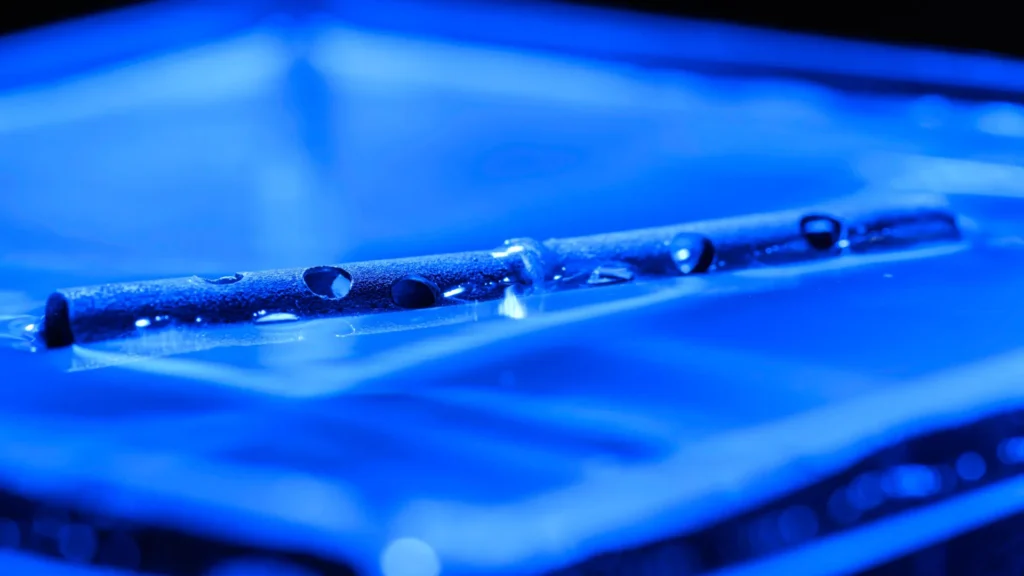
The fundamental principle underpinning the unsinkable nature of these treated tubes lies in their unique interaction with water. When a superhydrophobic tube, with its specially prepared interior, is introduced into a body of water, its water-repelling properties ingeniously capture and maintain a stable, persistent pocket of air within its core. This ingeniously trapped air functions as an internal buoyancy chamber, effectively preventing water from inundating the tube’s interior. By maintaining this air-filled void, the tube’s overall density remains significantly lower than that of water, thus precluding it from gaining weight and succumbing to sinking. This elegant solution draws inspiration from remarkable strategies observed in the natural world, illustrating a powerful instance of biomimicry. The process strikingly resembles the survival tactics employed by diving bell spiders, which masterfully construct and sustain air bubbles as underwater habitats, and by fire ants, notorious for their ability to interlock their water-resistant bodies to form robust, floating rafts during floods.
Crucially, the Rochester team introduced a further enhancement to bolster the system’s stability and reliability. "Importantly, we added a divider to the middle of the tube so that even if you push it vertically into the water, the bubble of air remains trapped inside and the tube retains its floating ability," explained Dr. Guo. This internal partition acts as a safeguard, preventing the dislodgement or collapse of the trapped air pocket under external pressure or turbulent conditions, thereby ensuring the tube’s buoyancy remains unimpaired. This simple yet effective design element significantly elevates the robustness of the system, addressing potential vulnerabilities that might arise in real-world applications.
A Chronology of Superhydrophobic Advancements
The development of these unsinkable tubes represents an evolution of Dr. Guo’s previous pioneering work in superhydrophobic technologies. His research group first publicly demonstrated superhydrophobic floating devices in 2019. That earlier iteration relied on a different structural design: two water-repelling disks sealed together to create the necessary buoyancy. While demonstrably effective under controlled conditions, this initial design possessed inherent limitations. The sealed disks could, under certain extreme circumstances, particularly when subjected to severe tilting angles, lose their ability to float as the delicate balance of trapped air might be compromised.
The newer tube-based design, however, marks a substantial leap forward in both simplicity and performance. By adopting a tubular structure, the researchers have not only streamlined the overall design but have also achieved vastly superior stability. This enhanced stability is particularly crucial in turbulent environments, such as those encountered in dynamic ocean conditions, where unpredictable waves and currents pose significant challenges to conventional buoyant structures. The refinement from disks to tubes underscores a commitment to engineering solutions that are not only scientifically sound but also practically robust and adaptable to harsh operational realities.
Unprecedented Durability and Resilience
The true testament to the breakthrough’s significance lies in the rigorous testing protocols to which the new tube design was subjected. The results unequivocally demonstrate an unprecedented level of durability and resilience. "We tested them in some really rough environments for weeks at a time and found no degradation to their buoyancy," Dr. Guo affirmed, highlighting the sustained performance under stress. This extended period of testing without any observed decline in buoyant capability is a critical indicator of the technology’s potential for long-term deployment.
Perhaps even more astonishing is the system’s ability to withstand significant physical damage without compromising its fundamental unsinkable property. The researchers deliberately inflicted severe structural damage upon the tubes to assess their resilience. "You can poke big holes in them, and we showed that even if you severely damage the tubes with as many holes as you can punch, they still float," Dr. Guo elaborated. This remarkable resistance to damage, where even multiple perforations do not lead to sinking, stands in stark contrast to conventional buoyant systems, where even minor breaches can lead to catastrophic failure. This intrinsic damage tolerance is a game-changer for applications where structural integrity cannot always be guaranteed, such as in collision-prone maritime environments or disaster relief scenarios.
From Laboratory Bench to Real-World Applications: Scaling Up the Vision
The potential applications of this superhydrophobic tube technology extend far beyond mere scientific curiosity, promising to revolutionize various sectors. The researchers have already demonstrated that multiple unsinkable tubes can be seamlessly connected to form larger rafts. These modular rafts could serve as the foundational elements for an entirely new generation of maritime infrastructure, including genuinely unsinkable ships, robust navigational buoys, and stable floating platforms. In laboratory settings, the team successfully experimented with tubes of varying lengths, reaching nearly half a meter, indicating the scalability of the design. Dr. Guo confidently asserts that the design can be scaled up to sizes substantial enough to support considerably heavy loads, opening doors for large-scale industrial and commercial applications.
Beyond conventional transportation and infrastructure, the team has also unveiled a compelling potential application in the realm of renewable energy. They successfully demonstrated that rafts constructed from these superhydrophobic tubes possess the remarkable ability to capture kinetic energy from moving water. This capability immediately suggests a significant role for the technology in the burgeoning field of generating electricity from ocean waves. Imagine arrays of these unsinkable platforms, passively converting the ceaseless motion of the seas into clean, sustainable energy. This dual functionality – providing stable platforms and simultaneously generating power – underscores the versatility and transformative potential of the Rochester innovation.
Supporting Data and Background Context: The Enduring Quest for Buoyancy
The quest for unsinkable vessels is deeply rooted in human history, spurred by countless maritime disasters. The sinking of the RMS Titanic on April 15, 1912, after striking an iceberg in the North Atlantic, stands as the most iconic example. Deemed "unsinkable" by its builders due to its advanced (for the time) watertight compartment design, the loss of over 1,500 lives sent shockwaves across the globe and fundamentally reshaped maritime safety regulations. The subsequent International Convention for the Safety of Life at Sea (SOLAS), first adopted in 1914, mandated crucial improvements in ship construction, life-saving appliances, and navigation safety. Despite these advancements, the principle of buoyancy remains inherently challenged by structural damage. Any breach that allows water to ingress and displace air within a vessel compromises its ability to float. Dr. Guo’s work directly addresses this fundamental limitation by ensuring that buoyancy is maintained even after severe damage.
The concept of superhydrophobicity itself has been a subject of intense scientific interest for decades. Inspired by the "lotus effect," where water droplets roll off lotus leaves without wetting them, scientists have sought to replicate and engineer such surfaces. This effect is attributed to a combination of microscopic surface roughness and hydrophobic chemical coatings. The University of Rochester’s breakthrough takes this concept a step further by applying it to the internal surface of a structure, creating a stable, intrinsic air pocket rather than merely repelling water from an exterior. This shift from external protection to internal, damage-tolerant buoyancy is a critical differentiator. Previous attempts at unsinkable designs often focused on compartmentalization or using low-density materials. While effective to a degree, these methods still typically fail if the integrity of enough compartments is compromised or if the low-density material itself is damaged. The Rochester tubes offer a passive, inherent unsinkability that does not rely on active systems or perfect structural integrity.
Broader Impact and Implications: A Safer, More Sustainable Future
The implications of this breakthrough resonate across multiple sectors, promising a future where maritime operations are inherently safer and more resilient.
- Maritime Safety: The most immediate and profound impact will be on maritime safety. Ships, submersibles, and life-saving equipment could be designed with intrinsic unsinkability, drastically reducing the risk of loss of life and cargo in accidents, collisions, or severe weather. This could lead to a significant decrease in search and rescue operations and environmental damage from sunken vessels.
- Environmental Protection: Fewer shipwrecks mean less marine pollution from fuel, cargo, and other hazardous materials. The technology could also underpin stable platforms for ocean clean-up efforts or monitoring stations.
- Infrastructure Resilience: Floating platforms for housing, research, or industrial activities in coastal areas or offshore could become more robust and less vulnerable to extreme weather events or structural failures. Imagine floating cities or critical infrastructure that remain operational even after sustaining significant damage.
- Renewable Energy: The potential for wave energy harvesting is particularly exciting. Stable, damage-tolerant platforms are crucial for deploying and maintaining energy converters in harsh ocean environments. This technology could accelerate the development and adoption of marine renewable energy sources, contributing significantly to global decarbonization efforts.
- Defense and Exploration: Unsinkable drones, autonomous underwater vehicles (AUVs), and remote operating vehicles (ROVs) could revolutionize defense, surveillance, and deep-sea exploration, offering unparalleled reliability and operational longevity.
- Economic Impact: The reduction in insurance costs for maritime transport, the extended lifespan of vessels and offshore structures, and the creation of new industries around unsinkable technologies could stimulate significant economic growth.
While the current research showcases compelling laboratory results, the path to widespread commercialization will involve further engineering challenges. These include optimizing the manufacturing process for large-scale production, reducing material costs, ensuring long-term durability in varied and harsh marine environments (considering factors like biofouling, UV degradation, and extreme temperatures), and integrating the technology seamlessly into existing industrial designs. Regulatory bodies will also need to develop new standards and certifications for vessels and structures utilizing this novel unsinkability principle.
Acknowledgements and Future Outlook
This groundbreaking project received crucial financial backing and support from several prestigious organizations, underscoring the perceived significance and transformative potential of the research. The National Science Foundation, a leading independent agency of the United States government that supports fundamental research and education in all the non-medical fields of science and engineering, provided vital funding. Additional support came from the Bill and Melinda Gates Foundation, known for its philanthropic endeavors across global health, poverty alleviation, and education, signaling a potential interest in the technology’s application for humanitarian or developmental purposes. Furthermore, the University of Rochester’s own Goergen Institute for Data Science and Artificial Intelligence contributed to the project, highlighting the interdisciplinary nature of modern scientific breakthroughs.
The success of Dr. Chunlei Guo’s team at the University of Rochester marks a pivotal moment in the ongoing human endeavor to conquer the challenges posed by the natural world. By marrying sophisticated material science with biomimetic principles, they have not only pushed the boundaries of what is technologically feasible but have also reignited the centuries-old dream of truly unsinkable vessels. As the world grapples with climate change, rising sea levels, and the demand for sustainable energy, innovations like these unsinkable metal tubes offer a beacon of hope, promising a future where our interactions with the oceans are safer, more efficient, and environmentally responsible. The journey from the lab to full-scale deployment will undoubtedly be complex, but the foundational science has been laid, charting a course towards a new era of maritime resilience.