In the intricate landscape of modern motion control systems, effective communication protocols are paramount, operating at various scales from vast industrial networks to the minute connections within integrated circuits. While macroscopic connections between drives, motors, and controllers often rely on robust network protocols such as Ethernet, EtherCAT, or CAN, the internal workings of controllers and microcontrollers demand a different class of communication. At this critical circuit board level, where space, speed, and efficiency are paramount, protocols like the Serial Peripheral Interface (SPI) emerge as indispensable tools for synchronous serial data transmission.
The Evolution of Communication Protocols in Embedded Systems
The foundation of today’s complex motion systems rests on a layered approach to communication. Historically, early electronic systems relied on parallel bus architectures for data transfer. While conceptually straightforward, parallel buses demanded numerous dedicated lines for data, address, and control signals, consuming significant board space, increasing pin counts on integrated circuits, and leading to more complex routing challenges, especially for systems with multiple peripherals. As electronic devices became more compact and sophisticated, the limitations of parallel communication spurred the development of serial alternatives.
Serial communication, which transmits data one bit at a time over a single line (or a small set of lines), offered a compelling solution to these challenges. This shift was critical for embedded systems, where the physical footprint of components and the cost associated with manufacturing printed circuit boards (PCBs) are primary concerns. Among the various serial communication standards developed, SPI, originating from Motorola in the mid-1980s, quickly gained prominence due to its simplicity, speed, and efficiency in short-distance communication between integrated circuits. Its development paralleled the increasing demand for smaller, more powerful microcontrollers capable of orchestrating complex tasks with numerous peripheral components.
Understanding the Serial Peripheral Interface (SPI)
SPI is a synchronous serial data transmission standard, meaning that data transfer is synchronized by a shared clock signal. This characteristic ensures that both the transmitting and receiving devices are precisely aligned in their data sampling, minimizing timing errors and simplifying implementation compared to asynchronous protocols that rely on precise baud rates and start/stop bits.
At its basic physical layer, SPI typically employs a four-wire interface, facilitating full-duplex communication – the ability to send and receive data simultaneously. The four standard lines are:
- SCLK (Serial Clock): Generated by the master device, this line synchronizes data transmission and reception between the master and follower (often referred to as slave) devices.
- MOSI (Master Out, Follower In): The data line from the master to the follower.
- MISO (Master In, Follower Out): The data line from the follower to the master.
- SS/CS (Follower Select/Chip Select): An active-low signal from the master to individually select a specific follower device. When this line is low, the corresponding follower is active and ready to communicate.
This four-wire setup, while simple, provides robust and high-speed communication. Data rates can range from a few megahertz (MHz) to upwards of 10 MHz or even higher in specialized implementations, making it suitable for a wide array of embedded applications requiring rapid data exchange. The flexibility of SPI also extends to its data transmission length, which can be programmed from two to 24 bits or more per frame, depending on the specific microcontroller and peripheral capabilities.
Key Advantages and Characteristics of SPI
SPI’s widespread adoption in embedded systems, particularly within motion control, stems from several distinct advantages:
- High Speed: Compared to other common serial protocols like I²C (Inter-Integrated Circuit) or UART (Universal Asynchronous Receiver-Transmitter), SPI typically offers higher data rates, crucial for real-time applications where rapid sensor readings or control updates are necessary.
- Full Duplex Communication: The dedicated MISO and MOSI lines allow for simultaneous data transmission and reception, maximizing throughput and efficiency.
- Simplicity and Low Overhead: SPI does not require complex addressing schemes or arbitration mechanisms found in multi-master protocols like I²C. It also lacks start/stop bits or parity bits, reducing data overhead and simplifying software implementation.
- Flexible Data Format: The protocol is highly configurable. Clock polarity (CPOL) and clock phase (CPHA) can be adjusted to match the requirements of various peripheral devices, providing significant flexibility for designers.
- Low Pin Count: While more pins than I²C for a single follower, SPI significantly reduces the required pin count compared to parallel buses, thereby saving valuable PCB space and reducing overall system cost. For multiple followers, a separate SS/CS line is typically needed for each, though daisy-chaining can reduce this for certain types of devices.
- No Arbitration or Acknowledgment: The master always initiates communication and controls the clock, eliminating the need for complex bus arbitration. However, this also means SPI lacks a built-in acknowledgment mechanism, requiring the master to infer successful communication or rely on higher-level protocol checks.
These attributes make SPI an ideal candidate for connecting microcontrollers to a diverse range of peripheral devices, including various sensor types (e.g., accelerometers, gyroscopes, temperature sensors), control devices (e.g., motor drivers, DACs, ADCs), memory cards (e.g., SD cards, EEPROMs), and small displays.
SPI in Drive and Control Circuits: Practical Implementations
In motion control systems, the application of SPI is multifaceted, serving both primary control functions and critical diagnostic roles. A typical scenario involves a motor driver integrated with SPI connectivity. This driver features an SPI port that interfaces directly with a microcontroller. The microcontroller acts as the master, sending precise control signals—such as Pulse Width Modulation (PWM) commands, target velocities, or positional setpoints—to the motor driver. In highly integrated designs, the controller logic might even reside on the same chip as the motor driver, with internal SPI-like communication pathways facilitating data exchange.
Beyond direct control, SPI is invaluable for diagnostic purposes. Motor drivers often contain internal registers that store operational parameters, error flags, and status information (e.g., current consumption, temperature, fault conditions). The microcontroller can query these registers via SPI to monitor the system’s health, detect anomalies, and implement protective measures or adaptive control strategies. This capability is crucial for ensuring the reliability and longevity of motion systems in demanding environments.
Illustrative Case Studies and Industry Trends
Several leading manufacturers actively integrate SPI into their motion control solutions, underscoring its pivotal role in the industry.
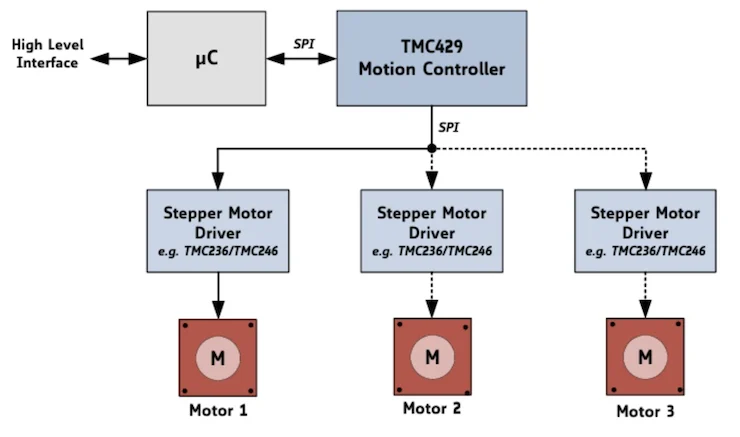
One prominent example is the Analog Devices TMC429 motion controller chip. This specialized integrated circuit is designed to function as a sophisticated three-axis motion controller. The TMC429 acts as a sophisticated intermediary, translating high-level commands from a host microcontroller into precise step and direction pulses required by stepper motor drivers. In this architecture, two distinct four-wire SPI interfaces are typically utilized: one for communication between the higher-level host microcontroller (master) and the TMC429 (follower), and another for the TMC429 (now acting as a master) to communicate with up to three daisy-chained stepper motor drivers (followers). This allows for efficient distribution of control logic, where the host MCU manages overall system behavior, the TMC429 handles complex motion profiling, and the drivers manage the physical motor currents. Industry experts often highlight such architectures for their modularity and ability to offload real-time motion control tasks from the main processor, improving system responsiveness and overall performance.
The application of such motion control chips with SPI extends across a wide spectrum of industries. In laboratory automation equipment, precise and repeatable motion is critical for tasks like fluid handling, sample positioning, and microscopy. 3D-printing systems rely heavily on accurate stepper motor control for layer-by-layer material deposition, where SPI-enabled controllers ensure smooth and precise movement of print heads and build platforms. Other general automation applications, from pick-and-place robots to conveyor belt systems, similarly benefit from SPI’s integration for robust motor control.
A significant trend driving the adoption of integrated SPI solutions is the increasing electrification of vehicle subsystems. Modern automobiles are incorporating a growing number of small electric motors for various functions, including power seats, window lifts, sunroofs, mirrors, active grille shutters, and climate control systems. This proliferation necessitates compact, efficient, and reliable motor control solutions. Chip manufacturers are responding to this demand by introducing highly integrated motor controllers.
Toshiba’s TB9104FTG gate driver, for instance, exemplifies this trend. Designed specifically for brushed DC motors in automotive applications, this gate driver features integrated SPI with on-board motor control circuits. The TB9104FTG streamlines the design process by incorporating essential functionalities directly onto the chip, including built-in motor current sense amplifier circuitry and a PWM drive circuit. The integrated SPI interface allows the vehicle’s central electronic control unit (ECU) or a local microcontroller to precisely control the motor, monitor its status, and read diagnostic information, all while minimizing external component count and wiring complexity. This level of integration is crucial for meeting the stringent space, weight, and reliability requirements of the automotive sector.
Broader Impact and Implications
The pervasive use of SPI in motion microcontrollers carries significant implications for the evolution of embedded systems and automation:
- Miniaturization and Space Efficiency: By reducing the number of required PCB traces and external components, SPI directly contributes to the miniaturization of electronic devices. This is a critical factor in the development of smaller, lighter, and more portable robots, drones, medical implants, and consumer electronics, opening up new possibilities for device form factors and functionalities.
- Enhanced Performance and Real-time Control: The synchronous and relatively high-speed nature of SPI makes it ideally suited for real-time control loops. In motion applications, where precise timing and rapid response to sensor feedback are paramount, SPI facilitates the quick exchange of data necessary for stable and accurate control. This translates to smoother motion, higher precision, and improved overall system performance.
- Design Flexibility and Modularity: SPI’s standardized interface allows engineers to easily integrate a wide variety of peripheral devices from different manufacturers into a single system. This modularity simplifies system design, reduces development time, and allows for greater flexibility in component selection, fostering innovation across diverse applications.
- Cost Reduction: The reduced complexity in wiring, fewer required pins on microcontrollers, and simpler PCB layouts contribute to lower manufacturing costs. This economic advantage makes advanced motion control more accessible for a broader range of products and industries.
- Driving Intelligent Edge Devices: As the trend towards distributed intelligence and edge computing accelerates, microcontrollers and specialized chips at the "edge" of a system need robust and efficient internal communication. SPI plays a fundamental role in enabling these intelligent edge devices to communicate effectively with their immediate peripherals, collecting data, executing local control, and performing preliminary processing before sending aggregated information upstream.
- Facilitating Advanced Diagnostics: The ability to easily access internal registers and diagnostic data via SPI empowers engineers with better tools for system debugging, predictive maintenance, and fault analysis. This leads to more reliable systems with reduced downtime and easier troubleshooting in the field.
In conclusion, the Serial Peripheral Interface (SPI) stands as a foundational communication protocol within the realm of motion microcontrollers. Its blend of simplicity, speed, and efficiency at the circuit board level has made it an indispensable tool for designers and engineers. From orchestrating the precise movements in 3D printers and laboratory equipment to enabling the growing array of electric motors in modern vehicles, SPI continues to drive innovation, enabling more compact, efficient, and intelligent motion control solutions that underpin much of our automated world. Its continued evolution and integration into advanced microcontrollers and specialized drivers ensure its relevance as a cornerstone technology for the foreseeable future.