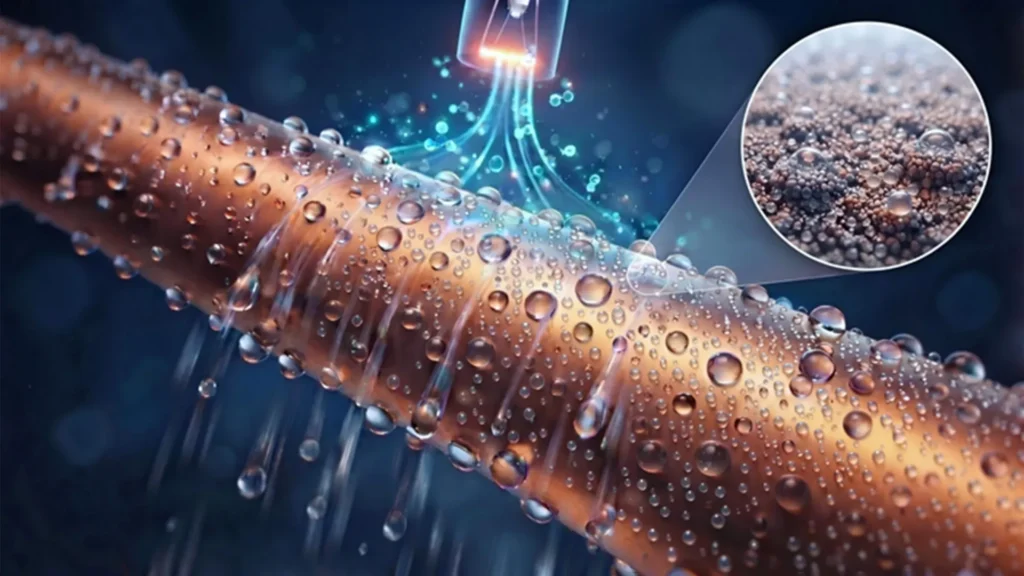
A joint research team at the Korea Advanced Institute of Science and Technology (KAIST) has announced a significant breakthrough in materials science that could redefine the efficiency of industrial heat exchange systems. By developing a specialized ultrathin polymer coating that meticulously manages the lifecycle of water droplets, the team has successfully demonstrated a condensation heat transfer performance that is up to 5.5 times higher than that of conventional copper surfaces. This advancement, led by Professor Youngsuk Nam from the Department of Mechanical Engineering and Professor Sung Gap Im from the Department of Chemical and Biomolecular Engineering, addresses a long-standing bottleneck in thermodynamics: the efficient removal of condensed liquid to maintain high rates of thermal energy transfer.
The technology, detailed in an announcement on August 23, leverages a sophisticated understanding of nanoscale surface structures to encourage rapid droplet formation and even faster detachment. By controlling the thickness and structural integrity of polymer coatings at the molecular level, the researchers have managed to overcome the traditional trade-off between the ease of droplet creation and the speed of their removal. This development holds immense promise for a wide array of sectors, including large-scale power generation, seawater desalination, and the thermal management of high-performance electronic devices.
The Thermodynamic Challenge of Condensation
To understand the magnitude of this breakthrough, one must look at the fundamental role condensation plays in modern infrastructure. Condensation is the phase-change process where water vapor transitions into liquid water upon contact with a cooler surface. While this is a common natural occurrence, in industrial settings, it is a critical mechanism for energy recovery and thermal regulation. In power plants, for instance, steam must be condensed back into water to be cycled back through the system; in desalination plants, water vapor is condensed to create fresh drinking water; and in electronics, phase-change cooling is often the most effective way to prevent hardware from overheating.
The primary obstacle in these processes is the formation of a "liquid film." On traditional metal surfaces, such as the copper tubes frequently used in industrial condensers, newly formed water droplets quickly merge into a continuous layer of liquid. This film acts as a thermal insulator, creating a barrier that resists the flow of heat from the vapor to the metal surface. Much like a thick blanket traps heat against the human body, this water film traps heat within the vapor, significantly slowing down the cooling process and reducing the overall efficiency of the system.
The ideal alternative is "dropwise condensation." In this scenario, water remains in discrete, individual droplets that roll off or fall away from the surface as soon as they reach a certain size. This keeps the surface "dry" and exposed to new vapor, allowing for a much higher rate of heat transfer. However, achieving sustained dropwise condensation has historically been difficult because the surface properties required to start droplet formation (nucleation) often conflict with the properties required to shed those droplets (mobility).
Resolving the Nucleation-Mobility Paradox
For decades, material scientists have faced a fundamental trade-off. To encourage the formation of water droplets, a surface usually needs a certain degree of roughness or chemical "defects" that serve as nucleation sites. However, these same rough structures tend to "pin" or trap the droplets, preventing them from sliding off the surface easily. Conversely, perfectly smooth or highly water-repellent (hydrophobic) surfaces allow droplets to move with ease but offer very few sites for new droplets to begin forming.
The KAIST team resolved this paradox by utilizing a technique known as initiated chemical vapor deposition (iCVD). Unlike traditional liquid-based coating methods, iCVD involves depositing gas-phase precursors onto a surface to grow a polymer layer. This allows for unparalleled precision in controlling the thickness and morphology of the coating.
During their research, the team focused on nanoscale polymer aggregates—tiny clusters of molecules that were previously considered "defects" or imperfections to be eliminated during the manufacturing of smooth coatings. Professor Nam and Professor Im realized that these aggregates could be repurposed as highly effective nucleation sites. By thinning the polymer film to specific nanometric dimensions, they were able to increase the density of these aggregates across the surface. Their findings showed that these thinner films could produce approximately three times as many initial water droplets as thicker, more uniform films.
Engineering the Surface for Rapid Detachment
Increasing the number of droplets was only half of the equation. To ensure the heat transfer remained efficient, those droplets needed to leave the surface as quickly as possible. To achieve this, the researchers introduced a specialized thermal treatment process after the iCVD coating was applied.
This heat treatment modified the chemical interaction between the polymer and the water, effectively weakening the adhesive forces that hold a droplet to a surface. By reducing this "pinning" force, the researchers ensured that droplets would detach and roll away while they were still very small—long before they could merge into a heat-blocking film.
The result is a surface that acts like a highly efficient "refresh" button. As soon as a droplet forms and absorbs a tiny amount of heat, it detaches, leaving a vacant spot where a new droplet can immediately form and begin the process again. The researchers likened this to a busy waiting room where seats are filled the instant they become vacant; the faster the turnover, the more people (or in this case, heat units) can pass through the system.
Quantitative Results and Performance Benchmarks
The team’s experimental data provides a clear picture of the technology’s superiority over current standards. When applied to copper tubes—the industry standard for heat exchangers—the polymer-coated surface reached a maximum condensation heat transfer coefficient of approximately 88 kW·m⁻²·K⁻¹.
To put this in perspective:
- Vs. Conventional Copper: The performance was 5.5 times higher than that of a standard copper surface where filmwise condensation occurs.
- Vs. Existing Hydrophobic Coatings: The new coating outperformed conventional water-repellent treatments by more than 50%.
Furthermore, the iCVD process proved its versatility by creating a uniform, ultrathin coating even on complex, curved geometries. This is a critical factor for industrial adoption, as most heat exchangers utilize intricate tubing systems rather than flat plates. The durability of the coating under high-heat and high-humidity conditions also suggests that it could survive the rigors of long-term industrial use, a common failing point for previous experimental coatings.
Industrial Implications and Environmental Impact
The potential applications for this technology are vast and could lead to significant reductions in global energy consumption. In the power generation sector, even a 1% increase in condenser efficiency can lead to massive savings in fuel and a corresponding decrease in carbon dioxide emissions. By boosting heat transfer by a factor of five, the KAIST technology could allow for smaller, more efficient condensers in coal, gas, and nuclear power plants.
In the realm of water security, the technology could revolutionize desalination. Many desalination processes rely on evaporating seawater and then condensing the steam into fresh water. Improving the condensation stage directly increases the volume of fresh water produced per unit of energy expended, making clean water more affordable and accessible in arid regions.
The electronics industry also stands to benefit. As microchips become more powerful, they generate heat at densities that traditional air cooling can no longer manage. Phase-change cooling systems using this new coating could allow for more compact and powerful data centers and consumer electronics by moving heat away from sensitive components with unprecedented speed.
Project Background and Academic Recognition
The study, titled "Nanoscale defect-engineered polymer coatings for enhanced condensation heat transfer," was the result of a multidisciplinary collaboration. Jun Soo Kim, a researcher in the Department of Mechanical Engineering, and Minjeong Kang from the Department of Chemical and Biomolecular Engineering, served as co-first authors, bridging the gap between mechanical thermodynamics and chemical engineering.
Professor Youngsuk Nam emphasized the paradigm shift this research represents. "This research is meaningful because it uses nanostructures previously regarded as defects as features that help droplets form," he stated. "We have presented a new method for improving heat transfer efficiency by separately controlling droplet formation and removal."
He further noted the scalability of the technology: "Because this technology can form extremely thin, uniform coatings even on surfaces with complex shapes, we expect it to be used in various energy and environmental applications, including industrial heat exchangers."
The research was published online in the prestigious international journal Nature Communications on July 16. The project received significant backing from several South Korean government entities, reflecting the strategic importance of energy-efficient technologies. Funding sources included the Mid-Career Researcher Program under the Ministry of Science and ICT and the National Research Foundation of Korea, the SME Technology Innovation Development Program via the Ministry of SMEs and Startups, and the Deep-Tech Startup Activation Support Program.
As the global community continues to seek ways to optimize energy use and mitigate the effects of climate change, innovations like the KAIST polymer coating provide a tangible pathway toward a more efficient industrial future. By turning what were once considered manufacturing flaws into functional assets, the team has not only improved heat transfer but has also opened a new chapter in the design of high-performance surfaces.