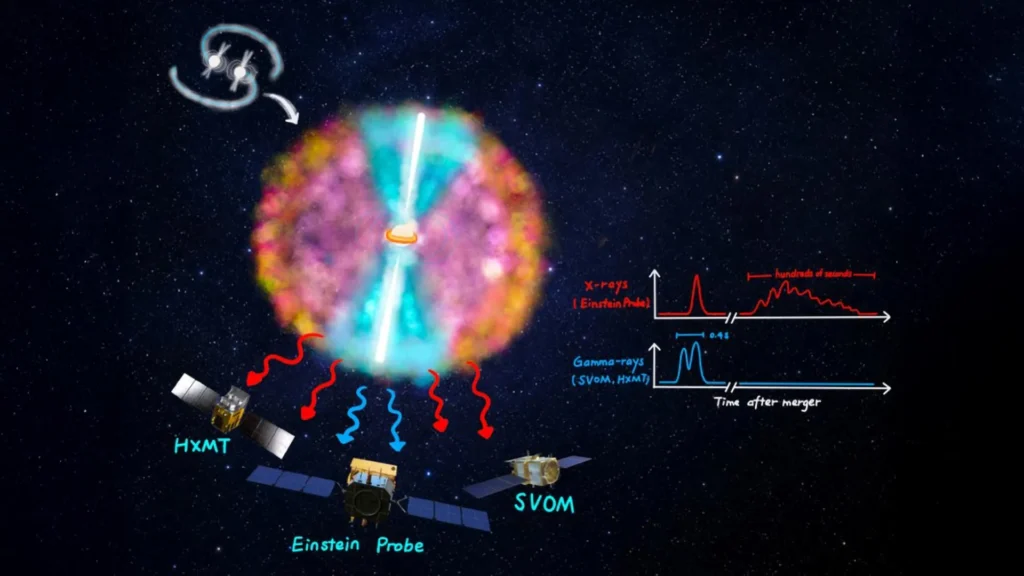
The landscape of high-energy astrophysics underwent a significant shift on July 4, 2025, when a team of international researchers, utilizing the advanced capabilities of the Einstein Probe (EP) satellite, detected a phenomenon that had long eluded the scientific community. The event, cataloged as EP250704a (and simultaneously designated as GRB 250704B), provided the first direct observation of a prolonged, "soft" X-ray emission phase following a short gamma-ray burst (GRB). This discovery suggests that the violent mergers of compact objects, such as neutron stars, may involve a much more complex and enduring aftermath than previously recorded by traditional gamma-ray observatories. By capturing this "hidden" phase, the Einstein Probe has opened a new window into the immediate evolution of post-merger remnants, offering critical insights into the physics of magnetars and the nature of gravitational-wave sources.
The July 4 Discovery: A Paradigm Shift in Real-Time
The detection of EP250704a began as a routine observation during a high-cadence sweep of the sky. An Li, a doctoral student at Beijing Normal University and the Transient Advocate for the Einstein Probe mission, was monitoring the incoming data when a sharp spike in activity was registered. At approximately the same moment, two other major Chinese-led space observatories—the Space-based Multi-band Variable Object Monitor (SVOM) using its Gamma-Ray Monitor (GRM) and the Hard X-ray Modulation Telescope (Insight-HXMT)—also flagged the event.
Initial data indicated a classic short GRB: a brilliant, high-energy flash of gamma radiation lasting less than half a second. Historically, short GRBs are the calling cards of cataclysmic collisions between two neutron stars or a neutron star and a black hole. Because these events are so brief, they are notoriously difficult to study in their earliest stages. Most narrow-field X-ray telescopes, such as the Neil Gehrels Swift Observatory, require a gamma-ray trigger to orient themselves toward the source, a process that can take minutes—often missing the most critical initial moments.
However, the Einstein Probe’s Wide-field X-ray Telescope (WXT), which utilizes innovative "lobster-eye" optics to monitor vast swaths of the sky simultaneously, was already looking in the right direction. As Li and the team analyzed the data, they realized the event was far from ordinary. While the gamma-ray signal vanished almost instantly, the soft X-ray emission persisted. Instead of the expected rapid decay, the source continued to pulse with energy for nearly ten minutes, revealing a rich, structured episode of activity that traditional instruments would have been blind to.
Bridging the Gap in Electromagnetic Detection
The primary reason this extended activity remained "hidden" for decades lies in the limitations of previous-generation hardware. Conventional gamma-ray instruments, such as Swift’s Burst Alert Telescope (BAT), are optimized for "hard" or high-energy radiation. While effective at catching the initial explosive flash, these instruments lack the sensitivity to detect "soft" or lower-energy X-rays, especially when they occur at cosmological distances.
Professor Bin-Bin Zhang of Nanjing University, a co-corresponding author of the study, noted that the energy spectrum of this ten-minute tail was so soft that it fell below the detection threshold of standard gamma-ray monitors. "Previous missions would have recorded only the brief gamma-ray flash, missing the prolonged activity revealed by EP," Zhang explained. This suggests that a significant portion of the energy released during a neutron star merger has been systematically overlooked by the global astronomical community until now.
The Einstein Probe’s ability to detect these low-energy photons allows scientists to observe the "thermal" and "non-thermal" transitions of the merger remnant. This discovery implies that what astronomers previously categorized as "simple" short bursts are actually multi-stage events with a complex energy injection process that lasts hundreds of times longer than the initial explosion.
The Magnetar Hypothesis: Searching for the Central Engine
A central question arising from the discovery of EP250704a is what could possibly power a ten-minute X-ray flare following a sub-second merger. To answer this, Yi-Han Iris Yin, a PhD student at the University of Hong Kong and lead analyst of the high-energy emission, conducted a rigorous study of the burst’s light curve and spectral evolution.
The analysis revealed that the prolonged emission was not merely the result of the initial blast wave hitting surrounding interstellar gas—a process known as an afterglow. Instead, the rapidly fluctuating brightness and evolving energy levels pointed to a "central engine" that remained active long after the stars had merged.
The most plausible candidate for this engine is a magnetar: a rapidly spinning, highly magnetized neutron star born from the wreckage of the two progenitor stars. In many merger scenarios, it was assumed that the resulting object would immediately collapse into a black hole. However, the data from EP250704a suggests that the remnant survived as a stable or meta-stable magnetar for at least several minutes. This magnetar would act like a cosmic lighthouse, pumping massive amounts of energy into the surrounding environment and creating the soft X-ray signature detected by the Einstein Probe.
"This discovery extends our view of neutron star mergers beyond the brief gamma-ray flash," Yin stated. "It reveals a previously hidden soft X-ray phase that may ultimately help us constrain the neutron star equation-of-state." The "equation-of-state" is a fundamental goal of nuclear physics, describing how matter behaves under the extreme densities found inside neutron stars—densities so high that a single teaspoon of material would weigh billions of tons.
A Global Multi-Wavelength Campaign
Recognizing the uniqueness of the July 4 event, the Einstein Probe team triggered an extensive international follow-up campaign. To confirm the nature of the burst and its distance from Earth, astronomers utilized a network of ground-based and space-based telescopes spanning the entire electromagnetic spectrum, from radio waves to optical light.
Professor Eleonora Troja of the University of Rome "Tor Vergata" led the effort to obtain the redshift of the event, a measure of how much the light has been stretched by the expansion of the universe. Spectroscopic analysis confirmed that the burst originated in a distant host galaxy. Crucially, the multi-wavelength data allowed the team to rule out other possibilities, such as a core-collapse supernova, which typically produces longer gamma-ray signals and a different optical signature.
The coordinated observations confirmed that the X-ray activity was inextricably linked to a compact object merger. By identifying the host galaxy and measuring the distance, the researchers were able to calculate the total energy output of the event, confirming that the soft X-ray component carried a substantial portion of the merger’s total electromagnetic budget.
Implications for Multi-Messenger Astronomy
The discovery of EP250704a has profound implications for the burgeoning field of multi-messenger astronomy. This discipline involves the simultaneous study of cosmic events using different "messengers," such as electromagnetic radiation (light) and gravitational waves (ripples in spacetime).
Since the historic 2017 detection of GW170817—the first time gravitational waves and light were observed from the same neutron star merger—scientists have been searching for more reliable electromagnetic counterparts to these events. Gravitational-wave detectors like LIGO, Virgo, and KAGRA can tell us that a merger has happened, but they often struggle to pinpoint the exact location in the sky.
The soft X-ray transients discovered by the Einstein Probe provide a new, highly effective probe for locating these mergers. Because these X-ray signals last much longer than the initial gamma-ray burst, they provide a wider window of opportunity for telescopes to find and study the source. Professor Troja emphasized that these fast X-ray transients are likely the primary electromagnetic counterparts to many gravitational-wave sources, offering a new way to map the universe’s most violent collisions.
Future Outlook: The Era of Einstein Probe
The Einstein Probe, a mission led by the Chinese Academy of Sciences (CAS) in collaboration with the European Space Agency (ESA) and the Max Planck Institute for Extraterrestrial Physics (MPE), was launched in early 2024 with the specific goal of discovering transient X-ray sources. Its success with EP250704a validates the "lobster-eye" telescope design and suggests that the universe is far more active in the soft X-ray spectrum than previously believed.
The researchers involved in the study suggest that this type of extended soft X-ray activity may actually be a common feature of short GRBs. If many, or even most, neutron star mergers produce a long-lived magnetar and a subsequent X-ray tail, it would change our understanding of the rate at which these remnants form and how they evolve.
As the Einstein Probe continues its mission, it is expected to uncover many more such events. This will allow scientists to build a statistical database of post-merger activity, helping to determine why some mergers result in immediate black hole formation while others create long-lived magnetars. Furthermore, these observations will be vital for the next generation of gravitational-wave detectors, providing the "eyes" to match the "ears" of the global gravitational-wave network.
In the broader context of astrophysics, the discovery of EP250704a reinforces the idea that we are only beginning to scratch the surface of the "transient" universe. By revealing the hidden phases of these cosmic explosions, the Einstein Probe is not just observing the deaths of stars; it is providing a laboratory for the most extreme physics possible in the universe, where gravity, magnetism, and density reach their absolute limits. The findings from July 4, 2025, will likely remain a cornerstone of GRB research for years to come, marking the moment when the "hidden" became visible.