Astronomers worldwide have captured and analyzed an extraordinary cosmic event: the violent destruction and gradual consumption of a massive star by a supermassive black hole. This unprecedented phenomenon, likened by researchers to "preparing a snack for lunch," has provided a rare glimpse into the extreme gravitational interactions that shape the universe and has been presented at the American Astronomical Society (AAS) conference in Phoenix, Arizona. The event, officially designated AT2024wpp and nicknamed "the Whippet," represents one of the most powerful cosmic explosions ever recorded, far exceeding the energy output of even the most luminous supernovae.
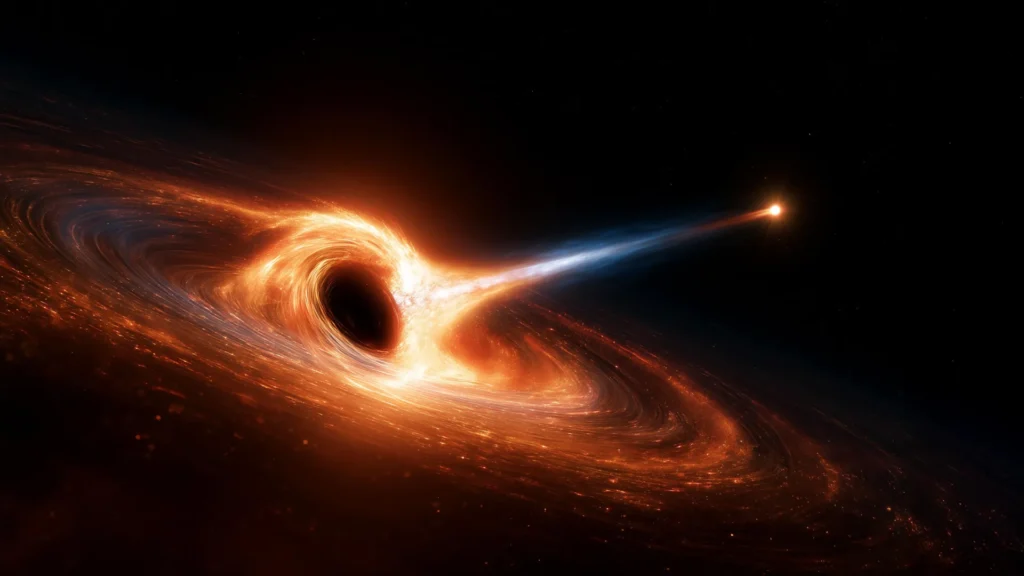
The star, caught in the gravitational grip of a black hole, was systematically torn apart by tidal forces. As the immense gravity of the black hole stretched and shredded the star, its material was not instantly engulfed. Instead, it was drawn into a swirling disk around the black hole, a process that fed the celestial monster over an extended period. This gradual consumption, while violent, allowed for detailed observation of the star’s demise, offering invaluable data for understanding black hole behavior and stellar evolution.
A Stellar Demise on an Unprecedented Scale
Associate Professor Daniel Perley of Liverpool John Moores University, lead author of a paper detailing the event in the Monthly Notices of the Royal Astronomical Society, described the encounter as a "black hole merging with a massive companion star, shredding it into a disk that feeds the black hole. It’s a rare and awe-inspiring phenomenon." While astronomers have previously witnessed Tidal Disruption Events (TDEs), where stars are pulled apart by black holes, the scale of AT2024wpp is orders of magnitude greater than anything observed before.
The sheer energy released during this cosmic collision was staggering. For a brief period, the event’s luminosity reached an estimated 400 billion times the output of Earth’s Sun. This dwarfs the energy output of typical supernovae, which are the explosive deaths of stars, and places AT2024wpp into a category of its own.
The Discovery of the Whippet
The remarkable event was first identified shortly after its light reached Earth. Anna Ho, an assistant professor of astronomy at Cornell University and a co-author on the study, utilized the Zwicky Transient Facility (ZTF) at Palomar Observatory in California to detect the initial optical signal. The ZTF, designed to scan vast swathes of the sky and identify transient celestial events, flagged the object as a potential candidate for further investigation.
Within a day of its initial detection, astronomers mobilized a global network of telescopes to observe the burgeoning phenomenon. Data from the Liverpool Telescope in the Canary Islands and NASA’s Swift satellite confirmed that the object exhibited characteristics consistent with a Luminous Fast Blue Optical Transient (LFBOT). LFBOTs are a class of extremely bright, rapidly evolving optical transients that are still poorly understood. The observed extreme blueness of AT2024wpp and its associated X-ray emissions strongly pointed towards a violent cosmic event.
Confirming the Black Hole’s Feast
Further analysis, including precise distance measurements provided by coauthors R. Michael Rich at UCLA and Yu Jing Qin at Caltech, revealed the extraordinary energy output of the transient. These measurements, combined with observations of its exceptionally high surface temperature, led the research team to the definitive conclusion: they were witnessing a massive star being torn apart and swallowed by a black hole.
"Even though we suspected what it was, it was still extraordinary," Perley stated, emphasizing the event’s unique power. "This was many times more energetic than any similar event and more than any known explosion powered by the collapse of a star."
A Chronology of Destruction
The timeline of AT2024wpp’s observed life is a testament to the rapid mobilization and collaborative nature of modern astronomy.
- Initial Detection: The Zwicky Transient Facility first registered the optical signature of AT2024wpp.
- Rapid Follow-up: Within 24 hours, observations from the Liverpool Telescope and NASA’s Swift satellite confirmed its unusual properties, suggesting an LFBOT.
- Energy Calculations: Distance measurements from UCLA and Caltech provided crucial data to estimate the event’s immense energy output.
- Confirmation of TDE: Combined observational data solidified the hypothesis that a black hole was consuming a star.
- Shock Wave Analysis: Subsequent observations revealed the outward propagation of a powerful shock wave.
- Chemical Signature Mystery: Early observations showed a lack of expected chemical signatures, followed by the surprising appearance of hydrogen and helium.
The Physics of a Cosmic Takedown
The destruction of the star by the black hole generated a complex interplay of physical processes. As the star’s material was pulled apart, it formed an accretion disk around the black hole. The intense gravitational forces and friction within this disk heated the material to extreme temperatures, producing copious amounts of X-ray radiation.
Simultaneously, a powerful outflow, often referred to as a "wind," of gas was ejected from the vicinity of the black hole. This outflow collided with material that the star had previously expelled before its final moments. The energy released from this collision generated the brilliant blue optical and ultraviolet emissions that characterized the early stages of the event, as well as the radio and millimeter signals later detected by astronomers.
A Shock Wave’s Journey and Fizzle
One of the most intriguing aspects of the event was the generation of a powerful shock wave. This wave, moving at approximately one-fifth the speed of light, propagated outward through the dense gas surrounding the star and black hole system. However, after roughly six months, the shock wave’s detectable signature abruptly "fizzled out."
Researchers believe this sudden dissipation occurred when the shock wave reached the outer edge of a vast bubble of gas that the doomed star had expelled over its lifetime. This "stellar wind bubble" acted as a boundary, absorbing or dissipating the energy of the shock wave, effectively masking its further outward propagation.
An Unexpected Signal from the Aftermath
Adding to the mystery of AT2024wpp, detailed observations from powerful instruments like the Keck Observatory, Magellan Observatory, and the Very Large Telescope revealed a peculiar absence of recognizable chemical signatures in the first month following the event. This was unusual for such energetic cosmic phenomena.
However, as the event began to fade, weak spectral lines of hydrogen and helium gas unexpectedly emerged. The helium, in particular, presented a significant puzzle. It was observed to be moving towards Earth at an astonishing velocity exceeding 6,000 kilometers per second. This extreme speed suggests the presence of a dense, cohesive structure that not only survived the initial cataclysm but is now hurtling in our direction.
Speculations on the Source of the Signal
The researchers have put forth several hypotheses to explain this anomalous helium signal. One possibility is that it originates from a "stream" of material ejected from the star’s core during the most intense phase of its disintegration. As the black hole’s gravity tore the star apart, its dense inner regions may have been expelled in a coherent jet.
A more speculative, yet equally fascinating, explanation posits that the material originates from a third, previously undetected member of the stellar system. This hypothetical companion object could be subjected to intense blasting from the fast-moving particles and X-ray radiation generated by the black hole as it feeds on the disrupted star. The sheer energy of this bombardment could be stripping material from the third object, sending it towards Earth.
Implications for Astrophysics
The study of AT2024wpp holds profound implications for our understanding of the universe. Firstly, such events are crucial for identifying and characterizing black holes, especially those that are not actively accreting material from their surroundings. The intense energy released during a TDE provides a luminous beacon that can reveal the presence and location of these enigmatic objects.
Secondly, the detailed observation of this event offers unprecedented insights into the formation and growth of black holes. By studying how matter falls into a black hole and the subsequent energetic outputs, scientists can refine models of accretion physics and understand the processes that drive the evolution of supermassive black holes at the centers of galaxies.
Moreover, the unique characteristics of AT2024wpp, particularly its extreme energy output and the observed shock wave behavior, are pushing the boundaries of existing astrophysical theories. The study of such rare and powerful phenomena allows researchers to test the limits of current physical models and potentially uncover new physics that govern the most extreme environments in the cosmos. The lingering puzzle of the fast-moving helium signal, in particular, promises to be a rich area for future investigation, potentially revealing hidden complexities within stellar systems or the behavior of matter under extreme gravitational stress. The Whippet has not only provided a spectacular show but has also opened new avenues for discovery in the ongoing quest to unravel the universe’s greatest mysteries.