The concept of a "milestone watch" has long been a cornerstone of luxury watch acquisitions, representing a tangible commemoration of significant life events. While traditional notions often frame these purchases as celebratory gifts for graduations, promotions, or weddings, a more profound perspective is emerging, one that views these timepieces as deeply personal mementos that transcend the immediate occasion. This reevaluation is exemplified by the circa early 1939 Longines Majetek ref. 3582, a watch that masterfully blends historical significance with profound personal resonance.

The Evolving Landscape of Milestone Watches
Historically, the purchase of a luxury watch has been intertwined with the marking of life’s significant achievements. This practice, deeply embedded in consumer culture, often involved elaborate gifts intended to signify the importance of an event. Retirement watches, once a common corporate gesture, and opulent birthday or engagement gifts, all fall under this traditional umbrella. However, the pervasive influence of enthusiast communities and the relentless amplification of social media trends have, to some extent, diluted the singular dominance of this "milestone" approach. Yet, the underlying principle of a watch serving as a marker of personal progress remains a powerful motivator for collectors.
The author’s personal journey reflects this evolving perspective. Initially viewing milestone watches as external validations, often detached from the actual achievement, a shift in thinking occurred. The publication of a first book in late 2025 prompted the acquisition of a traditional milestone watch, a piece desired for nearly fifteen years but possessing little direct connection to the literary endeavor. It was only upon reflection that the author realized a more profound connection existed not with the purchased watch, but with a segment of their book that centered on the Longines Majetek ref. 3582. This realization underscores a growing sentiment: that the most meaningful milestone watches are those that embody a deeper, more intrinsic connection to the personal journey, even if acquired retrospectively.

The Longines Majetek: A Synthesis of History and Design
Beyond its personal significance, the original Longines Majetek stands as a remarkable artifact in its own right, widely regarded as one of history’s most aesthetically compelling military-issued timepieces. Its origins trace back to 1935, a period of escalating geopolitical tension, when it was commissioned by the Czechoslovak Air Force to equip its rapidly modernizing fleet in anticipation of conflict. The ref. 3582, as it was officially designated, shared certain characteristics with its contemporaries in the pilot’s watch genre of the era. These included a stark, high-contrast dial – typically white Arabic numerals against a black background – designed for optimal legibility in challenging conditions, and proportionally generous case dimensions for the time.
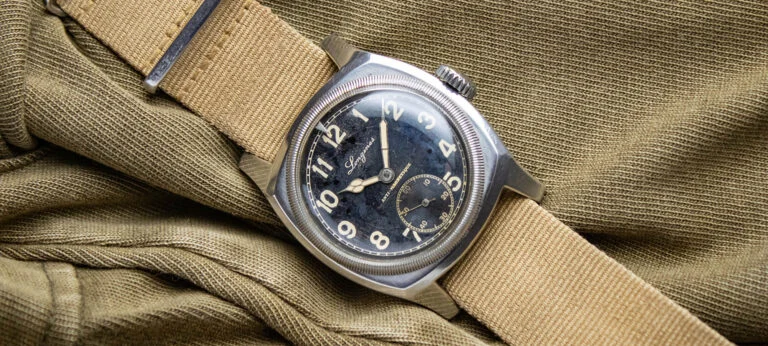
However, Longines distinguished the Majetek by imbuing it with a design that balanced utilitarian necessity with an undeniable sense of beauty. The two-piece stainless steel case, measuring a substantial 40mm by 1930s standards, features a faceted cushion shape that retains a crisp, sharp aesthetic even over nine decades later. The lugs of the Majetek are particularly noteworthy, contributing significantly to its unique character. Engineered to accommodate robust 24mm wide leather pilot straps, these long, elegantly fixed-bar lugs splay outwards organically, lending the watch a flowing, natural silhouette on the wrist. This distinctive profile earned the Majetek one of its affectionate nicknames: "Tartarugone," Italian for "big tortoise," a moniker derived from its broad on-wrist presence and a silhouette that vaguely evokes the shape of the marine creature.

Further underscoring its functional design is the finely fluted coin-edge bezel. This represented an early iteration of the bidirectional rotating bezel, a crucial navigational tool for pilots. When manipulated in conjunction with an internal triangular marker – a feature shared by the rehaut and crystal – it allowed aviators to precisely time minute-long course corrections during flight, even while wearing thick gloves. While lacking the refined smoothness of modern dive bezels, its utility remains remarkable, a testament to its ingenious engineering nearly a century ago. The only element that firmly anchors the Majetek to the traditional pilot’s watch archetype is its oversized crown, positioned at 3 o’clock and extending prominently above the case edge, ensuring ease of operation for gloved hands.
A Glimpse into Pre-War Military Provisioning
The caseback of this particular Majetek offers a compelling historical detail: the original engraving "Majetek Vojenské Správy," which translates from Czech to "property of the military administration." This inscription, coupled with the movement’s likely production timeframe, strongly suggests this example dates to the immediate pre-war period. The historical context is crucial: following the full occupation of Czechoslovakia by Nazi Germany in March 1939, subsequent Majetek production continued for the Czechoslovak military in exile. These watches were supplied to pilots serving with distinction in the British Royal Air Force, the Free French Air Force, and the Soviet Air Force. However, the exigencies of wartime production led to a general simplification of manufacturing processes. Consequently, many genuine military-issued examples from this later period were delivered without the characteristic military stamps or serial numbers. A further simplified variant would later be produced by Eterna, omitting many of the refined features characteristic of the Longines originals.

Dial and Movement: A Testament to Enduring Craftsmanship
The dial of the Longines Majetek ref. 3582 is a masterful blend of military practicality and refined aesthetic sensibilities. The bold Arabic hour numerals ensure immediate readability, complemented by a classic "chemin-de-fer" (railway track) outer minute scale that further enhances legibility while adding a touch of vintage elegance. The sub-dial for the running seconds at 6 o’clock maintains this theme of functional clarity. A particularly striking feature is the cathedral handset, an elaborate touch for a military pilot’s watch, yet remarkably easy to read, ensuring crucial timekeeping information was accessible even in the often dim and chaotic cockpit environment. The dial’s layout exhibits a fine sense of visual balance, with minimal text: a discreet Longines script logo and two simple lines of inscription.
The passage of nearly ninety years has imparted a unique patina to the dial’s original matte black surface, creating an organic swirl of cool grays, tans, and subtle hints of blue. In contrast, the hands and numerals have aged uniformly into a pale khaki hue, a testament to the quality of their original luminescent material.

Beneath the dial lies the robust Longines caliber 15.68Z. While it may lack the intricate, architecturally beautiful independent bridges found in some earlier movements, the 15.68Z is a legendary caliber in its own right. Introduced in early 1939, it was specifically engineered for military applications. Its substantial 34mm diameter and a steady beat rate of 18,000 vibrations per hour provided a low-stress platform conducive to reliable timekeeping. From 1942 to 1948, the 15.68Z, along with its very similar counterpart the 14.68Z, dominated the prestigious Neuchâtel observatory chronometer trials. A subsequent rule change eventually necessitated these large movements being categorized for pocket watches rather than wrist chronometers. Although bringing these movements to current chronometer specifications is a highly specialized undertaking, this particular example, even after many years since its last servicing, remains a functional and dependable runner. The watch’s wide 24mm fixed lugs, while presenting a slight challenge in finding compatible straps, contribute to an overall wrist presence that is attractively reminiscent of Panerai’s iconic timepieces.
A Meaningful Connection Through Time
The Longines Majetek ref. 3582, even when acquired long after the personal milestone it came to represent, offers a more authentic and profound commemoration than a contemporaneous gift ever could. It transcends its role as merely a historically significant and aesthetically superior addition to a collection. Instead, it serves as a potent reminder that the appreciation and acquisition of timepieces can evolve. It signifies that there is always an opportunity to reassess and embrace a more meaningful approach to collecting, allowing watches to become not just objects of admiration, but deeply personal anchors to our life’s most significant moments. The enduring appeal of this vintage military watch lies not only in its storied past and impeccable design but also in its capacity to redefine how we perceive and celebrate our own life’s journey.