When Philip Pounds, co-founder of Unlayered 3D, appeared on Google Meet for our interview, he was seated shotgun in a moving vehicle. A moment later, Alex Stedman, the company’s other co-founder, his gaze fixed forward, explained his initial foray into 3D printing: "I originally got into 3D printing because I wanted to make robotics parts in low volumes." This unconventional start to our conversation with two recent graduates of Rose-Hulman Institute of Technology, both on the cusp of launching a groundbreaking 3D printing company, immediately underscored the dynamic and forward-thinking nature of Unlayered 3D. Stedman, in fact, had just celebrated his 22nd birthday the day prior. Pounds, meanwhile, discovered his passion for additive manufacturing in his university’s makerspace, eventually purchasing his own printer to fabricate go-kart components.
The genesis of Unlayered 3D is a testament to youthful ambition and entrepreneurial spirit. Pounds and Stedman, roommates during their junior and senior years at Rose-Hulman, established their startup in their shared apartment just last year. Their progress has been remarkably swift; by the current year, they had developed a pilot unit, which they showcased at the prominent RAPID + TCT 2026 exhibition in Boston. This significant industry event occurred less than two months before their college graduation, highlighting their dedication and ability to balance academic rigor with entrepreneurial pursuit. With their sights set on a full commercial launch, the duo is poised to relocate to San Francisco, embarking on a significant chapter in their lives and the evolution of desktop 3D printing.
The Five-Axis Revolution: Redefining Desktop Manufacturing
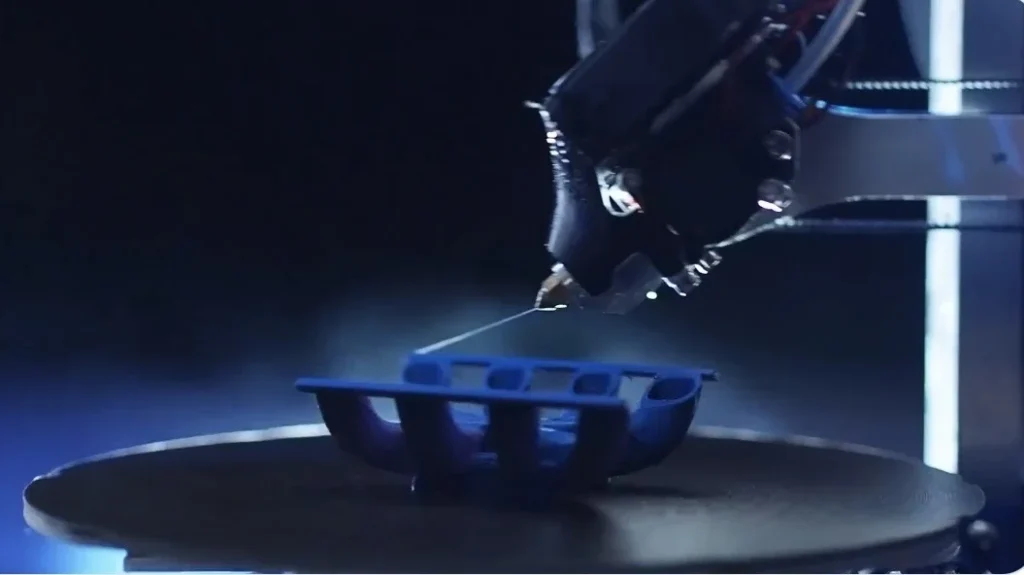
At the core of Unlayered 3D’s innovation lies its five-axis desktop machine. While not the absolute first five-axis printer to enter the market, such machines remain a rarity in the desktop segment, offering a significant leap in manufacturing capabilities. This advanced kinematic configuration allows for printing complex geometries without the need for support structures, a major advantage that streamlines post-processing and material waste. Beyond the elimination of supports, five-axis printing enables the production of stronger parts, parts with superior surface finish, and the creation of conformal geometries that are impossible with traditional three-axis machines.
The co-founders of Unlayered 3D firmly believe that five-axis technology represents the inevitable future of the entire desktop 3D printing market. Pounds articulated this vision, stating, "Once the software problem with five-axis slicing is solved, I don’t think there’s any reason why people would continue to use three-axis machines." This sentiment is echoed by Stedman, who drew a parallel to the rapid advancements in materials and machine accessibility: "If you told someone six years ago that you could print nylon or carbon fiber at your desk, on a machine that cost a few hundred dollars and it wouldn’t be a janky build, no one would have believed you. But now that’s where the market is, and now engineers expect to have high-quality machines right at their fingertips."
Rose-Hulman’s Incubator: Fostering Innovation and Entrepreneurship
While Unlayered 3D is not a formal campus spinout, as the technology was developed independently by the students in their personal time, the institute’s environment played a crucial role in its formation. Rose-Hulman’s commitment to fostering an innovation and entrepreneurial ecosystem provided the fertile ground for Pounds and Stedman’s ideas to flourish. They received indispensable financial backing and professional development support, which were instrumental in their journey.
"We’re lucky because at our school, everything we made is ours," Pounds remarked, emphasizing the institution’s supportive intellectual property policies. "Some schools will demand equity in the company in exchange for any support, or try to have some claim to your IP. Rose-Hulman just wants to see us succeed, and we’re very thankful for that." This student-centric approach allowed the young entrepreneurs to retain full ownership of their groundbreaking technology.
The university’s entrepreneurial spirit is further exemplified by its angel investor fund. "We’ve both always been a little more entrepreneurial, but at first we just wanted to make a 3D printer. Then once we saw it was viable we started to take the company aspect more seriously," Pounds explained. "Rose-Hulman actually has an angel investor fund, so we got a few thousand bucks last summer to keep developing it and gauge if there was a market for it." This initial seed funding was critical for validating their concept and advancing their prototype.
Furthermore, a professional development grant from Rose-Hulman enabled the duo to attend RAPID + TCT, a pivotal moment for Unlayered 3D. This opportunity allowed them to present their technology to a wider audience, gather valuable feedback, and forge connections within the industry.
A Generational Shift: The Return to Hardware
The narrative of Unlayered 3D also speaks to a broader trend observed within the engineering and technology sectors. Pounds and Stedman represent a growing cohort of young engineers who are increasingly drawn to hardware innovation. Stedman astutely notes that this isn’t merely a new trend but rather a "return to fundamentals."
"40 years ago, all engineering more or less revolved around hardware," Stedman observed. "Everyone knew how to fix stuff. So I do think that’s happening again, and part of it is that the career opportunities aren’t so heavily skewed towards software as they have been in the recent past." This shift is partly attributed to evolving market demands. "There’s a lot less demand for software professionals, and at our school, at least, computer science enrollment has dropped. But you still need to be able to know how to code!" he added, underscoring the continued importance of computational skills even within hardware-focused roles.
This re-emphasis on hardware aligns with the inherent nature of Unlayered 3D’s product. The company’s integrated five-axis slicing software is a key differentiator, designed to overcome the complexities associated with advanced multi-axis printing and set them apart in a rapidly expanding market.
Navigating the Future: Iteration, Feedback, and Launch
As Unlayered 3D enters its second year of operation, the founders are actively refining their business model, with a strong emphasis on customer feedback. This iterative approach is central to their development process. "There’s much to be determined, including how exactly they want to execute the commercial launch, what the specific price point will be for the first machines, and the exact portion of their machines that will be comprised of American-made parts," the article notes. However, the impression is one of confident progression.
The company is currently on its fifth iteration of the machine, a testament to their commitment to continuous improvement based on user insights. This agile development methodology allows them to adapt to the evolving needs of the market and address challenges proactively. The ability to adapt and learn from early adopters is crucial for any hardware startup aiming for long-term success.
The co-founders are acutely aware of the complexities involved in bringing a novel hardware product to market. Key decisions regarding commercial launch strategy, pricing, and supply chain localization are being carefully considered. The goal is to ensure a robust and sustainable entry into the competitive 3D printing landscape. The inherent challenges of manufacturing, supply chain management, and market penetration are significant, but Pounds and Stedman appear well-equipped to tackle them.
The Entrepreneurial Drive: A Glimpse into Unlayered 3D’s Operations
Pounds and Stedman exemplify the entrepreneurial drive required for success in the hardware sector. Their ability to multitask, as demonstrated by the interview’s commencement while en route to collect parts from a supplier, highlights their hands-on approach to business. "We’re on our way to go pick up a bunch of parts from one of our suppliers," Pounds confirmed, illustrating the practical realities of managing a manufacturing startup.
The journey of Unlayered 3D, from its inception in a college apartment to its presence at major industry events and its impending relocation to San Francisco, is a compelling narrative of innovation, perseverance, and the transformative power of additive manufacturing. As they prepare for their full commercial launch, the company stands poised to make a significant impact on the desktop 3D printing market, driven by their advanced five-axis technology and a deep understanding of the evolving needs of engineers and manufacturers. Their story serves as an inspiration, showcasing what is possible when bright minds, supported by an encouraging educational environment, are empowered to pursue ambitious technological ventures. The future of manufacturing may well be shaped by such agile, visionary startups.