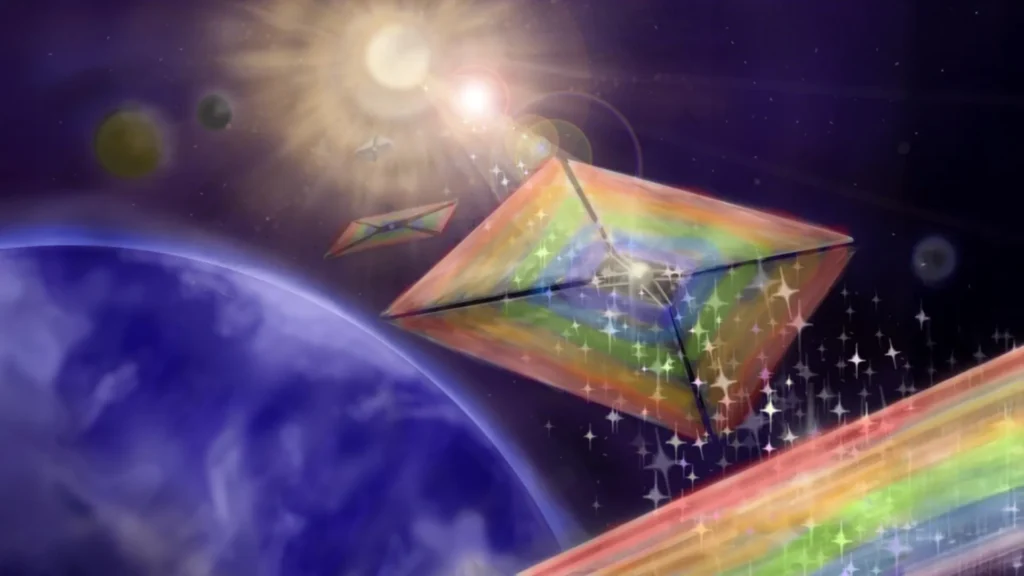
The ambitious dream of reaching another star within a practical human timeframe necessitates propulsion systems far exceeding the capabilities of conventional chemical rockets. Among the most promising and extensively studied concepts is the solar sail – a vast, ultralight, reflective membrane designed to harness the miniscule yet persistent pressure exerted by photons. When propelled by focused, extremely powerful ground-based lasers, such sails could theoretically accelerate spacecraft to a significant fraction of the speed of light, opening pathways to interstellar exploration that were once confined to science fiction. However, a recent study published on arXiv by researchers Chao Shen and Jiaze Li from the Harbin Institute of Technology has uncovered an unexpected physical phenomenon: the very light intended to propel a lightsail at relativistic velocities could eventually generate a drag effect, thereby diminishing propulsion efficiency.
The Grand Vision: Interstellar Travel and Laser Sails
For decades, humanity has gazed at the stars, dreaming of interstellar voyages. Yet, the sheer scale of cosmic distances renders traditional propulsion methods impractical. The nearest star system, Alpha Centauri, lies approximately 4.37 light-years away, while Proxima Centauri, its closest component, is 4.24 light-years distant. A conventional spacecraft traveling at the speeds achieved by missions like Voyager 1 (around 17 kilometers per second or 0.000056c) would take tens of thousands of years to reach even our nearest stellar neighbor. This temporal barrier necessitates a leap in propulsion technology.
Enter the concept of solar sails. The idea, first formally described by figures like Johannes Kepler in the 17th century and later by Konstantin Tsiolkovsky and Friedrich Zander in the early 20th century, relies on the principle of radiation pressure. Photons, despite having no rest mass, carry momentum. When billions of these photons strike a reflective surface, they impart a tiny push. Over vast distances and with sufficient light intensity, this cumulative push can accelerate a spacecraft to incredible speeds.
Modern interpretations of solar sails, particularly the "lightsail" concept, envision augmenting natural sunlight with directed energy from powerful Earth-based lasers. Initiatives like Breakthrough Starshot, launched in 2016 with significant backing, aim to develop the technology to send gram-scale probes, known as "StarChips," to Alpha Centauri within a generation. Their audacious goal is to accelerate these tiny probes to 20% of the speed of light (approximately 60,000 kilometers per second), achieving the journey in just over 20 years. This ambitious timeline underscores the critical need for highly efficient, high-velocity propulsion.
Small-scale solar sails have already been successfully demonstrated. Japan’s IKAROS (Interplanetary Kite-craft Accelerated by Radiation Of the Sun) mission in 2010 became the first operational solar sail to successfully navigate interplanetary space. More recently, The Planetary Society’s LightSail 2, launched in 2019, proved the viability of solar sailing in Earth orbit, demonstrating controlled altitude changes purely through solar radiation pressure. These missions, while not reaching relativistic speeds, validate the fundamental principle and pave the way for larger, more powerful designs.
Unveiling the Relativistic Drag Mechanism
The study by Shen and Li delves into the nuanced physics of light interaction with a sail at extreme velocities. The researchers categorize the forces exerted by photons into three primary components:
- Incident Light: This is the most significant contribution, arising directly from the momentum of photons hitting the sail’s surface. Each photon transfers its momentum upon impact.
- Specular Reflection: This force results from photons bouncing off the sail perfectly, like a billiard ball off a cushion. In an ideal scenario, the angle of incidence equals the angle of reflection, and the momentum transfer is maximized.
- Diffuse Scattering: This is the weakest component, occurring when photons are absorbed by the sail material and then re-emitted in random directions. While some net forward momentum is still imparted, it’s less efficient than direct reflection.
At relatively low, sub-relativistic speeds, all three effects contribute synergistically to pushing the sail forward. However, the situation dramatically changes once the spacecraft approaches a significant fraction of the speed of light, introducing complex relativistic phenomena.
The Doppler Effect and Diminishing Thrust
One of the first relativistic hurdles encountered by a lightsail is the relativistic Doppler effect. As the sail races away from its laser source, the light waves stretching between the source and the sail undergo a pronounced redshift. The frequency of the incoming light decreases, which in turn reduces the energy (E=hν, where h is Planck’s constant and ν is frequency) and momentum (p=E/c) of the individual photons.
This reduction in photon energy directly translates to a weaker push. The momentum transferred by incident light, specularly reflected light, and diffusely scattered light all diminish as the incoming photons become "redder" and less energetic. Consequently, the continued acceleration of the sail becomes progressively less efficient. The faster the sail travels, the harder it becomes for the ground-based laser to maintain or increase its speed, requiring exponentially more power to achieve smaller gains in velocity. This effect is a known challenge in laser propulsion, leading to the concept of "power beaming" where the laser array must continually increase its output or adjust its wavelength to compensate for the redshift.
The Critical Threshold: Relativistic Light Aberration
The truly novel finding of the Shen and Li paper emerges when the lightsail reaches approximately 75% of the speed of light (0.75c). At this extreme velocity, another relativistic phenomenon, relativistic light aberration, becomes critically important.
To understand aberration, consider the perspective of a stationary observer on Earth versus the perspective of the rapidly moving lightsail. From Earth, the laser beam is directed precisely at the sail. However, from the perspective of the sail moving at 0.75c, the light appears to be coming from a slightly different, more "forward" direction relative to its trajectory. This is analogous to how falling rain appears to be coming directly from the front when driving a car at high speed, even if it’s falling vertically.
The crucial insight from the study is that this aberration effect impacts the re-emitted light from diffuse scattering. From the stationary observer’s viewpoint on Earth, the diffusely scattered light, which normally would be re-emitted in various random directions, begins to be preferentially directed forward, in the same direction the sail is traveling.
According to Newton’s third law of motion – for every action, there is an equal and opposite reaction – this forward-directed radiation produces a reaction force in the opposite direction. This means that the weakest of the three forces, diffuse scattering, begins to act as a drag force once the sail surpasses roughly 75% of the speed of light.
While the overall force from the laser array is still pushing the sail forward (as incident and specular reflection continue to contribute net thrust), the efficiency of the propulsion system drops substantially. The drag created by diffuse scattering effectively works against the primary thrust, making it significantly harder to achieve and maintain higher relativistic speeds. This presents a fundamental physical limit that must be addressed in the design of future interstellar probes.
Beyond Radiative Dynamics: A Multitude of Interstellar Challenges
The study by Shen and Li focuses specifically on radiative dynamics, simplifying out several other formidable challenges inherent in interstellar flight. Real-world solar sails would confront an even more complex array of obstacles:
Non-Radiative Drag: The Interstellar Medium
The vacuum of space is not truly empty. Interstellar space contains an extremely sparse but omnipresent interstellar medium (ISM) composed primarily of hydrogen and helium atoms, along with traces of dust and cosmic rays. While incredibly tenuous (averaging just a few atoms per cubic centimeter in the local interstellar cloud), a spacecraft traveling at 0.75c would experience these particles as a dense, high-energy plasma stream.
Collisions with these interstellar atoms and dust grains would generate significant drag, slowing the spacecraft down. Moreover, these hypervelocity impacts could erode the sail material, damage sensitive instruments, and generate harmful secondary radiation. Designing a sail that can withstand continuous bombardment at relativistic speeds without significant degradation or damage is a monumental material science challenge.
Thermal Management: The Laser’s Blistering Heat
One of the most immediate and intense challenges for a laser-driven lightsail is thermal management. To achieve the accelerations envisioned by projects like Breakthrough Starshot, a terawatt-scale laser array (equivalent to the power output of thousands of nuclear power plants) would need to be focused onto a sail just a few meters across. Even with highly reflective materials, a small percentage of incident laser energy would be absorbed as heat.
Current sail materials, typically made from polymers like Kapton or Mylar coated with reflective metals, have relatively low melting or sublimation points (a few hundred degrees Celsius). Even advanced ceramics or graphene might struggle under such immense power densities, potentially reaching thousands of degrees. Without effective heat dissipation, the sail could quickly overheat, warp, or even melt and vaporize, rendering it useless. Engineers are exploring innovative strategies like emissive coatings, active cooling mechanisms, or even structural designs that allow heat to radiate efficiently into space, but the scale of the thermal load is unprecedented.
Material Science: The Ideal vs. The Real
For simplicity, Shen and Li modeled the lightsail as an idealized mirror. In reality, fabricating a sail that is simultaneously ultralight, immensely strong, highly reflective across specific laser wavelengths, and capable of withstanding extreme temperatures and relativistic particle impacts is an engineering marvel in itself.
The pursuit of such materials is driving research into advanced metamaterials and photonic crystals. These engineered materials possess unique optical properties not found in nature, allowing for precise manipulation of light. In principle, such sophisticated materials might even be designed to mitigate or potentially utilize the aberration effects described in the study. For instance, by creating sails with varying reflective properties or microstructures, engineers might be able to subtly adjust the re-emission angles of scattered light. This could potentially help a lightsail automatically correct its orientation and stabilize its trajectory, ensuring it remains perfectly centered within the narrow laser beam over vast distances. Such "smart sails" could be critical for maintaining propulsion efficiency and mission integrity.
Navigating the Cosmos: Broader Implications and Future Research
The journey to interstellar flight is fraught with intricate physics and engineering complexities. The Shen and Li paper, while highlighting a new challenge, also underscores the iterative nature of scientific discovery. Each identified problem brings researchers closer to understanding the full scope of what it will take to send humanity’s emissaries to other stars.
Spacetime Curvature and Gravitational Effects
While simplified out in the paper, for journeys spanning light-years, the curvature of spacetime around massive objects (stars, black holes) and the gravitational fields encountered will play a role. A relativistic probe will need to navigate these gravitational wells, which could alter its trajectory and velocity in subtle but significant ways. Precision navigation and trajectory correction mechanisms will be essential.
Radiation Shielding and Communication
At relativistic speeds, the already harsh space radiation environment becomes even more extreme due to relativistic beaming and increased particle energies. Protecting delicate electronics and scientific instruments from cosmic rays and secondary radiation will require innovative shielding solutions that add minimal mass. Furthermore, communicating with a probe traveling at 0.75c across light-years introduces significant challenges due to signal degradation, time dilation effects, and the immense distances involved.
Deceleration and Target Acquisition
Perhaps as challenging as acceleration is the act of deceleration and target acquisition at the destination. A probe arriving at 0.2c or 0.75c would flash past a target star system in mere hours or days. Stopping or slowing down to conduct observations would require an equally powerful, reverse-thrusting mechanism, potentially another laser array at the destination, or an incredibly complex "braking sail" design.
Expert Perspectives and the Road Ahead
While the discovery of relativistic drag from diffuse scattering presents a new design constraint, it is unlikely to be viewed as a showstopper by the advanced propulsion community. Experts in the field, such as those associated with Breakthrough Starshot, have long acknowledged the multitude of unknown unknowns and complex physics inherent in achieving interstellar flight. This study provides crucial empirical data and theoretical insight that will inform future designs.
"This research highlights the intricate physics that must be mastered when pushing the boundaries of space travel," a hypothetical statement from a theoretical physicist might read. "It’s not a reason to abandon the lightsail concept, but rather a vital piece of the puzzle that will enable us to refine our models and engineer more robust solutions. Understanding these effects allows us to build better sails and propulsion systems."
The long road to a fully operational interstellar solar sail is still very much in its early stages. However, each study, whether it identifies a new challenge or proposes an innovative solution, brings humanity closer to realizing its ancient dream. If humanity is ever to send a probe to another star, engineers will require a detailed and comprehensive understanding of every single force, no matter how subtle, that could affect its epic journey. The work of Shen and Li is a significant step in that ongoing scientific endeavor.