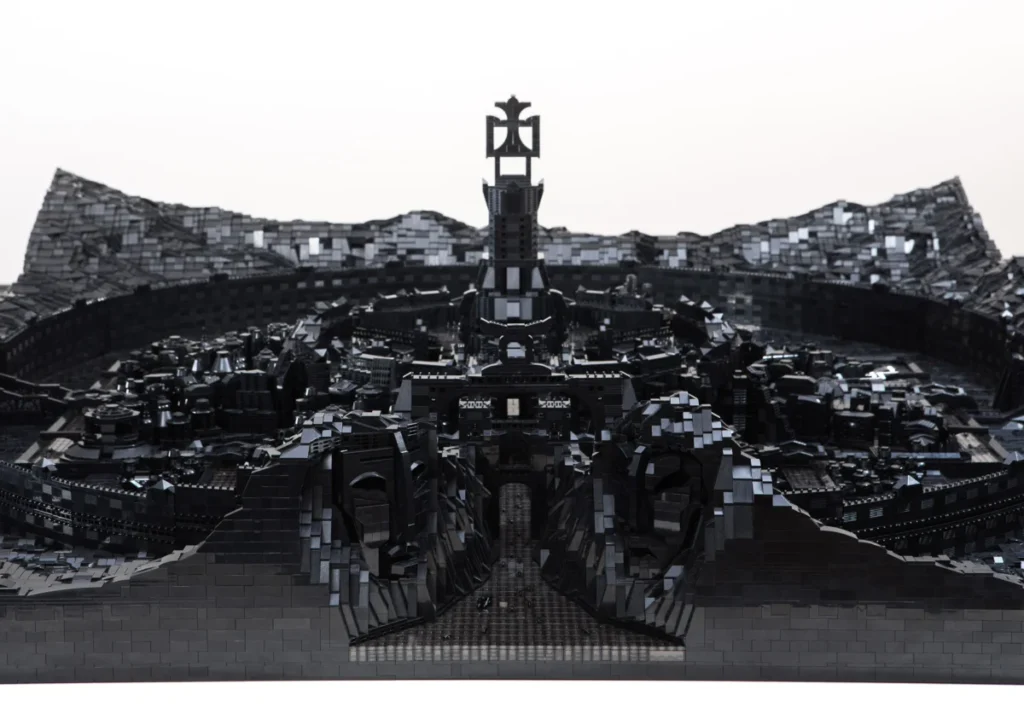
Toronto-based artist Ekow Nimako is challenging the boundaries of contemporary sculpture and social commentary by utilizing one of the world’s most recognizable toys to construct a new vision of Black identity. Through his "Building Black" series, Nimako employs tens of thousands of black LEGO elements to create intricate, large-scale installations that blend African history with speculative future narratives. His work, most notably the massive Kumbisaleh 3020 CE, serves as a cornerstone for a burgeoning movement that uses art as a primary vehicle for Black liberation and the decolonization of the imagination.
Nimako’s artistic philosophy is rooted in Afrofuturism—a cultural aesthetic that combines elements of science fiction, historical fiction, fantasy, and Afrocentricity to critique the historical displacement of Black people and to envision a future defined by Black agency. By using a monochromatic palette of exclusively black LEGO bricks, Nimako removes the distractions of the toy’s traditional primary colors, forcing the viewer to engage with the form, texture, and profound cultural implications of the sculptures.
The Architect of Kumbisaleh 3020 CE
At the heart of Nimako’s current acclaim is Kumbisaleh 3020 CE, a 30-square-foot architectural marvel permanently housed at the Aga Khan Museum in Toronto. The piece is a speculative reimagining of the capital of the ancient Kingdom of Ghana, Kumbi Saleh, as it might appear a millennium into the future. Constructed from over 100,000 individual LEGO elements, the sculpture is a dense metropolis of obsidian-hued towers, intricate marketplaces, and advanced infrastructure.
The ancient Kingdom of Ghana, which flourished between the 6th and 13th centuries, was a hub of trade and intellectual exchange, yet it is often overshadowed in Western educational curricula by the history of the transatlantic slave trade. Nimako’s work seeks to bridge this gap. "I reached into the past to essentially propel us into the future," Nimako stated regarding the project. By projecting a medieval African power into the year 3020, the artist bypasses the trauma of colonization and enslavement, presenting a timeline where African innovation remained uninterrupted.
The scale of the project is not merely a feat of engineering but a symbolic gesture of reclamation. In a world where urban planning and architectural prestige are often viewed through a Eurocentric lens, Kumbisaleh 3020 CE asserts a Black architectural presence that is both ancient and hyper-modern.
A Chronology of Creative Evolution
Nimako’s journey from a child playing with blocks to a globally recognized artist is a testament to the power of sustained creative vision. Born in 1979, Nimako’s fascination with LEGO began at the age of four. While many children eventually set aside their building sets, Nimako recognized the medium’s potential for complex expression early on.
He pursued formal training at York University in Toronto, graduating with a Bachelor of Fine Arts (BFA) in 2010. This academic background provided the conceptual framework necessary to elevate his technical skill with LEGO into the realm of fine art. Since his graduation, Nimako has maintained a prolific pace, contributing to 16 exhibitions and completing three major public art commissions.

His career reached a significant milestone with the launch of the "Building Black" series, which focuses on the representation of Black life and mythology. In 2021, his work was featured in Make: Volume 78, highlighting his role as a leading figure in the global "maker" movement. Looking forward, Nimako’s trajectory continues to ascend; his exhibition Journey of 2,000 Ships debuted at the Dunlop Gallery in Regina, Saskatchewan, in late 2022, further expanding his exploration of African seafaring narratives and the myth of the Atlantic.
The Technicality of the Medium
The choice of LEGO as a medium is both a technical challenge and a political statement. Technically, building with LEGO requires an advanced understanding of geometry, weight distribution, and structural integrity, especially when working on a scale as large as Nimako’s. Unlike traditional clay or stone sculpture, LEGO is an additive process governed by the "grid" of the studs and tubes.
Nimako’s decision to use only black bricks adds an additional layer of complexity. Working with a single color makes it difficult to define shadows and depth, requiring the artist to rely entirely on the orientation of the bricks and the play of light across different finishes—matte, gloss, and transparent—to create definition.
Politically, the use of a mass-produced, Western toy to create Afrofuturistic monuments is a form of "culture jamming." By repurposing a product from a Danish corporation to tell stories of African liberation, Nimako subverts the traditional uses of the medium. Furthermore, his work addresses a historical lack of representation within the toy industry itself. For decades, the "default" colors in building sets did not reflect the diversity of the global population; Nimako’s work insists on a Black presence in these creative spaces.
Afrofuturism as a Tool for Liberation
The concept of Afrofuturism is central to Nimako’s impact on the art world. While the term was coined in the 1990s, the practice dates back much further, encompassing the music of Sun Ra, the literature of Octavia Butler, and more recently, the cinematic world of Marvel’s Black Panther.
Nimako describes his work as a method of dreaming reality into existence. "Every system we experience through the expanse of human civilization, it’s been thought up," he explains. By visualizing a reality where Black civilizations are technologically advanced and free from the scars of colonial violence, Nimako provides a psychological blueprint for progress.
This "imagination of what could be" is particularly resonant in the current social climate. Following the global protests for racial justice in 2020, there has been an increased demand for art that does more than just document suffering. Nimako’s sculptures offer a "proactive" rather than "reactive" form of art. Instead of reacting to oppression, his work acts as if that oppression never occurred, or was successfully overcome centuries ago, allowing for a pure exploration of Black potential.
Institutional and Public Response
The reception of Nimako’s work by major cultural institutions signals a shift in the art world’s valuation of "alternative" mediums and Afrofuturistic themes. The Aga Khan Museum’s decision to house Kumbisaleh 3020 CE permanently is significant, as the museum is dedicated to the contribution of Muslim civilizations and their artistic legacies. Nimako’s work fits into this mission by highlighting the sophisticated Islamic history of the ancient Ghana Empire.

Furthermore, the LEGO Group has recognized Nimako’s contributions. While the artist operates independently, his collaborations and the company’s acknowledgement of his work reflect a broader corporate realization of the need for diverse representation.
Public reaction has been equally robust. Educators and parents have noted that Nimako’s work provides a unique entry point for children to discuss complex topics like history, race, and the future. By using a medium that children already love, Nimako makes the profound concepts of Afrofuturism accessible to a younger generation, fostering a sense of pride and possibility.
Broader Implications for Contemporary Art
Ekow Nimako’s work sits at the intersection of several major trends in the 21st-century art world: the rise of "maker" culture, the increasing legitimacy of toys as fine art media, and the global push for decolonized narratives.
His influence extends beyond the gallery walls. By demonstrating that a common toy can be used to address the most pressing social issues of our time, Nimako encourages other artists and "makers" to look at their own tools with fresh eyes. His work suggests that liberation does not always require new materials; sometimes, it requires a new way of assembling the pieces we already have.
As the "Building Black" series continues to grow, it serves as a growing monument to the resilience and creativity of the African Diaspora. Nimako’s vision of 3020 CE is not just a fantasy; it is a call to action. It challenges viewers to consider what kind of future they are currently building and whether that future has room for the liberation and flourishing of all people.
In the landscape of modern art, Nimako has carved out a space that is entirely his own—one brick at a time. His sculptures stand as obsidian beacons of hope, proving that with enough imagination, the building blocks of the past can indeed be used to construct a limitless future. Through his hands, the humble LEGO brick has been transformed from a childhood pastime into a powerful instrument of cultural revolution.