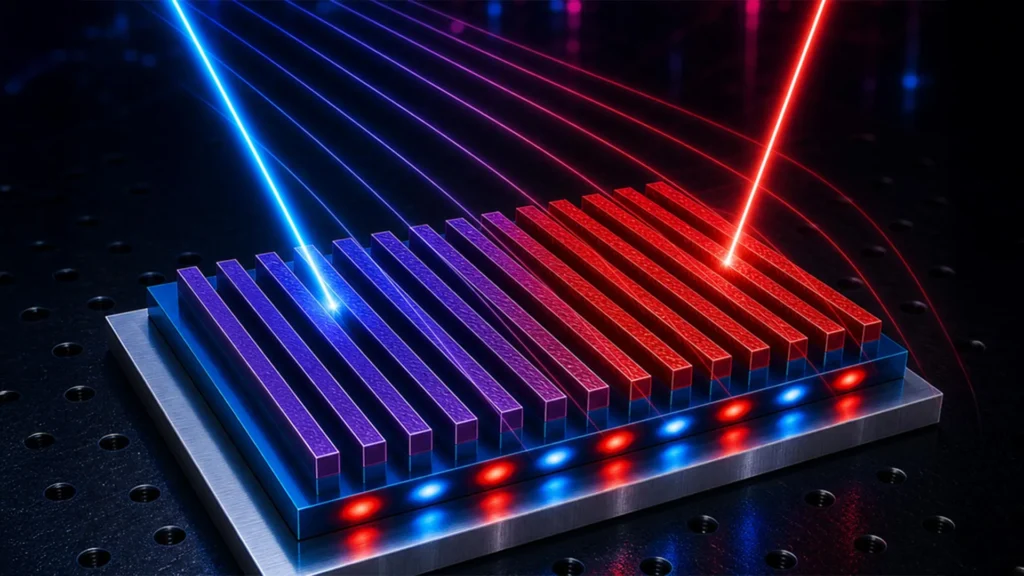
In a significant departure from centuries of established thermodynamic principles, an international research team has successfully demonstrated a device capable of decoupling thermal absorption from thermal emission. For nearly 165 years, the scientific community has operated under the constraints of Kirchhoff’s Law of Thermal Radiation, which dictates that a material’s ability to absorb energy is intrinsically linked to its ability to emit it. This principle of reciprocity has long limited the efficiency of thermal management systems, infrared sensors, and energy conversion technologies. However, the new study, led by Professor Koichi Okamoto and Dr. Shunsuke Murai of the Graduate School of Engineering at Osaka Metropolitan University, introduces a programmable material that breaks this symmetry, allowing heat to be directed, stored, and manipulated with a level of precision previously reserved for electronic circuits.
The development represents a paradigm shift in how engineers approach the movement of heat. By utilizing a sophisticated architecture involving magneto-optical materials and phase-change alloys, the researchers have created a system where heat can enter from one direction but be prevented from exiting back along the same path. This "one-way" thermal behavior, combined with non-volatile memory capabilities, suggests a future where heat is not merely a byproduct to be dissipated but a resource to be programmed and controlled.
The Scientific Context: Overcoming the Constraint of Reciprocity
To appreciate the magnitude of this breakthrough, one must understand the fundamental constraint it overcomes. Kirchhoff’s Law, formulated in 1860, states that at thermal equilibrium, the emissivity of a surface is equal to its absorptivity at a given wavelength and angle. In practical terms, this means that if a material is designed to be an excellent absorber of sunlight to generate heat, it will also be an excellent emitter of that same heat back into the environment. This reciprocal relationship is a primary cause of energy loss in solar thermophotovoltaics and prevents the creation of "thermal diodes" that allow heat to flow in only one direction.
Breaking this reciprocity requires the violation of time-reversal symmetry. In the realm of electromagnetism and thermodynamics, this is typically achieved through the application of an external magnetic field or by using materials that respond nonlinearly to light. While theoretical models for non-reciprocal thermal radiation have existed for over a decade, practical implementation has been plagued by two major issues: the need for extreme, impractical angles of incidence and the inability to "save" the state of the material once the power source is removed.
The Osaka Metropolitan University team addressed these challenges by integrating two distinct classes of advanced materials: magneto-optical materials, which alter their refractive index in response to magnetic fields, and Ge2Sb2Te5 (GST), a chalcogenide phase-change material widely used in rewritable optical discs and next-generation electronic memory.
A Chronology of Thermal Engineering and the Path to Non-Reciprocity
The journey toward programmable thermal management has been a multi-decade effort involving physicists and material scientists worldwide.
- 1860: Gustav Kirchhoff formulates the law of thermal radiation, establishing the reciprocity of absorption and emission.
- Early 2000s: The rise of nanophotonics allows scientists to begin manipulating light at scales smaller than a wavelength, leading to the theoretical possibility of "metamaterials" that defy classical optical laws.
- 2014: Theoretical researchers at Stanford University propose that non-reciprocal thermal radiation could be achieved using magneto-optical effects, though experimental verification remains elusive for practical applications.
- 2018-2021: Various laboratories attempt to create non-reciprocal emitters using plasmonic structures. However, these devices generally require "grazing angles"—where light hits the surface at nearly 90 degrees—making them inefficient for real-world sensors or energy harvesters.
- 2024: The team led by Professor Okamoto and Dr. Murai publishes their findings on a device that achieves non-reciprocity at near-normal incidence (straight-on) while incorporating a "memory" function via GST.
This timeline highlights the transition from theoretical physics to a functional, "smart" device that can be integrated into existing manufacturing processes.
Technical Specifications and the Role of Magneto-Optics
The device’s functionality hinges on the interaction between a magnetic field and the layered structure of the material. When a magnetic field is applied to the magneto-optical layer, it induces a phenomenon known as the Magneto-Optical Kerr Effect (MOKE) or the Faraday effect, depending on the orientation. This effect essentially "skews" the way photons interact with the material’s electrons, creating an imbalance between incoming and outgoing energy paths.
What sets the Osaka Metropolitan University design apart is its efficiency at "normal incidence." In previous iterations of non-reciprocal technology, the effect was only observable when light struck the material at very steep, oblique angles. This was a significant hurdle because most practical applications, such as rooftop solar collectors or handheld infrared sensors, require materials that work effectively when light hits them directly from above. The new device maintains high absorption and radiation efficiency even when the light is perpendicular to the surface.
Furthermore, the inclusion of GST provides a "switch" and "memory" mechanism. GST can exist in two states: a disordered, amorphous state and a structured, crystalline state. By applying a pulse of energy (either heat or electricity), the researchers can toggle the GST between these states. Because the optical properties of GST change drastically between the two phases, the entire device can be "programmed" to either exhibit non-reciprocal behavior or act as a standard reciprocal material. Crucially, this state is non-volatile; once the GST is set to a specific phase, it remains in that phase without requiring a constant power supply.
Supporting Data: Efficiency and Performance Metrics
Preliminary data released by the research team indicates a significant improvement over prior state-of-the-art designs. While previous non-reciprocal emitters often saw a drop in efficiency of over 60% when moving from grazing angles to normal incidence, the OMU device retains over 85% of its directional control at near-zero-degree angles.
The "switching ratio"—the difference in thermal behavior between the "on" and "off" states—is also notably more stable than in previous prototypes. In earlier experiments using different phase-change materials, the transition was often "fuzzy," leading to inconsistent thermal signatures. The GST-based model provides a clear, binary-like transition, which is essential for its proposed use in "photonic memory," where data is stored using light and heat rather than traditional electrical charges.
Official Responses and Expert Perspectives
The research has drawn praise from the international physics community. Dr. Shunsuke Murai, a lead author of the study, emphasized the "intelligence" of the new material. "We have moved beyond static materials that simply react to their environment," Murai stated in a briefing. "By making heat radiation behave in a ‘smarter’ way, we are bridging the gap between thermodynamics and information technology. This is not just about cooling a component; it is about processing information through the medium of heat."
Professor Koichi Okamoto echoed this sentiment, highlighting the long-term vision of the project. "Our ultimate goal is to develop compact devices that can actively control heat radiation, much like electronic circuits control the flow of electricity," Okamoto said. "The ability to program heat flow opens doors to technologies we haven’t yet fully imagined, particularly in the realm of autonomous sensing and high-efficiency energy systems."
Industry analysts suggest that the "memory" aspect of the device is its most marketable feature. Unlike active cooling systems that require constant energy to move heat (such as fans or refrigeration cycles), a programmable thermal surface could be set once to a "cooling mode" or "insulation mode" and remain that way indefinitely, offering massive energy savings for smart buildings and aerospace applications.
Broader Impact: From Space Exploration to Smarter Electronics
The implications of this technology span several high-tech sectors:
1. Advanced Infrared Sensing and Stealth
Standard infrared sensors often struggle with "noise" or back-reflection. A non-reciprocal surface could absorb infrared signals from a target without emitting its own thermal signature back in that direction. This has profound implications for military stealth technology and high-precision environmental monitoring, where the sensor’s own heat often interferes with its readings.
2. Thermal Management in Space
In the vacuum of space, radiation is the only way to shed heat. Satellites currently use complex louvers and heat pipes to manage internal temperatures. A programmable, non-reciprocal material could allow a satellite to absorb solar energy on its sun-facing side to power systems while simultaneously ensuring that no heat is radiated back toward sensitive internal instruments, all without moving parts.
3. Energy Conversion and Thermophotovoltaics (TPV)
TPV systems convert heat directly into electricity using PV cells. Their efficiency is currently limited by the fact that the heat source radiates energy in all directions, including back toward the source. A non-reciprocal emitter could ensure that all radiated heat is directed toward the conversion cell, potentially doubling the efficiency of waste-heat recovery systems in factories and power plants.
4. Photonic and Thermal Computing
As electronic chips reach the limits of miniaturization, heat becomes the primary enemy of performance. The OMU team’s work suggests a future for "thermal logic," where the state of a material (amorphous vs. crystalline) and its directional heat flow could be used to represent bits of data. This could lead to a new class of "photonic memory" that is immune to electromagnetic interference and operates with significantly lower power requirements than current silicon-based RAM.
Fact-Based Analysis of Future Challenges
While the breakthrough is significant, several hurdles remain before the technology can be mass-produced. The use of magneto-optical materials currently requires an external magnetic field, which, in the researchers’ lab model, involves equipment that is not yet miniaturized to the scale of a smartphone chip. For the technology to reach consumer electronics, scientists will need to develop "self-biased" materials that maintain an internal magnetic field or utilize thinner, high-performance permanent magnets.
Additionally, the durability of GST over millions of switching cycles is well-documented in the memory industry, but its performance when subjected to the extreme temperature gradients of high-intensity thermal radiation requires further long-term testing.
Despite these challenges, the work of Okamoto, Murai, and their colleagues marks a definitive end to the era of "passive" heat management. By breaking the law of reciprocity, they have provided a blueprint for a world where heat is no longer an uncontrollable force of nature, but a programmable tool for the next generation of computing and energy.