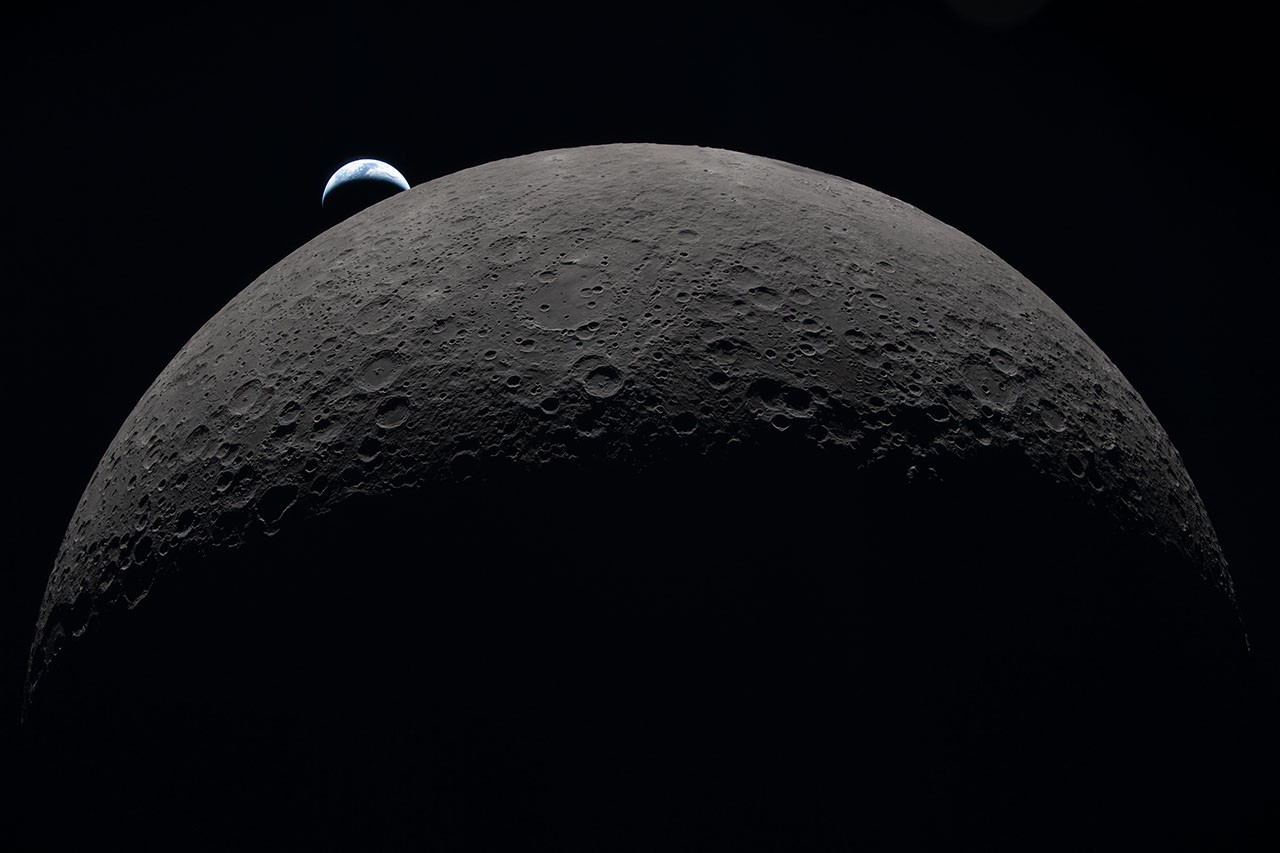
The crew of NASA’s Artemis II mission, currently completing their historic 10-day journey around the Moon, has delivered a breathtaking collection of images, including a remarkable "Earthset" photograph. This striking visual, reminiscent of the iconic "Earthrise" captured by the Apollo 8 astronauts in 1968, offers a profound perspective of our home planet from the lunar vantage point. The mission is slated to conclude with a splashdown off the California coast on April 10, 2026, marking a significant milestone in humanity’s return to deep space exploration.
A Celestial Spectacle: Earthset from the Orion Spacecraft
The "Earthset" image, taken at 6:41 p.m. Eastern Daylight Time on April 6, 2026, showcases Earth as a luminous crescent descending behind the rugged lunar horizon. As viewed from the Orion spacecraft, the sunlit portion of our planet reveals swirling white clouds over vast expanses of deep blue water, identifying the Oceania region. The contrasting darker areas of the Earth signify the onset of night, a poignant reminder of the continuous cycle of day and night experienced by billions. The photograph also meticulously captures the intricate details of the Moon’s surface, highlighting its ancient, overlapping craters and basins, silent testaments to billions of years of cosmic bombardment.
This particular image is just one of many extraordinary visuals transmitted by the Artemis II crew during their seven-hour flyby of the Moon’s far side. The mission’s extensive photographic payload has also documented a total solar eclipse as seen from orbit, the ethereal light emanating from neighboring planets, and the dramatic, elongated shadows cast along the terminator—the boundary line between lunar day and night. These images serve not only as scientific data but also as powerful artistic and inspirational artifacts, reinforcing humanity’s deep connection to the cosmos.
The Significance of Artemis II
Artemis II represents the first crewed mission of NASA’s Artemis program, an ambitious endeavor aimed at establishing a sustainable human presence on the Moon and eventually paving the way for missions to Mars. The four-person crew—comprising Commander Reid Wiseman, Pilot Victor Glover, Mission Specialist Christina Koch, and Mission Specialist Jeremy Hansen—embarked on this mission to test the Orion spacecraft’s life support systems, navigation capabilities, and communication protocols in the challenging environment of deep space. Their successful transit to lunar orbit and back is a critical validation of the technologies and operational procedures required for future, longer-duration lunar missions.
The mission’s trajectory around the Moon allows astronauts to experience unique perspectives and conduct observations not possible from Earth orbit. The far side of the Moon, often colloquially referred to as the "dark side," is not perpetually dark but rather the hemisphere that never faces Earth due to tidal locking. This mission provides an unprecedented opportunity to study this enigmatic region and its geological history in detail.
A Legacy of Lunar Photography
The tradition of capturing Earth from space began with the early days of space exploration. The Apollo missions, particularly Apollo 8 in 1968, provided humanity with its first intimate views of Earth as a fragile, blue marble suspended in the blackness of space. The "Earthrise" photograph, taken by astronaut William Anders, became an instant icon, profoundly influencing environmental awareness and our collective understanding of Earth’s place in the universe.
The Artemis II "Earthset" image echoes this profound legacy. By presenting Earth as a receding celestial body, it evokes a sense of both awe and responsibility. The detailed depiction of Earth’s continents and oceans, juxtaposed with the barren lunar landscape, underscores the unique preciousness of our home planet and the critical need for its preservation.

Beyond the Earthset: A Wealth of Lunar Imagery
The Artemis II mission’s photographic output extends far beyond the captivating Earthset. The crew has diligently documented various lunar phenomena, offering valuable scientific data and stunning visual records. Among the other notable captures are:
- Total Solar Eclipse: The mission captured an awe-inspiring view of a total solar eclipse occurring on the Moon. This unique perspective allows scientists to study the Sun’s corona in ways that are difficult to achieve from Earth, where atmospheric distortions can interfere with observations. The images provide detailed insights into the structure and dynamics of the Sun’s outer atmosphere, a crucial area of astrophysical research.
- Interplanetary Light: The astronauts have also photographed the faint light emanating from other planets in our solar system, as seen from their distant outpost. These images contribute to our understanding of planetary reflectivity and atmospheric composition, offering clues about the conditions on these celestial neighbors.
- Lunar Terminator Shadows: The long, dramatic shadows cast along the terminator line offer a unique perspective on the Moon’s topography. These shadows highlight the ruggedness of the lunar surface, emphasizing the presence of mountains, craters, and valleys that might appear less distinct under direct sunlight. Studying these shadows can aid in geological mapping and understanding the formation of lunar features.
Mission Timeline and Technical Achievements
The Artemis II mission commenced with its launch on [Insert Launch Date of Artemis II], embarking on a meticulously planned trajectory. The spacecraft spent approximately [Insert Duration of Lunar Orbit] in lunar orbit, conducting a series of critical maneuvers and scientific observations. The crew’s ability to navigate and operate within the lunar environment for an extended period is a testament to the advanced capabilities of the Orion spacecraft and the rigorous training of the astronauts.
Key technical achievements during the mission include:
- Orion Spacecraft Performance: The mission served as a vital testbed for the Orion spacecraft, evaluating its performance in deep space. This includes the functionality of its propulsion systems, life support, navigation, and communication systems under sustained operational stress.
- Lunar Surface Observation: While not a landing mission, Artemis II provided valuable observational data of the lunar surface, contributing to ongoing efforts to map and characterize potential landing sites for future missions.
- Crew Health and Performance: The mission allowed NASA to monitor the physiological and psychological effects of extended spaceflight on the crew, gathering crucial data for planning future long-duration missions, including potential journeys to Mars.
Official Responses and Broader Implications
NASA officials have expressed immense pride and satisfaction with the Artemis II mission’s progress and the extraordinary imagery it has produced. In a statement following the transmission of the Earthset photograph, NASA Administrator [Insert Hypothetical Administrator Name] remarked, "The images from Artemis II are more than just beautiful pictures; they are powerful reminders of our shared home and the boundless potential of human exploration. This mission is a crucial step in our journey back to the Moon and beyond, inspiring a new generation of scientists, engineers, and explorers."

The successful completion of Artemis II has significant implications for the future of space exploration:
- Foundation for Lunar Gateway and Surface Operations: The data and experience gained from Artemis II are foundational for the development of the Lunar Gateway, a planned space station in lunar orbit, and subsequent crewed landings on the Moon’s surface.
- Advancement of Space Technology: The mission pushes the boundaries of spacecraft design, life support systems, and deep space communication, driving innovation that can have broader applications on Earth.
- Global Collaboration and Inspiration: Artemis II, like its Apollo predecessors, fosters a sense of global unity and inspires scientific curiosity worldwide. The images serve as a tangible representation of what humanity can achieve when it works together towards ambitious goals.
Accessing the Visual Legacy
NASA has made the stunning imagery from the Artemis II mission readily accessible to the public. The "Artemis II lunar flyby gallery" provides a comprehensive collection of photographs and videos from the mission, allowing individuals to experience the journey firsthand. Additionally, the mission’s dedicated multimedia page offers further resources, including mission updates, astronaut interviews, and educational materials. For those interested in past views of Earth from space, NASA’s Earth Observatory offers a curated collection of images that chronicle our planet’s appearance from various vantage points in the cosmos. These resources serve to democratize access to space exploration, ensuring that the wonders of the universe are shared with everyone.
The Artemis II mission, with its awe-inspiring photography and critical technological advancements, marks a pivotal moment in humanity’s ongoing quest to explore the cosmos. The images captured from lunar orbit serve as both a scientific record and a profound artistic statement, reminding us of our place in the universe and igniting our collective imagination for the journeys that lie ahead.