A groundbreaking study from MIT has introduced a novel system called "bifur-circuits," which leverages advanced metamaterials to create interactive objects capable of sensing and dynamically altering their configurations. This innovation promises to redefine the design and functionality of everyday items, from adaptable furniture that transforms and stows away, to smart antennas that automatically adjust to changing environmental conditions without requiring bulky mechanical components. The research, spearheaded by mechanical engineering graduate student Marwa AlAlawi, along with co-senior authors Ticha Sethapakdi and Associate Professor Stefanie Mueller from MIT, represents a significant leap towards embedding intrinsic intelligence directly into hardware, opening a vast array of possibilities across multiple industries.
The Dawn of Intelligent Metamaterials: A Paradigm Shift in Design
At the heart of this development are mechanical metamaterials – meticulously engineered, three-dimensional structures composed of repeating units whose unique geometries allow them to form complex shapes in predictable ways. Unlike conventional materials, metamaterials exhibit extraordinary properties when subjected to external forces like squeezing, pushing, or pulling, enabling them to bend or twist with remarkable precision. A prime example is "auxetic" metamaterials, which counter-intuitively expand perpendicular to the direction of an applied tensile force, rather than narrowing. This property has long fascinated material scientists, hinting at a future where materials themselves possess inherent, programmable functionality.
The concept of metamaterials, while relatively modern in its practical applications, has roots in theoretical physics and materials science dating back to the late 20th century. Researchers have explored ways to create materials with properties not found in nature, often by designing their internal structure at a micro or nano-scale. Early work focused on electromagnetic metamaterials, leading to concepts like "invisibility cloaks" and perfect lenses. More recently, the focus has broadened to mechanical metamaterials, driven by advancements in computational design and additive manufacturing, particularly 3D printing, which allows for the fabrication of these intricate, repeating geometries with unprecedented accuracy.
Prior to this latest breakthrough, MIT researchers had already demonstrated the potential of auxetic metamaterials by constructing reconfigurable antennas. These antennas could adopt three distinct shapes based on how the structure was stretched, allowing them to dynamically adjust their frequency range. This eliminated the need for complex, cumbersome moving parts, a common limitation in traditional antenna design. However, the team soon recognized a constraint: these auxetic designs were limited to only three fixed states, restricting the overall adaptability and versatility of the antennas. The ambition was to expand this reconfigurability exponentially, pushing the boundaries of what these smart structures could achieve.
Introducing Bifur-Circuits: Unlocking Exponential Reconfigurability
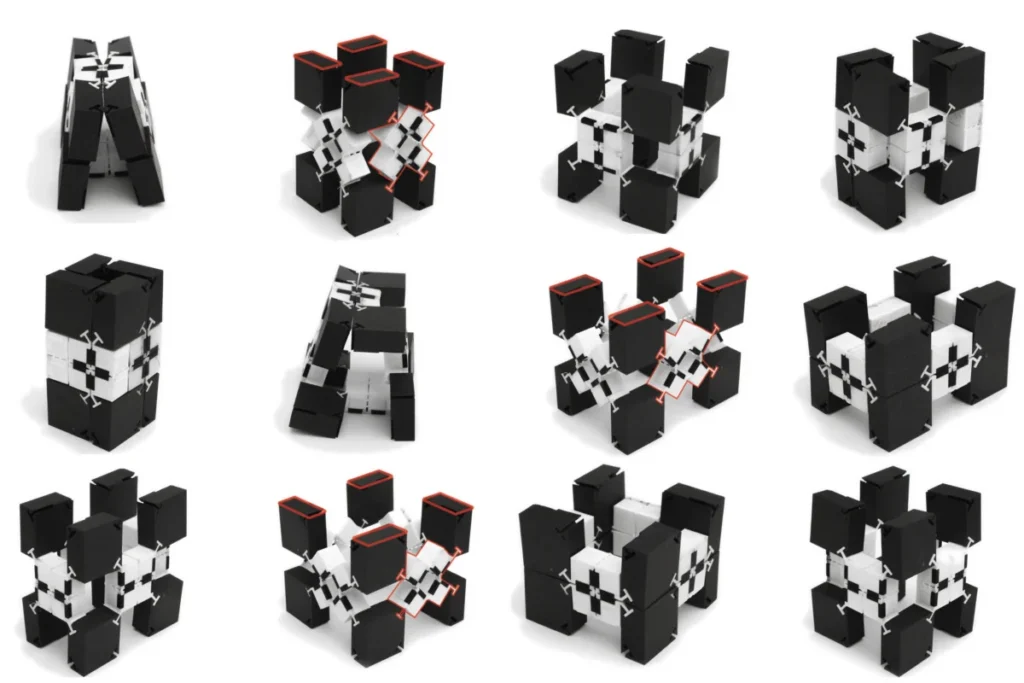
To overcome the limitations of previous designs, the MIT team conceived and developed "bifur-circuits." These represent an evolution of auxetic metamaterials, designed to achieve a far greater number of shapes. The innovation lies in how their modular units are connected and rotated, creating a versatile system that vastly expands the available configuration space. Crucially, these units are also designed to be electrically modular. Conductive material is seamlessly integrated into the bifur-circuits in such a way that electrical connections are maintained throughout the entire structure, regardless of how the object is rotated, pressed, or twisted into new forms. This continuous electrical connectivity is vital for the structures to "sense" their own configurations and communicate that information.
Marwa AlAlawi, the lead author of the paper detailing the devices, articulated the significance of this expansion: "Metamaterials can make complex mechanical assemblies easy to manufacture just by using repeating units. Our work expands on this design space. If we think of mechanical metamaterials as building blocks, then our work is one way to take advantage of their geometry to embed intrinsic intelligence into hardware, which could open many possibilities." This statement underscores the team’s vision: to move beyond mere shape-changing materials towards hardware that possesses inherent awareness and adaptive capabilities.
The core principle enabling the vast array of configurations in bifur-circuits is a property known as mechanical bifurcation. This phenomenon describes a sudden, often dramatic, change in a mechanism’s behavior when a force exerted upon it crosses a critical threshold or "tipping point." A common illustration is bending a plastic ruler: gently bending its ends yields a gradual curve, but once the applied force reaches a certain magnitude, the ruler abruptly buckles into a new, stable configuration. In the context of bifur-circuits, this bifurcation occurs when connected blocks are rotated in specific ways around a pivot point. This property is engineered to allow connected blocks to form a multitude of stable configurations, far exceeding what a single, isolated block could achieve. The brilliance of the design lies in the fact that adding more bifur-circuit units to a structure exponentially increases the number of potential configurations, making truly complex and adaptable systems feasible. AlAlawi further emphasized this exponential growth, stating, "Bifurcation allow us to significantly expand on this reconfigurability space. Just adding one extra unit gives us so many more combinations out of the same structure."
Overcoming Engineering Hurdles: The Path to Practicality
Developing bifur-circuits was not without its challenges. One of the most significant hurdles the researchers faced was the incorporation of a conductive material that was sufficiently flexible to accommodate the extreme bending and twisting inherent in the reconfigurable designs, yet efficient enough to ensure a reliable flow of electricity. Achieving this delicate balance was critical for the structures to maintain electrical connectivity and, consequently, their sensing capabilities across all possible configurations. AlAlawi noted, "The conductive material was a constraint we had to work around in the design process, and it dictated how the sensing between blocks would happen." This iterative design process involved careful material selection and integration, ensuring that the structural integrity and electrical functionality were not compromised.
Once the design was perfected, rigorous testing was imperative to validate the durability and reliability of these novel reconfigurable structures. The researchers subjected the bifur-circuits to extensive compression tests, with the prototypes enduring more than 10,000 cycles of compression. Remarkably, the structures demonstrated no degradation in their electrical connectivity, a testament to the robustness of the integrated conductive pathways and the overall mechanical design. This durability is crucial for real-world applications, where these intelligent metamaterials would be expected to perform reliably over extended periods and numerous transformations.
To facilitate the wider adoption and design of bifur-circuits, the research team also developed a user-friendly construction and simulation tool. This software simplifies the intricate design process, allowing engineers and designers to rapidly prototype and visualize various configurations. A key feature of this tool is its ability to generate precise instructions for multimaterial 3D printers, enabling the fabrication of complex, reconfigurable objects in a single pass. This streamlines the manufacturing process, making the production of these intelligent metamaterials more accessible and efficient. The integration of advanced manufacturing techniques, particularly multi-material 3D printing, is vital for realizing the complex geometries and integrated functionalities of bifur-circuits, allowing for the seamless embedding of conductive elements within the structural units during fabrication.
Demonstrated Versatility: From Furniture to Future Robots
The practical versatility of bifur-circuits was vividly demonstrated through several compelling prototypes. One notable example was a chair designed to sense its own geometry. This chair could transform into a tea table with integrated storage, and then flatten entirely for easy stowing. As its shape changed, the structure autonomously sensed its configuration and transmitted corresponding messages to an electronic display. This level of self-awareness and interactive feedback represents a significant advancement in smart furniture, offering unprecedented adaptability in living and working spaces. Imagine urban apartments where furniture adapts to the needs of the moment, or disaster relief shelters that can be quickly reconfigured to serve multiple purposes.
Beyond furniture, the implications for communication and sensing technologies are profound. The research highlighted the potential for bifur-circuits to be used in designing antennas that form new shapes to dynamically adjust their frequencies in response to changing environmental conditions, all without the need for bulky, failure-prone mechanical parts. In a world increasingly reliant on robust and adaptive wireless communication, from 5G networks to satellite constellations, such reconfigurable antennas could offer unparalleled flexibility and resilience.
Another intriguing application showcased was a shape-shifting controller that could launch different video games based on its current configuration. This concept extends beyond gaming, suggesting new paradigms for human-computer interaction where physical interfaces dynamically adapt to the user’s intent or the task at hand. This could lead to more intuitive and engaging user experiences across various digital platforms.
Broader Impact and Future Horizons
The implications of bifur-circuits extend far beyond these initial demonstrations. The ability to embed "intrinsic intelligence" directly into hardware through mechanical metamaterials opens up a wealth of possibilities across diverse fields. In healthcare, these materials could be used to create interactive rehabilitation tools that adapt to a patient’s progress or specific needs, providing personalized support and feedback. In robotics, bifur-circuits could lead to the development of shape-changing grippers for modular soft robots, allowing them to manipulate objects of varying sizes and delicate compositions with greater dexterity and adaptability. Furthermore, the concept of reconfigurable shelters that could respond to changing environmental conditions after a natural disaster offers a humanitarian application with immense potential, enabling rapid deployment and adaptation to unpredictable circumstances.
The research was conducted by a multidisciplinary team from MIT, including lead author Marwa AlAlawi, mechanical engineering graduate student; co-senior authors Ticha Sethapakdi, an electrical engineering and computer science (EECS) graduate student at MIT; and Stefanie Mueller, an associate professor in MIT’s departments of EECS and Mechanical Engineering, who also leads the Human-Computer Interaction Group at the Computer Science and Artificial Intelligence Lab (CSAIL). Their co-authors included researchers from MIT, the University of Tokyo, and the University of Michigan, highlighting the collaborative nature of this cutting-edge research. The findings are slated for presentation at the prestigious ACM Symposium on User Interface Software and Technology, a key venue for showcasing innovations in human-computer interaction. This presentation to a global audience of experts underscores the significance and potential impact of their work.
Looking ahead, the researchers are keen to explore even more applications for bifur-circuits. Their future work will focus on enhancing the interactivity within these structures and investigating additional metamaterial shapes to further expand the design space. AlAlawi articulates this forward-looking vision: "Bifur-circuits are one step toward developing mechanical building blocks with integrated intelligence. It would be interesting to build on this work and come up with building blocks that allow us to create a structure with any form or shape we want, and which are structurally stable and can be actuated." This ambition points towards a future where intelligent, reconfigurable materials become fundamental building blocks for a vast array of adaptive technologies, blurring the lines between static structures and dynamic, responsive systems.
This pioneering work, supported in part by Japan’s Science and Technology Agency and the Bahrain Crown Prince International Scholarship Program, positions MIT at the forefront of intelligent materials research. It marks a significant milestone in the quest to imbue inanimate objects with a form of intelligence, promising a future where our environments and tools are not only functional but also inherently adaptive, intuitive, and responsive to our evolving needs. The development of bifur-circuits signifies a fundamental shift in how we conceive and interact with the physical world, moving towards a future where hardware is not just built, but intelligently grown and dynamically reconfigured.