Water covers most of Earth’s surface, yet it behaves in ways that set it apart from nearly every other liquid. Its unique properties, such as expanding instead of contracting when it freezes, its unusually high specific heat capacity, and its maximum density at 4 degrees Celsius rather than 0 degrees Celsius, have puzzled scientists for centuries, making it one of the most studied yet least understood substances. Scientists have long linked these odd behaviors to intricate changes in water’s microscopic structure as temperature and pressure vary, but they have consistently lacked a robust, consistent methodology to describe, quantify, and compare these elusive structural transformations across different theoretical models and experimental observations. Now, in a significant scientific advancement, researchers at the University of Osaka have harnessed the power of artificial intelligence (AI) to tackle this fundamental challenge, introducing a novel system that provides a unified, objective way to compare diverse methods of describing the structure of supercooled water, thereby helping to identify which descriptors most effectively capture the critical features of its complex molecular arrangements. This groundbreaking research, which promises to redefine our understanding of the most ubiquitous liquid on Earth, was recently published in the prestigious journal Communications Chemistry.
The peculiar nature of water is not merely an academic curiosity; it underpins life on Earth. Its expansion upon freezing, for instance, means that ice floats, insulating aquatic life beneath frozen surfaces and preventing entire bodies of water from freezing solid from the bottom up. If water behaved like most other substances and contracted upon freezing, lakes and oceans would freeze solid, rendering complex aquatic ecosystems impossible. Similarly, water’s exceptionally high specific heat capacity—the amount of energy required to raise its temperature—allows large bodies of water to absorb vast quantities of solar energy, thereby moderating global temperatures and creating stable climates conducive to life. These macroscopic phenomena are direct consequences of water’s intricate molecular architecture and the dynamic interactions between its constituent H2O molecules.
For decades, scientific inquiry into water’s anomalies has centered on the concept of hydrogen bonding. Each water molecule, composed of one oxygen atom and two hydrogen atoms, can form up to four hydrogen bonds with neighboring water molecules. These bonds are weaker than covalent bonds but collectively create a dynamic, transient network that constantly forms, breaks, and rearranges itself. The precise geometry and energetics of this hydrogen bond network dictate water’s structural properties at the molecular level, which in turn manifest as its macroscopic behaviors. Understanding how this network evolves under varying conditions of temperature and pressure is paramount to unraveling water’s mysteries. However, the sheer complexity and fleeting nature of these molecular arrangements have historically presented formidable challenges to accurate and consistent description, leading to a proliferation of theoretical models and structural descriptors, each with its own merits and limitations.
The Enigma of Supercooled Water
The unusual properties of water become even more pronounced and intriguing under conditions known as supercooling. For liquid water to transition into its solid, crystalline form—ice—its molecules must first arrange themselves into an orderly crystal lattice. This process typically initiates at a "nucleation site," which can be any surface or impurity where ice crystals can begin to form and grow. Microscopic dust particles, tiny impurities dissolved in the water, or even minute scratches on the inner surface of a container can all serve as these initial starting points for crystallization.
However, if these crucial nucleation sites are absent or suppressed, water can remarkably remain in a liquid state even when cooled significantly below its normal freezing point of 0 degrees Celsius (32 degrees Fahrenheit). This metastable condition is known as supercooled water. In laboratory settings, water has been supercooled to temperatures as low as approximately -42 degrees Celsius (-43.6 degrees Fahrenheit) before it spontaneously freezes, a point known as the homogeneous nucleation temperature. This extraordinary resistance to freezing in the absence of external triggers highlights the energetic barrier that must be overcome for water molecules to align into a stable ice lattice. Supercooled water is not just a laboratory curiosity; it plays a vital role in natural phenomena, such as the formation of clouds and precipitation in Earth’s atmosphere, where water droplets often remain liquid at sub-zero temperatures, influencing weather patterns and climate dynamics.
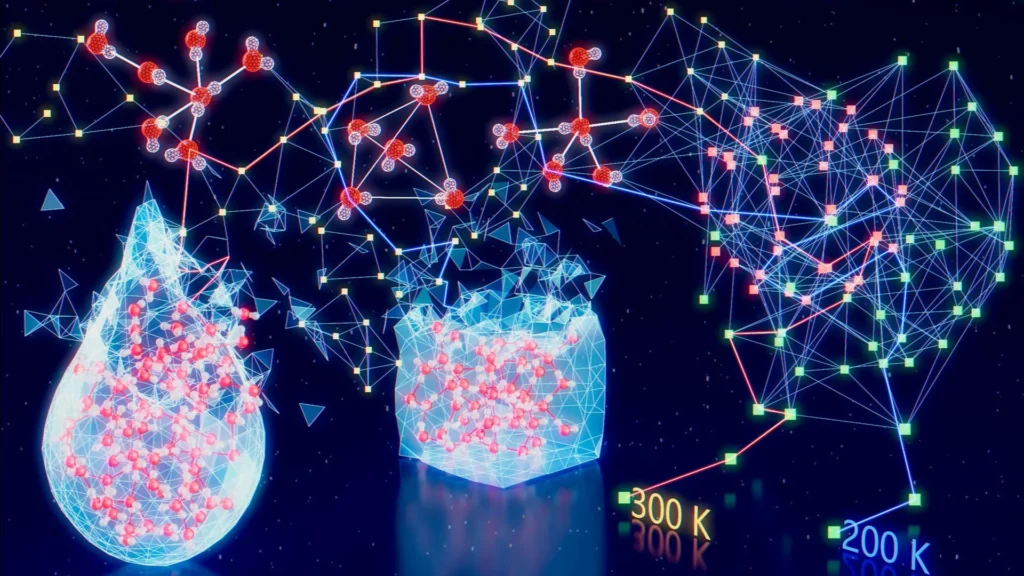
Scientists hypothesize that many of water’s peculiar behaviors, especially in its supercooled state, are intimately linked to a delicate balance between two distinct, competing forms of liquid water at the molecular level. These are often referred to as a high-density liquid (HDL) and a low-density liquid (LDL). The HDL state is characterized by a more compact, disordered arrangement of water molecules, with hydrogen bonds exhibiting greater flexibility and less specific orientation. Conversely, the LDL state involves a more open, tetrahedral arrangement of molecules, where hydrogen bonds are more structured and geometrically precise, resembling the lattice structure found in ordinary ice, albeit in a disordered, fluctuating liquid form.
At typical temperatures above freezing, the balance favors the more compact HDL structures. As the temperature drops, particularly into the supercooled regime, the more open, ice-like LDL arrangements become increasingly dominant. This dynamic interplay between HDL and LDL structures, constantly forming and breaking networks of hydrogen bonds, is believed to be the underlying mechanism driving water’s density anomaly and other unusual thermodynamic responses. The existence of a potential "second critical point" in supercooled water, where these two liquid phases might separate, remains a subject of intense research and debate within the scientific community, further underscoring the profound complexity of this ubiquitous substance.
A Historical Quest to Understand Water’s Structure
The scientific endeavor to comprehend water’s unique attributes stretches back centuries. Early observations of ice floating and the expansion of water upon freezing were documented by natural philosophers as far back as the 17th century. However, it was not until the advent of modern chemistry and physics that scientists began to formulate molecular-level explanations. In the mid-20th century, pioneers like J.D. Bernal and R.H. Fowler proposed early models of water structure, suggesting a quasi-crystalline, hydrogen-bonded network. Later, in the 1950s, Henry Frank and Wen-Yang Wen introduced the concept of "flickering clusters," describing water as a dynamic equilibrium of transiently hydrogen-bonded molecular groups that constantly form and break.
The development of computational chemistry and molecular dynamics simulations in the latter half of the 20th century provided unprecedented tools for investigating water’s microscopic behavior. Researchers could now simulate the movement and interaction of thousands of water molecules over picosecond timescales, offering insights into the formation and breaking of hydrogen bonds. These simulations became invaluable for testing theoretical models and generating vast datasets of structural information. Despite these advancements, a consistent and universally accepted framework for quantitatively describing water’s structural states remained elusive.
Over the years, researchers have proposed a multitude of different ways to describe the local arrangement of water molecules. These "structural descriptors" aim to capture various aspects of the molecular environment, such as the tetrahedral bond order, which quantifies how closely a molecule’s immediate neighbors resemble a perfect tetrahedral arrangement, characteristic of ice. Other descriptors include local density, coordination numbers (the number of nearest neighbors), and various angular distribution functions that characterize the orientation of molecules relative to one another.
The challenge inherent in this profusion of descriptors lies in their independent development. Each descriptor often uses different scales, dimensions, and types of information, making direct comparisons and objective evaluations exceedingly difficult. One descriptor might focus on hydrogen bond angles, while another emphasizes molecular packing. Without a common metric or a unified framework, determining which descriptors most accurately and efficiently capture the "key structural information" relevant to water’s macroscopic properties has been a persistent bottleneck in the field. This fragmentation has often led to a lack of consensus and hindered progress towards a comprehensive understanding of water’s phase transitions and anomalous behavior. The scientific community has long recognized the need for a more standardized approach to assess and validate these diverse structural metrics.
Artificial Intelligence Revolutionizes Structural Analysis
Addressing this long-standing challenge, researchers at the University of Osaka, led by corresponding author Kang Kim and senior author Nobuyuki Matubayasi, turned to the cutting-edge capabilities of artificial intelligence. Their innovative approach leverages a neural network model to provide an objective and systematic method for evaluating the efficacy of various structural descriptors in differentiating between the elusive high-density liquid (HDL) and low-density liquid (LDL) states of supercooled water. This application of AI marks a significant paradigm shift in how scientists can analyze and interpret complex molecular data.
"Past studies have shown that using machine learning to classify and understand structural data is effective," explains Kang Kim. "We specifically wanted to incorporate a neural network model into this study to evaluate how accurate the descriptors were at capturing key structural information, in a way that is like human cognition but with unparalleled consistency and data processing power." The choice of a neural network was strategic, given its ability to identify complex, non-linear patterns within large datasets without explicit programming for every possible scenario. This mimics, in a computational sense, the human brain’s capacity for pattern recognition and learning from experience, but on a scale and with a precision unattainable by human observation alone.
To train the AI system, the researchers meticulously fed the neural network with vast amounts of structural data. This data was not generated experimentally, but rather derived from sophisticated molecular dynamics simulations of supercooled water. These simulations, which model the interactions and movements of thousands of water molecules over extremely short time intervals (femtoseconds to nanoseconds), provide a rich, atomic-level view of water’s constantly evolving hydrogen bond network under various temperature and pressure conditions. Each data point represented a specific molecular configuration, characterized by the values of numerous structural descriptors.
Through repeated trial and error—a core principle of machine learning known as iterative optimization or backpropagation—the neural network learned to recognize meaningful patterns within these molecular structures. Initially, the network would make predictions about whether a given molecular configuration belonged to an HDL or LDL state based on the input descriptor values. By comparing its predictions against known classifications (derived from the underlying simulation data or expert knowledge) and adjusting its internal parameters (weights and biases), the system progressively refined its ability to accurately differentiate between the two liquid forms. This iterative learning process allowed the AI to develop a nuanced "understanding" of which structural features were most indicative of the HDL and LDL states, effectively learning to prioritize and synthesize information from the various descriptors.
New Clues Emerge from Water’s Hidden Structure
Once trained, the AI network was deployed to perform its central task: comparing the effectiveness of 16 different structural descriptors in distinguishing between LDL and HDL structures across a range of temperatures relevant to supercooled water. "The network used what it had learned to compare how 16 descriptors differentiated between LDL and HDL structures at different temperatures," reports Nobuyuki Matubayasi. "In this way, we determined the most efficient descriptors." While the study does not explicitly name the specific "most efficient" descriptors in the provided text, the methodology itself represents a critical advancement. It provides a robust, data-driven framework for objectively evaluating and ranking structural metrics, moving beyond qualitative assessments or subjective choices that have characterized previous approaches.
The AI’s ability to systematically analyze and compare these descriptors represents a significant leap forward for condensed matter physics and physical chemistry. By identifying which structural metrics are most sensitive and accurate in capturing the subtle differences between HDL and LDL, the Osaka team has provided the scientific community with a powerful new tool. This framework can guide future research by allowing scientists to select the most informative descriptors for their simulations and analyses, ultimately leading to more precise and consistent models of water’s behavior. The results offer new clues to water’s hidden structure, moving the field closer to a comprehensive, unified theory of water’s anomalies.