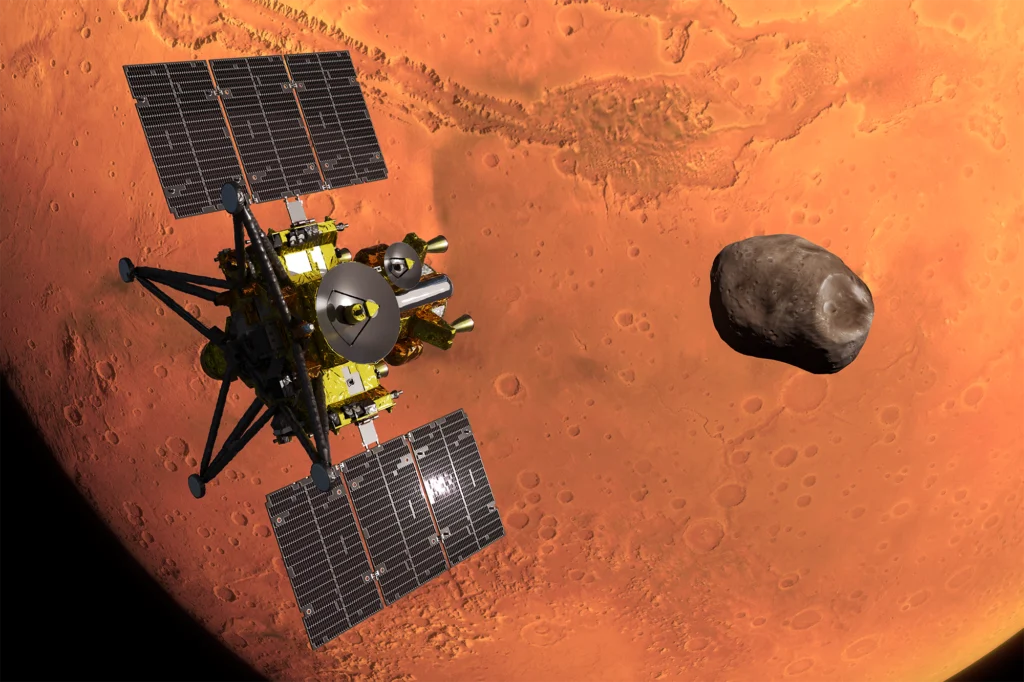
The Japan Aerospace Exploration Agency (JAXA) is poised to embark on a groundbreaking celestial endeavor next week with the launch of its Martian Moons eXploration (MMX) probe. This ambitious mission, scheduled to commence its voyage across the solar system on October 20th, 2026, at 4:41 a.m. Japan Standard Time (October 19th, 3:41 p.m. Eastern), carries the historic distinction of being the first to attempt wheeled locomotion on an ultra-low-gravity celestial body. The 4,200-kilogram spacecraft marks a significant leap in planetary exploration, aiming to unravel the mysteries surrounding the origins of Mars’ two moons, Phobos and Deimos, and to pave the way for future deep-space missions.
The year-long journey to the Martian system is a testament to the meticulous planning and engineering prowess of JAXA and its international partners. Upon arrival in late 2027, the MMX probe will deploy its sophisticated suite of remote-sensing instruments. These advanced tools are designed to meticulously analyze the Martian moons, gathering critical data to determine whether Phobos and Deimos are indeed fragments ejected from an ancient colossal collision with Mars, or if they are instead captured asteroids that originated from the outer solar system. The resolution of this scientific debate has long been a central objective for planetary scientists, offering profound insights into the early history of the solar system and the formation of planetary bodies.
A cornerstone of the MMX mission, and perhaps its most captivating objective, is the acquisition of approximately 10 grams of regolith – the loose, unconsolidated rocky material covering the surface – from Phobos. This precious lunar sample is slated for return to Earth in 2031, a feat that would represent the first-ever sample return from the Martian system. This monumental achievement, however, faces a potential race against time. China’s Tianwen-3 Mars sample return mission is also scheduled for a 2031 return, creating an exciting scientific rivalry to be the first to bring Martian moon material back to our home planet. The successful return of these samples will enable Earth-based laboratories to conduct in-depth analyses far beyond the capabilities of instruments that can be sent to the moons themselves, potentially revolutionizing our understanding of these enigmatic celestial bodies.
Idefix: The Dawn of Wheeled Exploration on Ultra-Low-Gravity Worlds
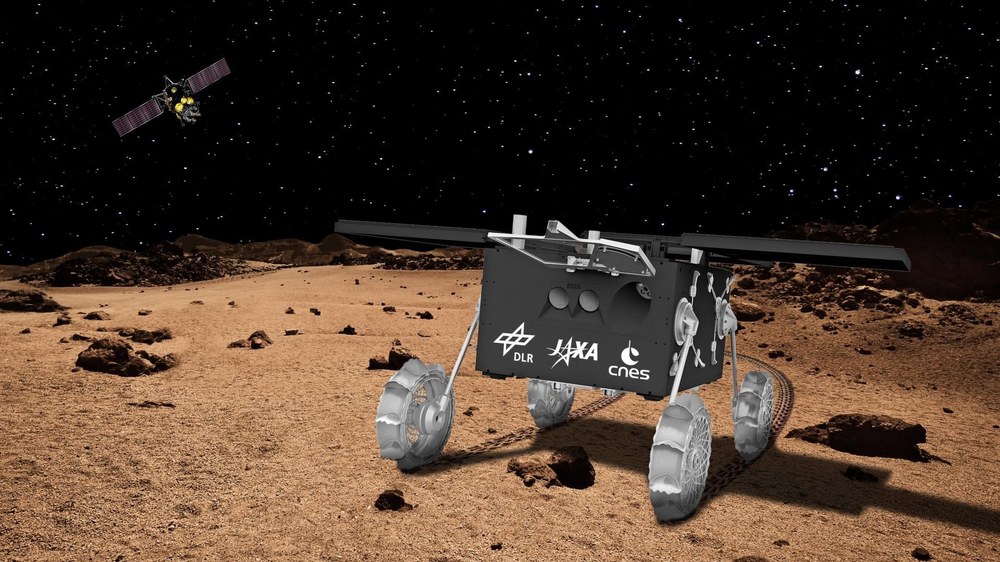
Central to the MMX mission’s exploration of Phobos is the deployment of "Idefix," a compact yet highly capable 25-kilogram wheeled rover. Idefix is designed to traverse the surface of Phobos for an unprecedented 100 days, a duration that will allow for extensive scientific investigation. Its mission parameters include characterizing the surface granularity, chemical composition, and geological makeup of Phobos using its advanced ground sensors. The significance of this endeavor cannot be overstated: Idefix will be the first wheeled rover to conduct driving operations on a celestial body with such an extremely low gravitational pull.
Prior to Idefix, mobility on low-gravity bodies such as asteroids was largely confined to small, hopping landers. A notable example includes JAXA’s MINERVA probes, which provided limited mobility during a 2018 sampling mission. These previous missions offered glimpses into the challenges of operating on surfaces with minimal gravitational influence. Idefix, however, represents a paradigm shift, promising a more comprehensive and dynamic exploration. The data gathered by Idefix will be instrumental not only in answering fundamental questions about the origins of Phobos and Deimos but also in providing invaluable insights for the design and operation of future lander missions to these and other similar celestial bodies.
Engineering Challenges in a Gravity-Defying Environment
The scientific aspirations of the MMX mission are met with considerable engineering hurdles, primarily stemming from the exceptionally low gravity of Phobos. With a mass of approximately 27 kilometers along its longest axis and a potato-like shape, Phobos exerts a gravitational pull that is roughly 2,000 times weaker than that experienced on Earth. This drastic difference in gravity presents unique challenges for deployment, locomotion, and operational stability.
Bastian Deutschmann and Fabian Buse, chief mission engineers at the German Aerospace Center (DLR) in Munich – the institution responsible for building Idefix in collaboration with the French space agency CNES – have highlighted these complexities. Deutschmann explained the stark reality of operating in such an environment: "Idefix has a mass of 25 kilos, but its effective weight on Phobos will be 12 grams – the same as a grape or a medium-sized envelope." This minuscule "weight" has profound implications for every aspect of the rover’s design and operation, from how it is released from the MMX spacecraft and how it stabilizes itself on the surface, to the speeds at which it can safely navigate.
Learning from Past Missions: Avoiding the Philae Predicament
The development of Idefix has been informed by lessons learned from previous complex landing missions, particularly the European Space Agency’s (ESA) Philae lander. DLR, along with CNES and other partners, was involved in the Philae mission, which attempted to land on comet 67P/Churyumov-Gerasimenko in late 2014. The Philae mission encountered significant difficulties when its anchoring harpoons and hold-down thruster failed to function as intended. This resulted in the lander bouncing for several hours before eventually settling in a crevasse, where limited solar power availability curtailed its operational mission to a mere 60 hours.
To prevent a similar fate for Idefix, meticulous planning is underway. Deutschmann emphasized that "the MMX spacecraft will map the surface of Phobos to help us pick a suitable landing site," with the goal of identifying areas that are as flat and free from craters as possible. This pre-selection of a safe landing zone is critical for minimizing the risk of instability or entrapment upon touchdown.
A Controlled Descent and a Resilient Recovery System
The MMX probe is slated to release Idefix from an altitude of approximately 40 meters. The descent will be carefully controlled, with the rover impacting the surface at a speed of 1 meter per second (approximately 2.2 mph). This relatively gentle impact is crucial for ensuring that Idefix does not rebound uncontrollably into space. The escape velocity of Phobos is a mere 10 m/s (22.3 mph), meaning that a higher impact velocity could easily propel the rover away from the moon. DLR anticipates that even with these precautions, Idefix might bounce for around 15 minutes, covering a few tens of meters before finally coming to rest.
In anticipation of the possibility that Idefix may not land upright, the CNES team, under the leadership of rover engineer Brysbaert Clement, has developed an innovative universal uprighting mechanism. This ingenious system features wheels mounted on extendable arms. Each arm is attached to a 360-degree electrically rotatable "shoulder," allowing the legs to swing to either side of the rover’s chassis. This design ensures that, regardless of its initial orientation, Idefix possesses the capability to reorient itself and achieve an upright position.
Powering Up and Navigating the Martian Moonscape
Once upright, Idefix’s three solar panels will sequentially deploy from its top surface, unfolding to the rear, left, and right of the chassis. The ability to optimize solar energy capture is paramount, especially considering the extreme temperature fluctuations on Phobos. Nighttime temperatures can plummet to around minus 150 degrees Celsius (-238 degrees Fahrenheit). Without a reliable power source to maintain the operational temperature of its electronic systems, Idefix’s circuits would freeze, become brittle, and ultimately fail.
The independently rotatable legs of the rover can be adjusted to angle the solar panels towards the sun, maximizing energy absorption even if the initial sun angle is not ideal for flat deployment. This adaptability is considered critical to mission success, as stated by Buse.
Even with successful uprighting and power generation, Idefix’s mobility will be severely restricted by the low gravity. Deutschmann noted that the rover will operate at a "glacial speed of just 1 mm/s." He further elaborated on the critical safety constraint: "In an emergency stop, we must not fall over forwards, so that puts a hard limit on our upper velocity." This limit is set at 5 cm/s. However, Idefix is programmed to move at a significantly slower pace to mitigate risks during periods when it may be out of communication with mission control. Navigating autonomously at higher speeds in an environment with such low gravity could lead the rover into hazardous terrain without the ability to recover quickly.
WheelCams: Unlocking the Secrets of Lunar Regolith
Beyond its locomotion capabilities, Idefix is equipped with a unique scientific instrument: a pair of "WheelCams." These cameras are strategically positioned to observe the interaction between the rover’s wheels and the Martian moon’s surface, specifically where the front and rear left wheels meet the regolith. Deutschmann explained the scientific value of these cameras: "These allow scientists to understand how the regolith behaves and flows in microgravity."
By meticulously observing how the regolith tumbles off the "grousers" – the grip-enhancing lugs encircling the wheel’s diameter – scientists will be able to estimate crucial properties of the lunar soil. These include grain size, shape, and cohesion, as well as the degree of compaction. This detailed understanding of the regolith’s mechanical behavior is considered invaluable for future missions.
Dan Negrut, a surface rover specialist at the University of Wisconsin-Madison, commented on the significance of this technology, stating, "The WheelCams should provide a rich record of the soil’s mechanical behavior." This data will not only inform future landing site selection and operational strategies for missions to Phobos and Deimos but could also have broader implications for understanding the dynamics of fine particulate matter in low-gravity environments throughout the solar system.
Broader Implications and the Future of Martian Exploration
The MMX mission, with its pioneering rover operations, represents a significant step forward in humanity’s exploration of the solar system. The successful deployment and operation of Idefix on Phobos will not only yield critical scientific data but will also serve as a vital testbed for technologies and operational concepts essential for future ambitious missions, including potential human exploration of Mars. The ability to conduct sustained, mobile surface operations on low-gravity bodies opens up new avenues for scientific discovery and resource utilization.
The return of Phobos regolith to Earth, alongside the potential for China’s Tianwen-3 mission to achieve the same with Martian surface samples, signifies a new era of sample return missions. These missions promise to deliver unprecedented insights into the composition, formation, and evolution of Mars and its moons, potentially reshaping our understanding of planetary habitability and the likelihood of life beyond Earth. As the MMX probe begins its long journey, the world watches with anticipation, eager to witness the unfolding of this historic scientific endeavor.