The Challenge of Optical Control at Sub-Picosecond Scales
The pursuit of faster information processing has long identified light as the ultimate carrier. Photons can carry significantly more data than electrons and do so with minimal heat generation and at the speed of light. However, the primary bottleneck in modern photonic systems is not the transmission of light, but its modulation and steering. To route information in a network or perform calculations in a photonic processor, light must be redirected or switched. Historically, this has required converting optical signals into electrical signals or using electrical fields to change the properties of a material through which the light passes.
In conventional devices, such as the liquid-crystal displays (LCDs) found in projectors or the optical modulators used in fiber-optic hubs, the switching mechanism relies on the movement of electrons. When an electrical signal is applied, electrons within the material are pushed into higher energy states. To return the material to its original state, those electrons must "relax" back to their lower energy levels. This relaxation process, while fast by human standards, is glacially slow in the context of high-end computing. It typically occurs on nanosecond (billionths of a second) or picosecond (trillionths of a second) timescales. This "electron bottleneck" creates a hard speed limit, preventing current technologies from reaching the femtosecond regime required for the next generation of optical breakthroughs.
A Paradigm Shift: The All-Optical Approach
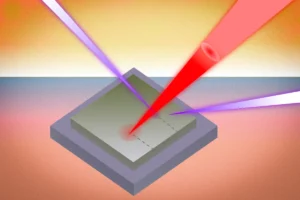
To overcome this limitation, the Caltech research team, led by Harry Atwater, the Howard Hughes Professor of Applied Physics and Materials Science, moved away from electrical modulation entirely. Their approach utilizes a "pump-probe" configuration, where a powerful primary beam of light—the pump—is used to alter the environment for a secondary, weaker beam—the probe.
"Steering light with light is very challenging because light typically interacts very weakly with matter," Professor Atwater noted regarding the fundamental difficulty of the project. To bridge this gap, the team turned to the field of nanophotonics, specifically the development of optical meta-surfaces. These are ultrathin sheets engineered at the nanoscale to possess optical properties not found in naturally occurring materials. By precisely controlling the geometry of these surfaces, the researchers were able to amplify the interaction between light and matter to a degree that allowed for efficient, high-speed steering.
The Physics of the Optical Kerr Effect
The core physical principle behind this new device is the optical Kerr effect. Discovered in the late 19th century, the Kerr effect refers to a change in the refractive index of a material in response to an applied electric field. In the case of the "optical" Kerr effect, that field is provided by the light beam itself.
When an intense pulse of light passes through a material, the oscillating electric field of the light distorts the electron clouds within the atoms. Crucially, in the optical Kerr effect, these electrons are not pushed into separate, long-lasting excited energy states. Instead, their motion within their existing orbitals is briefly modified. Because the electrons do not change energy levels, there is no "relaxation time" required. The change in the material’s refractive index—the measure of how much light bends as it enters the medium—appears and disappears almost instantaneously with the light pulse.
Despite its speed, the optical Kerr effect is notoriously weak. In most materials, even a very powerful laser produces only a negligible change in refractive index, making it insufficient for steering a beam of light by any useful margin. This is where the Caltech team’s engineering of the meta-surface became the deciding factor.
Engineering the Meta-Surface: Nanoscale Silicon Pillars
To amplify the Kerr effect, the researchers fabricated a meta-surface from a thin film of amorphous silicon. This surface was patterned with a dense forest of nanoscale pillars, each carefully designed to be smaller than the wavelength of the light being used. The geometry of these pillars—specifically their height, diameter, and spacing—was calculated to create a phenomenon known as an optical resonance.
When the pump beam hits these nanopillars, the light does not simply pass through. Instead, it becomes "trapped" momentarily, circulating within the pillars. This increases the amount of time the light interacts with the silicon. By extending the interaction time, the researchers effectively multiplied the strength of the optical Kerr effect.
The pump beam is projected onto the meta-surface in a specific pattern. This pattern creates a transient "grating" of altered refractive index across the surface. When the probe beam arrives, it "sees" this grating and is diffracted—or steered—at an angle. In their experiments, the team achieved steering angles of up to 13 degrees. Most importantly, the entire process of appearing and disappearing took only 74 femtoseconds, matching the duration of the laser pulse itself.
Supporting Data and Experimental Results
The experimental data provided in the Nature Nanotechnology paper highlights the precision of the system. The researchers utilized a laser system capable of producing pulses with a duration of 74 quadrillionths of a second. They observed that the switching speed of the steering mechanism was limited not by the material properties of the silicon meta-surface, but by the duration of the pump pulse itself.
- Switching Speed: 74 femtoseconds (fs).
- Steering Range: Up to 13 degrees of angular displacement.
- Efficiency: Significantly higher than previous non-resonant all-optical attempts due to the meta-surface enhancement.
- Material: Amorphous silicon, a material compatible with existing semiconductor manufacturing processes, suggesting a path toward scalability.
Lead author Claudio Hail, who conducted the research as a postdoctoral scholar at Caltech and is now an assistant professor at UC Berkeley, emphasized that the speed limit of the device is currently tethered to the laser technology used to drive it. This implies that as laser technology advances to provide even shorter pulses (attosecond pulses), the meta-surface may be able to respond even faster.
Broader Implications: From 6G to Time Crystals
The implications of femtosecond-scale light steering extend far beyond simple beam redirection. This technology lays the groundwork for several emerging fields in physics and engineering:
- Next-Generation Telecommunications: As the world moves toward 6G and 7G standards, the demand for bandwidth will require switching speeds in the terahertz and petahertz ranges. All-optical steering could allow for data routing at speeds 1,000 times faster than current electronic switches.
- Lidar and Autonomous Systems: High-speed beam steering is essential for Lidar (Light Detection and Ranging) systems used in autonomous vehicles. Current mechanical or slow-electronic steering can limit the resolution and frame rate of a vehicle’s "vision." Femtosecond steering could allow for near-instantaneous 3D mapping of environments.
- Photonic Computing: If light can be used to control light efficiently, the dream of an all-optical computer moves closer to reality. Such a machine would process data using photons rather than electrons, potentially operating at speeds orders of magnitude higher than today’s fastest supercomputers while consuming a fraction of the energy.
- Fundamental Physics (Time Crystals): The researchers noted that this technology could be used to create "synthetic time-varying optical materials." This includes the study of time crystals—structures that repeat not just in space, but in time. Controlling the temporal properties of light at this scale allows physicists to explore new states of matter and unconventional wave phenomena.
Collaborative Research and Funding
The study was a collaborative effort involving experts from multiple prestigious institutions. Alongside Atwater and Hail, the paper was co-authored by Lior Michaeli, now an assistant professor at Tel Aviv University. The cross-continental collaboration underscores the global interest in mastering light-matter interactions at the nanoscale.
The research was supported by a diverse array of funding bodies, reflecting its importance to both defense and fundamental science. Key supporters included the Air Force Office of Scientific Research (AFOSR) through its Meta-Imaging Multidisciplinary University Research Initiative, the Swiss National Science Foundation, the Fulbright Fellowship program, and the Breakthrough Foundation. The fabrication of the meta-surfaces was conducted at the Kavli Nanoscience Institute at Caltech, which provided the high-precision lithography tools necessary to create the nanoscale silicon pillars.
Conclusion and Future Outlook
The development of this 74-femtosecond light-steering device represents a milestone in the field of nanophotonics. By proving that the optical Kerr effect can be amplified through meta-surface engineering to perform practical work, the Caltech team has provided a blueprint for future high-speed optical components.
As the industry looks for ways to move beyond the physical limitations of silicon-based electronics, all-optical solutions like this one provide a promising path forward. The next steps for the research team will likely involve refining the efficiency of the steering and exploring how these meta-surfaces can be integrated into existing fiber-optic and chip-based architectures. With the "electron bottleneck" effectively bypassed, the future of computing and communication appears to be moving at the true speed of light.