The enigmatic interstellar visitor, Comet 3I/ATLAS, continues to confound and captivate astronomers, offering a rare glimpse into the chemical composition of planetary systems beyond our own. Recent observations utilizing the unparalleled capabilities of the Atacama Large Millimeter/submillimeter Array (ALMA), a facility co-managed by the U.S. National Science Foundation’s National Radio Astronomy Observatory (NSF NRAO), have unveiled an astonishing abundance of methanol within the comet. This discovery places 3I/ATLAS in a unique category, with its methanol concentration far exceeding that observed in the vast majority of comets originating from within our solar system.
This finding is more than just an interesting astronomical anomaly; it represents a significant chemical fingerprint from another solar system, providing invaluable data for understanding the diverse processes of planetary formation across the galaxy. "Observing 3I/ATLAS is akin to obtaining a detailed chemical analysis, a veritable fingerprint, from a solar system vastly different from our own," explains Dr. Nathan Roth, lead author of the groundbreaking research and a distinguished professor at American University. "The intricacies of its composition reveal the materials from which it was forged, and its remarkable abundance of methanol is something we simply don’t encounter with such frequency in comets native to our solar neighborhood."
A Chemical Echo from a Distant Star System
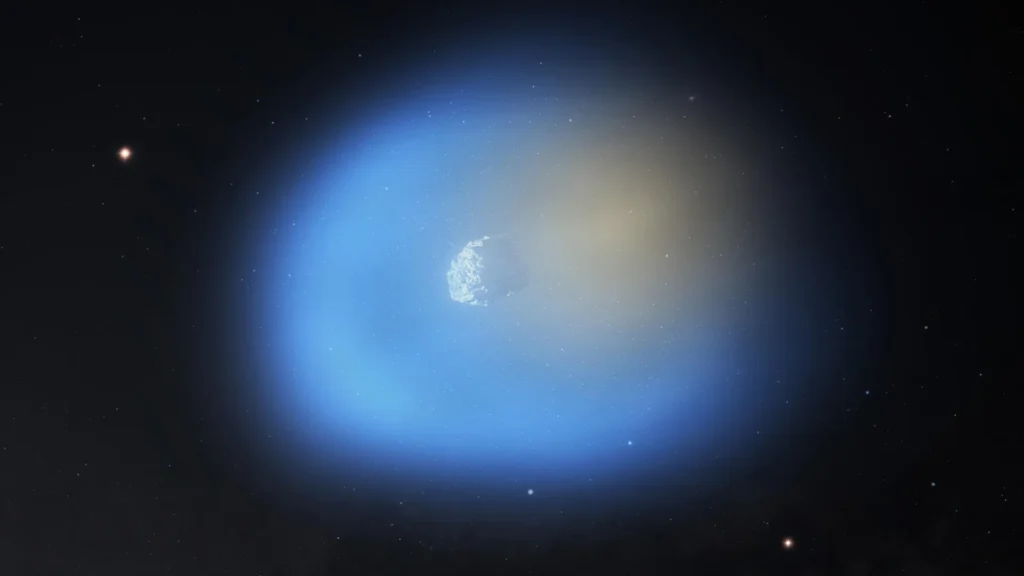
The research team, employing ALMA’s Atacama Compact Array situated in the arid Atacama Desert of Chile, meticulously observed 3I/ATLAS across several dates in late 2025 as the comet embarked on its journey closer to the Sun. As solar radiation intensified, it began to sublimate the comet’s icy surface, releasing volatile gases and dust that coalesced to form a luminous coma – an expansive envelope of material surrounding the comet’s solid nucleus.
By meticulously analyzing the molecular signatures present within this coma, astronomers were able to decipher the chemical inventory carried by the comet. Given that 3I/ATLAS originated from interstellar space, these measurements offer an unprecedented opportunity to investigate the formation conditions of small, icy bodies in exoplanetary systems without the necessity of undertaking arduous interstellar travel. This indirect observational approach allows scientists to probe the building blocks of other worlds from the relative proximity of our own solar system.
The scientific focus of this investigation centered on the faint submillimeter spectral lines emitted by two key molecules: methanol (CH₃OH), a fundamental type of alcohol, and hydrogen cyanide (HCN), a nitrogen-bearing organic molecule that is a common constituent of comets throughout our solar system. The interplay and relative abundances of these molecules are crucial indicators of the chemical environments in which they formed.
ALMA’s exceptional sensitivity and resolution revealed a striking disparity in the presence of these two molecules within 3I/ATLAS. The comet exhibited an exceptionally high ratio of methanol to hydrogen cyanide. On two distinct observation dates, researchers recorded methanol-to-HCN ratios of approximately 70 and 120. These figures firmly position 3I/ATLAS among the most methanol-rich comets ever documented within our solar system, a significant deviation from typical cometary compositions.
Anomalous Chemistry Hints at Unconventional Origins
The pronounced methanol abundance detected in 3I/ATLAS strongly suggests that the ice within this interstellar visitor formed under conditions significantly different from those that prevailed during the formation of most comets in our solar system. Alternatively, the ice may have been exposed to unique chemical processes at some point in its history.
This recent ALMA data complements earlier findings from the James Webb Space Telescope (JWST). In observations conducted when 3I/ATLAS was still traversing the outer reaches of our solar system, JWST data indicated that its coma was predominantly composed of carbon dioxide. The addition of abundant methanol, as revealed by ALMA, further solidifies 3I/ATLAS’s status as an object with an unusual chemical signature, a growing list of characteristics that distinguish it from its solar system counterparts.
ALMA’s advanced imaging capabilities also proved instrumental in tracking the spatial distribution and release mechanisms of different molecules emanating from the comet. The observations highlighted a remarkable divergence in the behavior of methanol and hydrogen cyanide. Hydrogen cyanide, a molecule typically found in the inner regions of cometary nuclei, appears to be primarily released from the comet’s central solid body, or nucleus. This behavior is consistent with that observed in many comets originating from our solar system.
In stark contrast, methanol appears to be liberated not only from the nucleus but also from microscopic ice particles dispersed within the coma itself. This distinct release pattern provides crucial insights into the comet’s internal structure and the thermal processing it has undergone.
The Role of Miniature Cometary Grains
The presence of methanol within these dispersed ice particles suggests that these tiny grains are not merely inert dust but are actively participating in the comet’s outgassing process. As 3I/ATLAS draws nearer to the Sun and its temperature rises, the ice within these microscopic grains sublimates, transforming directly into gas and releasing additional methanol into the surrounding coma. In essence, these small icy grains behave like miniature comets, contributing significantly to the overall composition of the cometary atmosphere.
While this phenomenon of ice sublimation from dispersed particles has been observed in some comets native to our solar system, the current study marks the first instance where the detailed physics of such outgassing processes have been meticulously traced in an object definitively originating from interstellar space. This observation is particularly significant as it allows scientists to directly compare the mechanisms of volatile release in an alien environment with those in our own solar system.
Comet 3I/ATLAS holds the distinction of being only the third confirmed object detected entering our solar system from interstellar space. It follows in the footsteps of the pioneering discoveries of 1I/’Oumuamua in 2017 and 2I/Borisov in 2019. Each of these interstellar visitors has presented its own set of peculiar characteristics, challenging existing models of cometary and asteroidal formation and composition. ‘Oumuamua, for instance, exhibited unusual non-gravitational acceleration and an elongated shape, while Borisov revealed a composition broadly similar to solar system comets but with subtle differences.
The ongoing study of these rare interstellar visitors, each a cosmic emissary from a distant stellar nursery, provides an invaluable opportunity to broaden our understanding of planetary system diversity. By comparing the chemical makeup and physical properties of objects like 3I/ATLAS with those of our own solar system, astronomers can refine theories about the conditions under which planets, comets, and other smaller celestial bodies form around stars throughout the Milky Way galaxy. The peculiar chemistry of 3I/ATLAS, with its exceptionally high methanol content and distinct release mechanisms, adds another compelling piece to the intricate puzzle of cosmic evolution.
Broader Implications for Exoplanetary Science
The discovery of abundant methanol in 3I/ATLAS has profound implications for the field of exoplanetary science. Methanol is a key organic molecule, considered a precursor to more complex organic compounds, including those essential for life as we know it. Its prevalence in an interstellar comet suggests that such molecules are not unique to our solar system and may be widely distributed throughout the galaxy.
This finding supports the growing hypothesis that the building blocks of life are common in the universe. If comets from other star systems carry significant amounts of methanol, they could potentially deliver these organic ingredients to nascent planets, seeding them with the raw materials for prebiotic chemistry. This concept is a cornerstone of astrobiology and fuels the search for life beyond Earth.
Furthermore, the unique formation conditions implied by 3I/ATLAS’s composition could shed light on the diverse environments present in other planetary systems. The high methanol abundance might indicate formation in cooler regions of protoplanetary disks, or perhaps in environments with specific chemical pathways that favor methanol production over other volatile species. Understanding these differences can help astronomers refine their models of exoplanetary system architecture and evolution.
The Power of ALMA in Interstellar Exploration
The role of ALMA in this discovery cannot be overstated. Its unparalleled sensitivity at millimeter and submillimeter wavelengths allows it to detect the faint spectral signatures of molecules in cometary comas that are often invisible to optical telescopes. Moreover, ALMA’s high spatial resolution enables scientists to distinguish between different emission sources within the comet and its coma, providing detailed insights into the distribution and release mechanisms of its constituent molecules.
The Atacama Compact Array, a component of ALMA, is particularly well-suited for observing extended sources like cometary comas, allowing for detailed mapping of molecular abundances and distributions. This capability was critical in differentiating the origins of methanol and hydrogen cyanide from 3I/ATLAS.
A Timeline of Discovery and Analysis
The journey of Comet 3I/ATLAS from interstellar space to our solar system has been a subject of intense astronomical interest.
- Initial Detection: The comet was first detected by the ATLAS (Asteroid Terrestrial-impact Last Alert System) survey in late 2023. Its trajectory was quickly identified as hyperbolic, indicating an origin outside our solar system.
- JWST Observations (Early 2025): The James Webb Space Telescope provided early compositional data, revealing a coma rich in carbon dioxide, suggesting formation in cold outer regions of its parent star system.
- ALMA Observations (Late 2025): The Atacama Large Millimeter/submillimeter Array conducted targeted observations of 3I/ATLAS as it approached the Sun, focusing on specific molecular signatures.
- Data Analysis and Publication (2026): The research team, led by Dr. Nathan Roth, meticulously analyzed the ALMA data, leading to the identification of the unusually high methanol abundance. The findings were subsequently published in a peer-reviewed scientific journal.
Future Prospects and Ongoing Research
The discovery of Comet 3I/ATLAS is a testament to the evolving capabilities of astronomical observatories and the persistent curiosity of scientists. As our observational tools become more sophisticated, and as we continue to catalog and study interstellar visitors, we are gaining an increasingly nuanced understanding of the universe.
Each new interstellar object observed provides a unique data point, contributing to a larger statistical sample that will ultimately allow astronomers to draw more robust conclusions about the frequency of planetary systems, the diversity of their compositions, and the potential for life beyond Earth. The continued study of 3I/ATLAS and future interstellar visitors promises to unlock further secrets of cosmic origins and the prevalence of the chemical ingredients necessary for life. The scientific community eagerly anticipates future observations and analyses that will undoubtedly build upon this remarkable discovery.