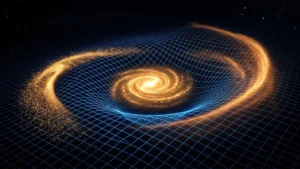
The quest to identify dark matter, the invisible substance that constitutes approximately 85% of the universe’s total matter and about a quarter of its total energy density, has long been the "holy grail" of modern astrophysics. Despite decades of observation confirming its gravitational influence on galaxies and cosmic structures, the fundamental nature of dark matter remains elusive. In a pioneering shift of methodology, a collaborative research team from Kyoto University, Hiroshima University, and Nihon University has proposed and executed a study that effectively transforms the entire planet into a massive dark matter detector. By utilizing the Earth’s own magnetic environment and the resonant properties of the ionosphere, researchers have established new, significantly tighter constraints on two leading dark matter candidates: ultralight axions and dark photons.
For years, the search for dark matter was dominated by the hunt for Weakly Interacting Massive Particles (WIMPs), heavy particles that were expected to appear in high-energy collisions at facilities like the Large Hadron Collider. However, as these searches have continually yielded null results, the scientific community has increasingly turned its attention toward the "ultralight" frontier. These hypothetical particles, including axions and dark photons, are characterized by their extremely low masses—estimated in this study to be between 19 and 21 orders of magnitude lighter than an electron. Because they are so light, they behave more like coherent waves than individual particles, necessitating a different approach to detection than traditional particle physics experiments.
The Earth-Ionosphere Cavity as a Natural Resonator
The core innovation of the Japanese research team lies in the utilization of the Earth-ionosphere cavity. This region, a hollow shell bounded by the conductive surface of the Earth and the lower layers of the ionosphere, acts as a natural electromagnetic resonator. Just as a musical instrument’s body amplifies specific sound frequencies, this planetary cavity amplifies electromagnetic waves at specific frequencies, known as Schumann resonances.
The most famous of these resonances occurs at approximately 7.83 Hz, with harmonics extending into the tens of Hertz. The researchers recognized that if ultralight dark matter particles like axions or dark photons interact with the Earth’s magnetic field, they could potentially convert into photons within this cavity. Because the cavity naturally resonates at frequencies that correspond to the mass range of these ultralight particles, it serves as a powerful, built-in amplifier for signals that would otherwise be too faint to detect in a standard laboratory setting.
"We asked ourselves whether we could use the Earth itself as a giant detector in the search," explained Atsushi Taruya, the corresponding author and a researcher at Kyoto University. This approach bypasses the primary limitation of laboratory-based axion searches: the scale of the magnetic field. While laboratory experiments use incredibly powerful superconducting magnets, they can only influence a volume of a few cubic meters. By leveraging the Earth’s magnetic field, the researchers were able to probe a volume millions of times larger, albeit at a lower magnetic intensity.
Overcoming Theoretical and Technical Hurdles
One of the significant challenges the team faced was the limitation of existing geophysical models. Previous theories regarding the Earth-ionosphere cavity were largely optimized for frequencies below 1 Hz, which excluded much of the interesting mass range for ultralight dark matter. To expand the search, the team developed a sophisticated new theoretical framework that accounted for the electrical conductivity of the atmosphere—a factor often simplified in earlier models.
This new framework allowed the researchers to make reliable predictions for electromagnetic signals up to 30 Hz. The model also highlighted a crucial distinction in how different dark matter candidates would manifest. According to their calculations, signals produced by axions—which require a background magnetic field to convert into photons—would vary significantly based on geographic location. The team identified Southeast Asia as a region where axion-induced signals would likely be strongest due to the specific orientation and strength of the geomagnetic field there. Conversely, dark photons, which do not require an external magnetic field to generate electromagnetic waves, would produce a signal with nearly uniform strength across the globe.
A Decade of Data: The Eskdalemuir Observatory Analysis
To put their theory to the test, the researchers analyzed a massive dataset spanning ten years, from 2012 to 2022. The data consisted of high-precision geomagnetic measurements collected by the British Geological Survey’s Eskdalemuir Observatory. Located in a remote area of Scotland, the Eskdalemuir site is one of the longest-running magnetic observatories in the world and is prized for its "magnetically quiet" environment, which is essential for isolating subtle signals from background noise.
The data processing phase was rigorous. The team had to filter out "artificial noise"—electromagnetic interference from power lines, lightning strikes (which are the primary source of natural Schumann resonances), and solar activity. Once the data was cleaned, they searched for a specific signature: a steady, persistent signal concentrated within an extremely narrow frequency range. Such a "monochromatic" signal is a hallmark of dark matter, which is expected to have a very long coherence time compared to transient terrestrial events.
The researchers employed Bayesian statistical analysis to determine if any detected fluctuations exceeded the threshold of background noise. This method allowed them to set "upper limits" on the strength of the interaction between dark matter and the electromagnetic field. If dark matter were interacting more strongly than these limits, the signal would have been clearly visible in the Eskdalemuir data.
Strengthening the Limits on the Invisible
The results of the study have provided some of the most stringent constraints to date on the properties of ultralight dark matter. By using the Earth-scale detector, the team placed new limits on the axion-photon coupling constant that are approximately 100 times tighter than previous ground-based laboratory experiments for this specific mass range.
Furthermore, these terrestrial results are now competitive with constraints derived from astrophysical observations. Satellites like the Chandra X-ray Observatory and NuSTAR have previously set limits by observing distant galaxy clusters and stars, looking for signs of axion conversion in cosmic magnetic fields. However, astrophysical limits often rely on complex assumptions about the density of plasma and the structure of magnetic fields in deep space. The Earth-based approach offers a more controlled environment where the magnetic field and atmospheric conditions are better understood, providing a vital cross-check for the results obtained from deep-space telescopes.
Intriguing Signals and the Dark Photon Mystery
While the search for axions primarily resulted in more refined limits, the search for dark photons yielded an "intriguing" result. The team identified several signal candidates in the 10-year dataset that could potentially be attributed to dark photon dark matter. These signals appeared as persistent peaks in the electromagnetic spectrum that were not easily explained by known geological or atmospheric phenomena.
However, the researchers have been careful to maintain a professional level of skepticism. "The source of those signals remains unknown, and they have not been confirmed as evidence of dark matter," the study notes. In the field of particle physics, a "signal candidate" is a far cry from a "discovery." The detected peaks could still be the result of undiscovered local interference or subtle periodicities in atmospheric conductivity that the current model does not fully capture. Nevertheless, the presence of these candidates provides a clear roadmap for future research, suggesting specific frequencies that warrant more intense scrutiny with even more sensitive equipment.
Context and Chronology of Dark Matter Research
The concept of dark matter has evolved significantly since Fritz Zwicky first coined the term "dunkle Materie" in 1933 while observing the Coma Cluster. The timeline of discovery highlights the transition from gravitational observation to direct detection attempts:
- 1933: Fritz Zwicky notices that galaxies in clusters are moving too fast to be held together by visible matter alone.
- 1970s: Vera Rubin and Kent Ford provide definitive evidence of dark matter through galaxy rotation curves, showing that stars at the edges of galaxies move as fast as those near the center.
- 1977: Roberto Peccei and Helen Quinn propose the axion as a solution to the "Strong CP Problem" in quantum chromodynamics, later identified as a dark matter candidate.
- 1980s-2000s: The "WIMP" paradigm dominates, leading to the construction of deep underground detectors like LUX and XENON.
- 2010s-Present: Lack of WIMP detection leads to a resurgence in ultralight dark matter theories, including axions and dark photons.
- 2024: The Kyoto-Hiroshima-Nihon team publishes their findings using the Earth-ionosphere cavity, marking a new era of planetary-scale detection.
Implications for the Future of Physics
The implications of this research extend beyond the mere narrowing of parameters for dark matter. It demonstrates a successful "convergence" of geophysics and fundamental particle physics. By proving that planetary infrastructure can be used to probe the smallest building blocks of the universe, the study opens the door for other large-scale natural features to be repurposed for scientific inquiry.
Future iterations of this experiment could involve a global network of geomagnetic observatories. If a signal candidate is detected simultaneously at stations in Scotland, Japan, and Southeast Asia, and its strength varies according to the team’s geographic predictions, it would provide nearly undeniable evidence of dark matter’s existence and identity.
While the mystery of dark matter remains officially unsolved, the development of this new theoretical framework provides a powerful tool for the next generation of physicists. By turning the Earth into a giant sensor, humanity has taken a significant step toward illuminating the "dark" side of the cosmos, moving closer to understanding the invisible scaffolding that holds the universe together. The search now continues, with eyes—and magnetic sensors—pressed firmly against the resonant boundary of our own atmosphere.