Emerson, a global technology and engineering company, has introduced its DeltaV Automation Platform for Data Centers, a comprehensive automation portfolio specifically engineered to address the escalating demands of data centers supporting advanced Artificial Intelligence (AI) workloads. This platform is designed to provide integrated monitoring and control for the critical infrastructure elements—thermal, mechanical, and electrical subsystems—within a scalable automation architecture, marking a significant evolution in how these complex facilities are managed. The move underscores a growing industry recognition of the need for sophisticated, unified control systems to meet the unprecedented operational challenges posed by AI’s rapid expansion.
The AI Imperative: Reshaping Data Center Demands
The exponential growth of AI technologies, from large language models (LLMs) to advanced machine learning and deep learning applications, has fundamentally reshaped the landscape of data center design and operation. Traditional data center infrastructure, often built for more predictable, general-purpose computing, struggles to cope with the unique and intense requirements of AI. AI workloads are characterized by several critical factors that push existing infrastructure to its limits:
- Extreme Power Density: AI servers, often packed with high-performance GPUs, consume significantly more power than conventional CPUs. This leads to rack power densities that can be several times higher, demanding robust and efficient power delivery systems.
- Intensified Cooling Requirements: Higher power consumption directly translates to greater heat generation. Traditional air-cooling methods are often insufficient or inefficient for these high-density environments, necessitating advanced cooling solutions, including direct-to-chip liquid cooling and immersion cooling, which require precise control.
- Compressed Project Timelines: The competitive nature of the AI market and the rapid pace of technological innovation mean that new data centers or expansions must be brought online faster than ever before. This compresses project timelines, increasing coordination requirements across an extensive network of stakeholders, including supply chains, engineering teams, design specialists, electricians, and various project personnel.
- Complex Interdependencies: The intricate relationship between power, cooling, and IT equipment requires seamless coordination. Failures in one subsystem can cascade rapidly, leading to costly downtime and service interruptions.
- Scalability and Flexibility: AI models are constantly evolving, and the computational demands can fluctuate dramatically. Data centers must be designed not only for current needs but also for rapid, flexible scaling to accommodate future technological advancements without significant operational overhaul.
These pressures highlight a critical gap in conventional data center management, which often relies on disparate "point solutions" for different infrastructure components. This fragmented approach leads to integration challenges, increased engineering effort, and inconsistencies in commissioning, operations, and maintenance, ultimately hindering the agility and reliability essential for AI-driven enterprises.
Introducing the DeltaV Automation Platform for Data Centers
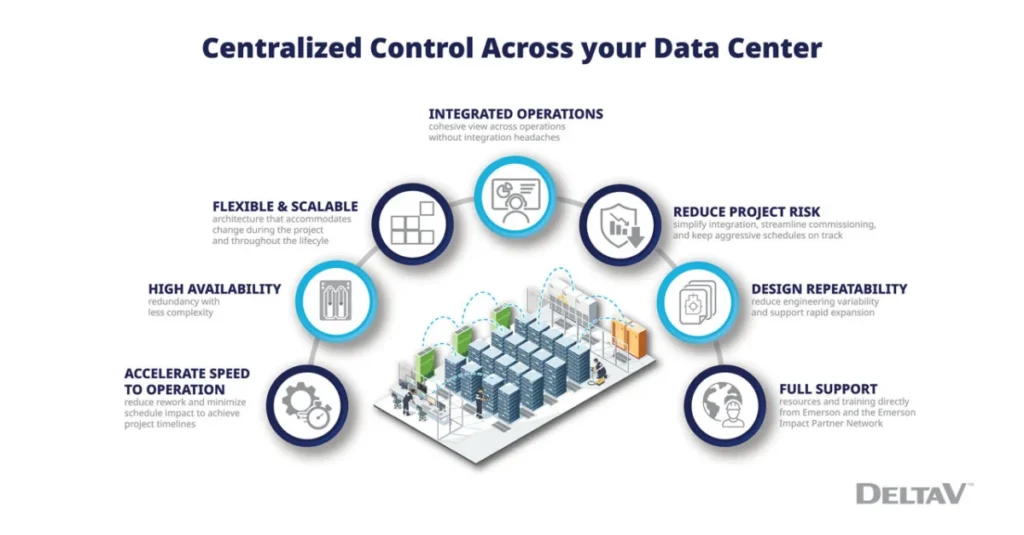
Emerson’s DeltaV Automation Platform directly addresses these challenges by offering a unified control approach. At its core, the platform aims to integrate what were previously siloed systems—thermal management, mechanical infrastructure, and electrical distribution—into a single, cohesive automation architecture. This integration is designed to reduce the complexity inherent in managing modern, high-density AI data centers.
The platform’s strategic advantage lies in its ability to centralize monitoring and control, providing a holistic view of the data center’s operational health. By connecting diverse subsystems, it facilitates a more efficient and responsive infrastructure. This integrated approach replaces the manual coordination efforts and separate management tools with an automated system that can react dynamically to changing conditions, optimize resource utilization, and preemptively address potential issues.
Key features and benefits of the DeltaV Automation Platform for Data Centers include:
- Unified Control and Monitoring: A single pane of glass for managing all critical infrastructure components, simplifying operations and reducing the need for specialized training across multiple systems.
- Reduced Engineering Effort: By providing a standardized and integrated architecture from the outset of project design, the platform significantly lowers the time and resources required for system integration and configuration.
- Improved Consistency: Standardized processes and automated control ensure consistent performance across all subsystems, from commissioning through day-to-day operations and maintenance.
- Enhanced Reliability and Uptime: Proactive monitoring and automated responses to anomalies help prevent failures and minimize downtime, which is crucial for AI workloads where continuous operation is paramount.
- Scalable Architecture: Designed to support large-scale facilities and accommodate future growth, the platform offers the flexibility needed for the rapidly evolving AI landscape.
- Advanced Process Control: Leveraging Emerson’s deep expertise in industrial automation, the platform applies sophisticated control strategies to optimize energy consumption and cooling efficiency.
Core Components: DeltaV DCS and PLCs
The DeltaV Automation Platform for Data Centers is built upon Emerson’s robust and proven DeltaV distributed control system (DCS) and DeltaV programmable logic controllers (PLCs). These components are not new to industrial automation, but their application and integration within the data center context represent a significant innovation.
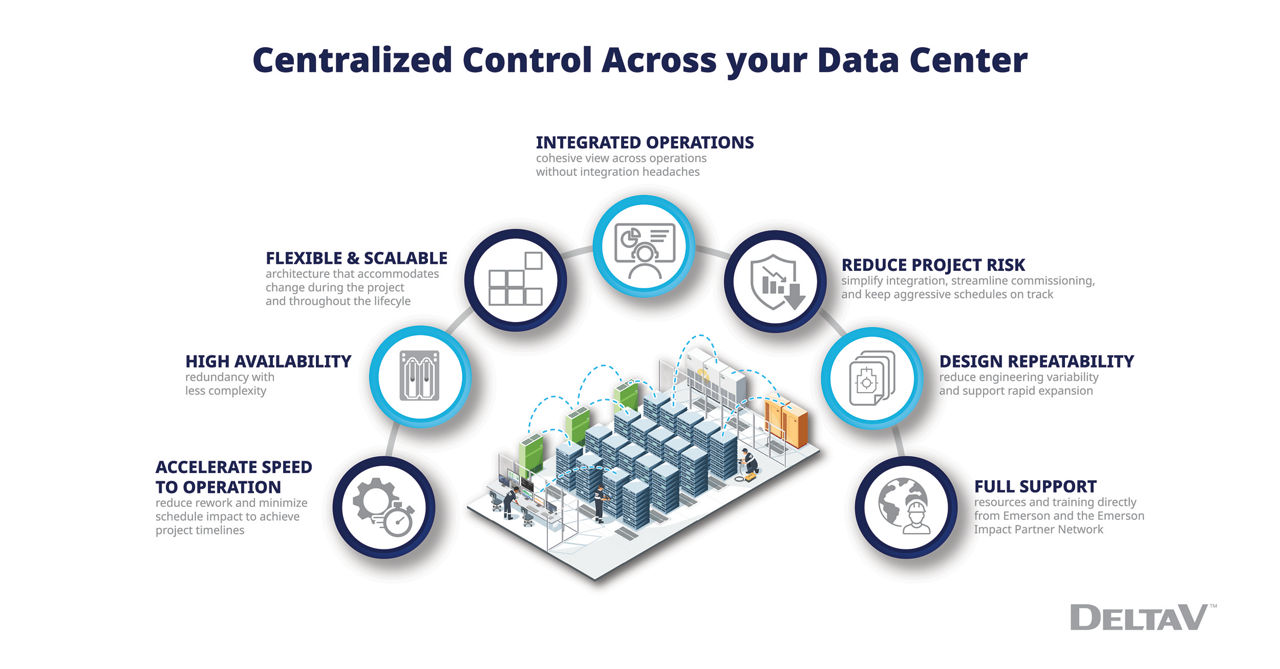
- DeltaV Distributed Control System (DCS): The DCS serves as the central nervous system of the platform, providing system-wide process control and orchestration. It collects data from various sensors and actuators across the data center, processes this information, and executes control strategies to maintain optimal operating conditions. The DeltaV DCS is known for its reliability, scalability, and advanced capabilities in complex process environments.
- DeltaV Programmable Logic Controllers (PLCs): PLCs are deployed at the subsystem level, providing localized control for specific mechanical, electrical, and thermal components. These PLCs connect seamlessly to the DeltaV DCS, feeding data upstream and receiving commands, ensuring a hierarchical and responsive control structure.
A distinguishing feature of this platform is the inclusion of context-specific AI tools within both the DeltaV DCS and DeltaV PLCs. These AI capabilities are intended to:
- Support Engineering Workflows: Automating routine tasks, suggesting optimal configurations, and providing intelligent diagnostics to streamline the design, implementation, and maintenance phases.
- Advanced Process Control: Employing AI algorithms to predict equipment behavior, optimize energy consumption (e.g., dynamic cooling adjustments based on workload forecasts), and fine-tune operational parameters beyond traditional PID control.
- Integration with AI Optimization Models: The platform is designed to interface with higher-level AI optimization models, allowing for predictive maintenance, capacity planning, and overall facility optimization based on real-time data and AI-driven insights.
This synergistic combination of DCS and PLCs, enhanced with AI tools, is engineered to support every phase of a data center’s lifecycle—from initial project execution and cost control during construction to maximizing operating performance and laying the groundwork for future autonomous operations.
Economic and Operational Implications: Why Automation is Critical
The investment in advanced automation platforms like Emerson’s DeltaV is driven by compelling economic and operational imperatives. The global data center market, valued at over $200 billion in 2023, is projected to grow at a compound annual growth rate (CAGR) exceeding 10% through the decade, largely fueled by AI. However, this growth comes with significant challenges related to energy consumption and operational costs.
- Energy Efficiency (PUE): Power Usage Effectiveness (PUE) is a key metric for data center efficiency, with an ideal PUE of 1.0. While average PUE has improved, AI data centers, with their high-density power requirements, face renewed pressure to optimize. Automation plays a crucial role in achieving lower PUE by dynamically managing cooling systems, power distribution, and server workloads to minimize waste. A well-automated system can identify inefficiencies in real-time and make adjustments, potentially reducing energy consumption by 15-30% compared to manually managed facilities.
- Operational Expenditure (OpEx) Reduction: By unifying control and automating processes, the DeltaV platform can significantly reduce the need for manual intervention, specialized labor, and reactive maintenance. This translates directly into lower operational costs over the lifespan of the data center. Predictive maintenance capabilities, powered by integrated AI, can also prevent costly catastrophic failures and extend equipment life.
- Accelerated Time-to-Market: In a rapidly evolving market, the ability to bring new facilities or expansions online quickly is a major competitive advantage. The platform’s integrated design and simplified integration reduce project complexities, helping data center operators meet aggressive deployment schedules. This is particularly vital when considering that the global AI market is expected to surpass $1.8 trillion by 2030, necessitating robust and timely infrastructure build-outs.
- Enhanced Reliability and Resilience: AI workloads are often mission-critical, making any downtime extremely costly. Automation enhances reliability by providing continuous monitoring, immediate fault detection, and automated failover capabilities, ensuring consistent operation even under stress.
- Mitigating Human Error: Complex, high-stakes environments are prone to human error. Automation reduces this risk by executing predefined protocols and making data-driven decisions, leading to more consistent and error-free operations.
Emerson’s Strategic Positioning and Vision
Emerson’s entry into the specialized AI data center automation market with its DeltaV platform is a logical extension of its long-standing expertise in industrial automation and process control. With a history spanning over a century, Emerson has been a pioneer in developing sophisticated control systems for complex industries, from oil and gas to pharmaceuticals and discrete manufacturing. The principles of precision control, reliability, and scalability, honed in these demanding environments, are directly applicable to the challenges of modern data centers.
While Emerson has traditionally focused on industrial processes, the convergence of operational technology (OT) and information technology (IT) has blurred industry lines. Data centers, especially those supporting AI, are increasingly resembling sophisticated industrial plants in terms of their power, cooling, and control requirements. Emerson is strategically leveraging this trend, bringing its robust, industrial-grade automation solutions to a new frontier.
While no direct quotes were provided in the original text, Emerson’s strategic rationale for this launch can be inferred:
"We recognize the transformative impact of AI and the immense pressure it places on data center infrastructure," an Emerson representative might state. "Our DeltaV Automation Platform is a direct response to this need, leveraging decades of expertise in process control to deliver unparalleled efficiency, reliability, and scalability for AI workloads. We are empowering data center operators to accelerate their projects, optimize their operations, and build the foundational infrastructure for the next generation of AI innovation."
This move positions Emerson not just as a technology provider but as a strategic partner in navigating the complexities of AI infrastructure development, emphasizing its commitment to innovation and customer success in a rapidly evolving digital landscape.
Broader Impact and Future Outlook
The introduction of integrated automation platforms like Emerson’s DeltaV signals a broader shift in data center design and operational philosophy. The days of disparate, manually managed infrastructure components are rapidly drawing to a close, especially for facilities catering to high-performance computing and AI.
- Towards Autonomous Data Centers: The context-specific AI tools within the DeltaV platform are a stepping stone towards more autonomous data center operations. As AI and machine learning capabilities become more sophisticated, these platforms can evolve to self-optimize, self-diagnose, and even self-heal, significantly reducing human intervention and maximizing operational efficiency.
- Enhanced Sustainability: With increasing scrutiny on the environmental footprint of data centers, robust automation is key to achieving sustainability goals. By optimizing energy consumption and resource utilization, platforms like DeltaV contribute to a greener data center ecosystem, aligning with global efforts to combat climate change.
- Standardization and Best Practices: The adoption of integrated platforms can drive standardization across the data center industry, leading to more predictable performance, easier replication of successful designs, and the establishment of new best practices for managing AI infrastructure.
- Competitive Landscape: Emerson’s entry with a dedicated platform intensifies the competition among automation and data center infrastructure providers. This will likely spur further innovation in the market, benefiting data center operators with more advanced and integrated solutions. Companies traditionally focused on building management systems (BMS), power management, or cooling solutions will need to evolve their offerings to provide comparable levels of integration and AI-driven intelligence.
In conclusion, Emerson’s DeltaV Automation Platform for Data Centers represents a pivotal advancement in managing the complex infrastructure required for AI workloads. By unifying control across thermal, mechanical, and electrical subsystems and embedding context-specific AI tools, the platform offers a compelling solution to the pressing challenges of power density, cooling, rapid deployment, and operational efficiency. This strategic offering not only leverages Emerson’s rich heritage in industrial automation but also positions the company at the forefront of enabling the next generation of AI-driven innovation, paving the way for more resilient, efficient, and ultimately, autonomous data centers.