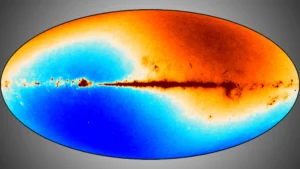
A subtle, persistent background of extremely low-frequency gravitational waves, meticulously detected through a global network of pulsars, has emerged as a potential cosmic Rosetta Stone, holding secrets to events that unfolded more than 13 billion years ago. These ethereal ripples in spacetime could provide critical insights into some of the Universe’s most profound mysteries, including the enigmatic emergence of its earliest supermassive black holes. New research from Colgate University, published as a Letter in Physical Review D, investigates whether the primordial seeds of these colossal cosmic entities could be a dominant source of the gravitational wave background now being measured by Pulsar Timing Arrays (PTAs).
The study, led by Colgate University researchers Sohan Ghodla and Cosmin Ilie, bridges two seemingly disparate realms of astronomical inquiry: the observation of unexpectedly massive black holes in the very young Universe and the gravitational waves generated billions of years later by pairs of supermassive black holes locked in a death spiral. Their findings suggest a compelling connection, proposing that a specific class of early black hole seeds – remnants left behind by hypothetical supermassive Dark Stars – could significantly, and potentially dominantly, contribute to the nanohertz gravitational wave signal that PTAs are now detecting.
"Pulsar timing arrays are usually thought of as probes of supermassive black-hole binaries in the relatively recent Universe," stated Ilie. "What our work shows is that the signal may also contain information about how the ancestors of those black holes formed at cosmic dawn. In that sense, gravitational waves observed today could provide a new window onto the birth of the first supermassive black holes." This assertion underscores the transformative potential of gravitational wave astronomy to peer back into the Universe’s infancy, offering a complementary perspective to traditional electromagnetic observations.
The Universe’s Gravitational Wave Symphony: A Nanohertz Chorus
Gravitational waves, predicted by Albert Einstein’s theory of general relativity over a century ago, are ripples in the fabric of spacetime, propagating at the speed of light. Their direct detection in 2015 by the Laser Interferometer Gravitational-Wave Observatory (LIGO) marked a watershed moment in astrophysics, opening a new window onto the violent, high-frequency events of the cosmos, such as merging stellar-mass black holes and neutron stars. However, LIGO and its counterparts are sensitive to gravitational waves in the kilohertz range.
The gravitational wave background (GWB) probed by PTAs operates at an entirely different, much lower frequency range: nanohertz. These are waves with periods ranging from months to years, meaning their wavelengths can span light-years. Such long-wavelength gravitational waves are theorized to originate from the most massive events in the Universe: the inspiraling and eventual merger of supermassive black hole binaries (SMBHBs) at the centers of colliding galaxies. As galaxies merge, their central SMBHs sink towards the new galactic core, eventually forming a binary system that radiates gravitational waves as it gradually loses energy and spirals inward.
Pulsar Timing Arrays are sophisticated astronomical observatories that leverage the extraordinary precision of pulsars – rapidly spinning neutron stars that emit highly regular beams of radio waves. These pulsars act as cosmic lighthouses, their pulses arriving at Earth with clockwork regularity. Gravitational waves passing through the Milky Way and the intervening space cause minute distortions in spacetime, subtly altering the travel time of these radio pulses. By monitoring an array of these "cosmic clocks" over many years, scientists can detect these tiny deviations, inferring the presence of a stochastic (randomly fluctuating) background of gravitational waves.
International collaborations such as NANOGrav (North American Nanohertz Observatory for Gravitational Waves), the European Pulsar Timing Array (EPTA), the Parkes Pulsar Timing Array (PPTA) in Australia, and the Indian Pulsar Timing Array (InPTA), which collectively form the International Pulsar Timing Array (IPTA), have independently reported compelling evidence for this nanohertz GWB in recent years. These detections represent a monumental achievement, confirming the existence of a pervasive gravitational wave signal across the cosmos. The most widely accepted astrophysical explanation for this background is indeed the collective "hum" of countless supermassive black hole binaries spiraling towards merger in the centers of galaxies throughout cosmic history. Systems whose black holes have a combined mass greater than approximately a billion Suns are particularly potent contributors at the frequencies detectable by PTAs.
The Cosmic Dawn and the Enigma of Early Supermassive Black Holes
While the GWB offers insights into the late stages of SMBH evolution, it also inadvertently shines a light on one of astrophysics’ most enduring puzzles: the origin of supermassive black holes themselves. Observations from powerful telescopes like the James Webb Space Telescope (JWST) and the Chandra X-ray Observatory have repeatedly uncovered surprisingly massive black holes (millions to billions of solar masses) existing at incredibly early epochs of the Universe – at redshifts (z) greater than 6, corresponding to times less than a billion years after the Big Bang. This poses a significant challenge to conventional black hole formation theories, which struggle to explain how these behemoths could have grown so large, so quickly, in the young Universe.
The prevailing hypothesis for SMBH formation involves "seeds" – smaller black holes that then grow by accreting gas and merging with other black holes. However, the early appearance of massive SMBHs necessitates "massive seeds" – black holes that are already substantial (hundreds to hundreds of thousands of solar masses) from their inception, rather than forming from the remnants of individual massive stars (which typically produce stellar-mass black holes of tens of solar masses). Understanding these early formation mechanisms is crucial for completing our picture of galaxy evolution, as SMBHs are known to co-evolve with their host galaxies, influencing their star formation rates and overall structure.
Tracing Ancient Seeds Through Cosmic Time
Ghodla and Ilie’s study directly tackles this enigma, investigating whether the descendants of such ancient, massive black hole seeds could persist through cosmic time, grow alongside their host galaxies through accretion and mergers, eventually pair up during galaxy collisions, and ultimately generate the gravitational wave background detected billions of years later by PTAs. Their research focused on two leading theoretical pathways for producing massive black hole seeds in the early Universe:
-
Direct Collapse Black Holes (DCBHs): This scenario proposes that under very specific, rare conditions in the early Universe, pristine gas clouds (devoid of heavy elements, or "metals") could collapse directly into massive black holes, bypassing the stellar phase. This requires strong ultraviolet radiation fields to suppress the formation of molecular hydrogen, which would otherwise cool the gas and allow it to fragment into smaller stars. These DCBHs could form with initial masses ranging from 10^4 to 10^6 solar masses. However, the conditions required for their formation are thought to be quite restrictive, suggesting a relatively low number density in the early Universe.
-
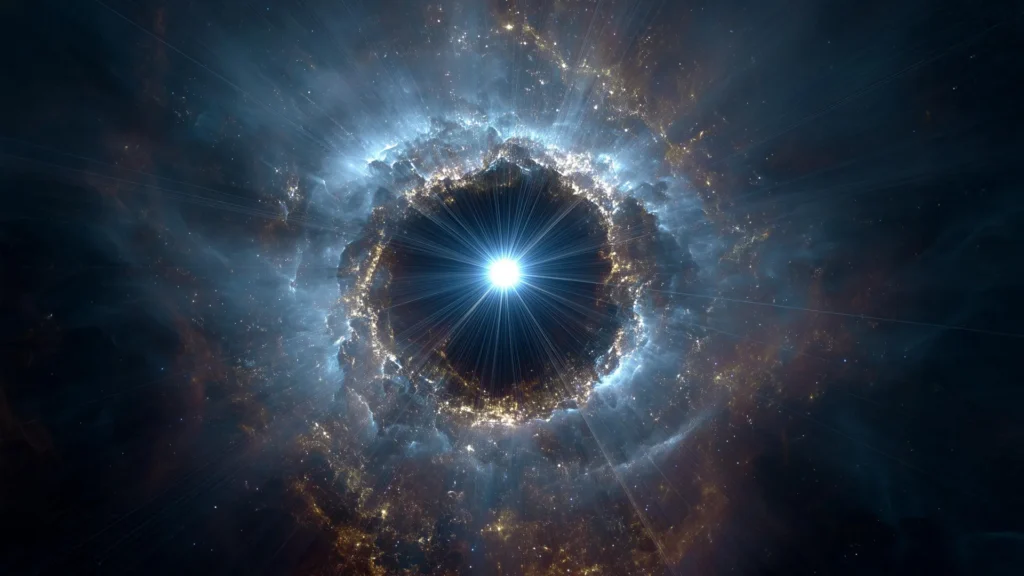
Supermassive Dark Stars (SMDS) Remnants: This more exotic, yet increasingly compelling, hypothesis posits the existence of "Dark Stars" during the cosmic dawn. Unlike conventional stars powered by nuclear fusion, Dark Stars are powered primarily by the annihilation of Weakly Interacting Massive Particles (WIMPs) – a leading candidate for dark matter – accumulated in their cores. If the early Universe contained a sufficient density of WIMPs, these particles could collect in the centers of primordial gas clouds, providing an internal heating source that prevents the cloud from collapsing into smaller, ordinary stars. Instead, these Dark Stars could remain relatively cool and extended, continuing to gather material from their surroundings. Under the right conditions, they could grow to immense sizes, potentially reaching masses of a million times that of the Sun or more, before eventually exhausting their dark matter fuel and collapsing into massive black holes.
The Colgate researchers developed sophisticated models to track the cosmic evolution of black holes born from these two pathways. They simulated how these nascent black holes would reside within dark matter halos (the gravitational scaffolding of galaxies), how frequently they would merge with other black holes as their host galaxies collided, and critically, how much gravitational wave radiation those mergers would produce over billions of years.
Dark Stars: A Dominant Contributor to the Gravitational Wave Hum?
The results of Ghodla and Ilie’s modeling proved particularly illuminating, especially concerning the role of supermassive Dark Stars. Their calculations indicate that if remnants of supermassive Dark Stars existed at a number density of approximately 10^-3 cubic megaparsecs (Mpc^-3) – meaning roughly one such black hole seed per thousand cubic megaparsecs – their descendants could potentially provide a large, and possibly dominant, share of the gravitational wave signal currently measured by PTAs. A megaparsec is an astronomical unit of distance, roughly 3.26 million light-years, so 10^-3 Mpc^-3 represents a significant but not overly abundant population.
In contrast, the direct collapse black hole population considered in the study appears likely to have been much less common. With characteristic densities near 10^-6 Mpc^-3 (one black hole seed per million cubic megaparsecs), these objects would contribute substantially less to the observed gravitational wave background. This distinction highlights the potential power of PTA observations to differentiate between competing models of early black hole formation.
"Produce too many of these massive seeds and you end up over-producing the PTA-detected signal. Produce too few, and you need other sources to efficiently assemble these supermassive black holes later in the life of the universe to match PTA observations," explained Ghodla, emphasizing the delicate balance required to reconcile theoretical models with observational data. Within the models examined, seed densities in the range of 10^-2 to 10^-1 Mpc^-3 would begin generating more gravitational wave background than current PTA observations allow, setting crucial upper limits on their early abundance. The exact limit is sensitive to the masses of the dark matter halos where these seeds initially formed.
Gravitational Waves: A New Lens on Cosmic Dawn
One of the study’s most profound conclusions is the unexpected capacity of current PTA measurements to place stringent limits on how common the earliest seeds of supermassive black holes could have been. This implies that gravitational wave astronomy offers an entirely novel way to probe the conditions and processes of the Universe’s earliest epochs, specifically at redshifts greater than 10, when the first stars and galaxies were forming. Even though the mergers of their descendants that create the gravitational waves happen much later in cosmic history, the characteristics of these waves retain an imprint of their ancient origins.
The calculations further support an earlier finding that binaries with total black hole masses roughly above 10^9 solar masses (a billion times the mass of our Sun) overwhelmingly dominate the predicted PTA signal. Binary systems containing less massive black holes contribute far less, reinforcing the idea that the GWB is primarily a probe of the most massive black holes in the Universe.
Connecting the Cosmic Tapestry: Dark Matter, Dark Stars, and Black Holes
The findings of Ghodla and Ilie weave together several of the most significant unsolved questions in modern cosmology. They forge a new observational link between the elusive nature of dark matter, the hypothetical existence of Dark Stars, the formation mechanisms of the first luminous objects and supermassive black holes, and the gravitational waves that ceaselessly traverse the Universe.
"Dark Stars were originally proposed as objects that might be seen directly at cosmic dawn," Ilie noted, referring to potential future observations by telescopes like JWST. "This work points to a completely different way of testing their possible role in cosmic history. Their descendants could leave a gravitational-wave imprint that persists all the way to the present-day Universe." This multi-messenger approach – combining gravitational wave astronomy with electromagnetic observations – promises a more complete and nuanced understanding of cosmic evolution.
Future Outlook and Implications
The implications of this research are far-reaching. If supermassive Dark Stars prove to be significant contributors to the GWB, it would lend substantial support to models involving WIMP dark matter, providing a unique astrophysical probe for the particle nature of dark matter. It would also revolutionize our understanding of how the Universe’s first massive structures formed, offering a compelling explanation for the rapid emergence of early supermassive black holes.
As Pulsar Timing Array measurements become even more precise, and astronomers continue to refine their understanding of distant black holes and the intricate dynamics of the galaxies that host them, researchers may soon be able to distinguish more clearly among the competing explanations for how the Universe’s first supermassive black holes formed. Future upgrades to PTA sensitivity, coupled with advances in theoretical modeling and complementary data from next-generation electromagnetic telescopes, will undoubtedly unlock further insights into the profound connections between the smallest particles of dark matter and the largest gravitational waves in the cosmos, painting an ever-clearer picture of the Universe’s tumultuous yet magnificent history. This convergence of diverse astronomical probes is pushing the boundaries of discovery, allowing humanity to reconstruct the story of our Universe from its earliest moments to the present day.