Europe is grappling with an unprecedented summer of extreme heat in 2026, as a series of relentless heat waves shatter temperature records and impose a severe toll on the continent. What began as an unusually warm spring has escalated into a summer of prolonged and dangerous heat, impacting public health, infrastructure, agriculture, and the natural environment across Western Europe and beyond.
An Unforeseen Escalation of Heat
The first signs of an atypical summer emerged in May 2026. A powerful heat dome settled over Western Europe, ushering in "exceptional temperatures" that broke records in numerous countries. This early heatwave, while remarkable in itself, proved to be merely a precursor to the more severe conditions that would define the rest of the summer. By mid-August, European nations were enduring their fifth major heatwave of the season. The latest and most intense of these events saw temperatures soar well above 40 degrees Celsius (104 degrees Fahrenheit) across vast swathes of the continent. These periods of extreme weather were characterized by relentless heat, persisting for days, and in some instances, weeks, with little respite even during nighttime hours.
The Unfolding Crisis: Health, Infrastructure, and Environment
The sustained and extreme temperatures have profoundly disrupted daily life in a region not typically accustomed to such climatic conditions. Public health systems have been pushed to their limits, with significant spikes in hospitalizations and heat-related fatalities. The stark reality of the heat’s impact on human life is underscored by preliminary reports suggesting that over 10,000 excess deaths may be linked to the heatwaves, with substantial numbers recorded in the United Kingdom, France, Germany, and Belgium.
Beyond the immediate health crisis, critical infrastructure has buckled under the strain. Highways and railway tracks have warped and buckled, leading to widespread road closures and significant disruptions to public transportation services. These infrastructure failures not only impede daily commutes and commerce but also strain emergency response capabilities.
The parched landscapes, exacerbated by a severe drought that has gripped the region for months, have become tinderboxes. Large and destructive wildfires have erupted in areas where such events were once a rarity, transforming familiar landscapes into scenes of devastation. The Copernicus European Drought Observatory has documented severe drought conditions, leading to record-low water levels in major European rivers. This hydrological crisis has had cascading effects, disrupting water and power supplies, further hindering transportation routes, and devastating agricultural yields.
A Visual Chronicle of the Heat
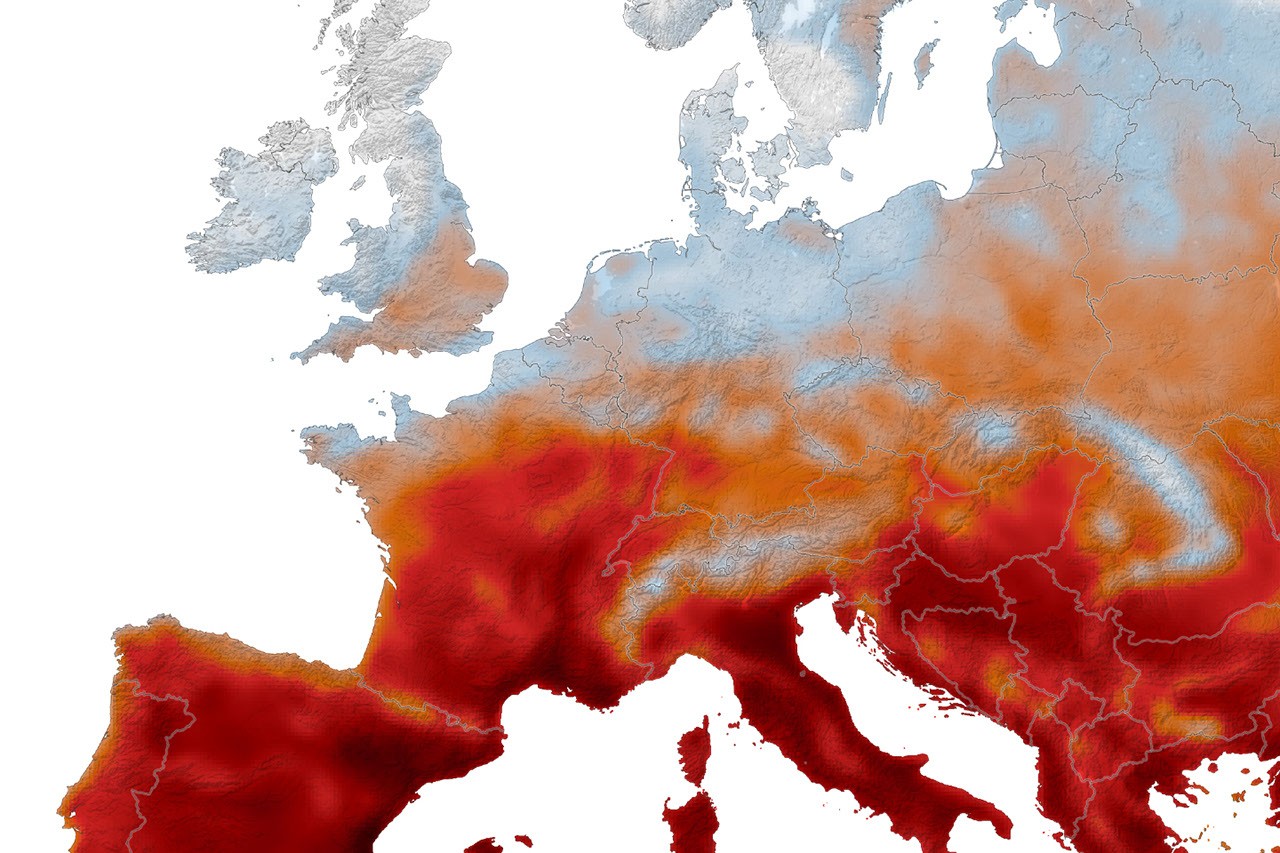
The animation provided by NASA’s Earth Observatory, utilizing data from the GEOS-FP system, offers a compelling visual narrative of the unfolding crisis. This animation, which depicts daily maximum surface air temperatures across Western Europe from May 1 to August 19, 2026, vividly illustrates the pervasive nature of the heat. The darkest red areas on the map, indicating temperatures meeting or exceeding 40 degrees Celsius (104 degrees Fahrenheit), highlight the extent and intensity of the heat dome.
The data reveals a pattern of record-breaking temperatures occurring with alarming frequency and magnitude. In London, for instance, the UK Met Office verified a temperature of 35.1 degrees Celsius (95.2 degrees Fahrenheit) on May 26, a staggering 2.3 degrees Celsius (4.1 degrees Fahrenheit) above the previous May record. Bordeaux, France, experienced a particularly brutal June, with its maximum temperature record being broken on three consecutive days, culminating in a scorching 42.5 degrees Celsius (108.5 degrees Fahrenheit) on June 24, as reported by Météo-France. Slovakia, meanwhile, registered new national records for both daytime and nighttime highs in August, underscoring the widespread nature of the heat. Europe’s Copernicus climate monitoring service confirmed that combined June and July temperatures across Western Europe were the highest on record.
Vulnerabilities Exposed: The Air Conditioning Deficit
A critical factor amplifying the severity of the heatwave’s impact in Europe is the region’s limited access to air conditioning. Compared to the United States, where an estimated 90 percent of homes are equipped with air conditioning, the International Energy Agency reports that only 23 percent of European households have such systems. This disparity directly contributes to the higher rates of heat-related illness and mortality observed in European cities during heatwaves when contrasted with comparable American urban centers.
Dr. Anamika Shreevastava, a researcher at New York University specializing in urban heat islands, highlights the immediate and critical nature of the air conditioning issue. Her research, which involved producing thermal maps based on NASA data, aims to equip city planners with tools to enhance urban resilience against heatwaves. "Air conditioning is an especially critical issue in Europe in the short term," stated Dr. Shreevastava, emphasizing the need for rapid interventions. She further noted that in the longer term, cities can implement strategies such as planting trees, expanding green spaces, utilizing reflective roof paints, and adopting building materials that retain less heat to mitigate urban heat island effects.
The Global Context of Heat Stress
The events in Europe are not isolated incidents but part of a broader global trend of increasing heat stress. The World Health Organization (WHO) identifies heat stress as the world’s leading cause of weather-related deaths. This condition significantly exacerbates pre-existing health issues, including cardiovascular disease, diabetes, mental health conditions, and asthma. Global estimates suggest that approximately 489,000 heat-related deaths occur annually, with Asia accounting for 45 percent and Europe for 36 percent of these fatalities.
The Disproportionate Impact on Vulnerable Populations
The elderly are particularly susceptible to the dangers posed by extreme heat. Deborah Carr, a sociologist at Boston University specializing in aging, points out that temperatures as low as 26.7 degrees Celsius (80 degrees Fahrenheit) can pose significant risks to older adults with underlying health conditions. "Nighttime heat is especially harmful for older adults whose homes lack air conditioning," Carr stated, emphasizing the critical role of nighttime cooling in preventing heat-related mortality.
Research teams, including one involving Dr. Carr, have utilized demographic data alongside temperature and climate projections from NASA archives to identify regions most at risk from current and future heat exposure. Their findings consistently point to Southern Europe as an area facing escalating heat exposure coupled with a growing elderly population, a demographic profile that amplifies the vulnerability to heatwaves.
Further underscoring the critical role of demographics, a study published in Lancet Planetary Health in August 2026 analyzed the interplay between rising global temperatures and human tolerance. Led by Stanford researcher Qinqin Kong, the study mapped areas where increasing heat is projected to lead to intolerable conditions for various age groups in the coming decades. The research concluded that safe thermal thresholds will be breached frequently and across vast regions, with older adults bearing a disproportionately higher risk.
"The human body can tolerate only a limited range of ambient heat," explained Kong, a recipient of a NASA Earth and Space Science and Technology award. "Understanding where, when, and to what extent these limits are exceeded is critical." Kong and his colleagues aim for their findings to inform the development of targeted heat action plans, enhance emergency preparedness, and bolster the planning of healthcare systems in anticipation of more frequent and intense heat events.

Timeline of the 2026 European Heatwaves:
- May 2026: An early heat dome brings record-breaking temperatures to Western Europe, serving as a precursor to the summer’s more intense heat.
- June 2026: Bordeaux, France, experiences three consecutive days of record-breaking maximum temperatures, reaching 42.5°C on June 24. Combined June and July temperatures across Western Europe are the highest on record.
- July 2026: Preliminary reports emerge indicating potentially over 10,000 heat-related deaths across Europe, with significant numbers in the UK, France, Germany, and Belgium. Severe drought conditions continue to grip the region.
- August 19, 2026: The date of the NASA Earth Observatory’s "Image of the Day" feature, highlighting the ongoing and severe heatwave impacting Europe. Slovakia sets new national records for both daytime and nighttime highs.
- August 2026 (late): A study published in Lancet Planetary Health details the disproportionate risks of extreme heat to older adults and identifies Southern Europe as a high-risk zone.
Broader Implications and Future Preparedness
The summer of 2026 serves as a stark and urgent wake-up call regarding the intensifying impacts of climate change. The interconnected crises of heatwaves, drought, and wildfires highlight the fragility of European infrastructure and societal systems when faced with extreme weather events. The prolonged and severe nature of these heatwaves underscores the need for immediate and long-term adaptation strategies.
Beyond the immediate need for increased access to cooling technologies and improved urban planning, the events of 2026 emphasize the critical importance of global cooperation in addressing climate change. The findings from researchers like Dr. Shreevastava and Ms. Kong point towards a future where heat extremes will become more commonplace, necessitating a proactive and multi-faceted approach to safeguarding public health and ensuring societal resilience. The data and analysis from organizations like NASA and the WHO provide the scientific foundation for developing and implementing effective mitigation and adaptation measures. The challenge now lies in translating this scientific understanding into tangible actions that can protect vulnerable populations and build a more resilient future in the face of a warming planet.