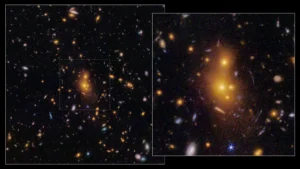
For decades, the cosmic ledger has failed to balance, leaving astronomers and physicists with a profound mystery regarding the fundamental composition of our universe. While the luminous stars, swirling galaxies, and vast nebulae that populate the night sky represent the most visible aspects of our reality, they account for only a fraction of the "ordinary" matter that should exist based on theoretical models of the early universe. This discrepancy, often referred to as the "missing baryon problem," has now been addressed by a team of researchers at the Massachusetts Institute of Technology (MIT) and the CHIME/FRB Collaboration. By utilizing the precise signatures of fast radio bursts (FRBs)—millisecond-long flashes of radio waves from deep space—scientists have successfully mapped the location of this missing matter, discovering that it resides in enormous, diffuse clouds far beyond the traditional boundaries of galaxies.
The Mystery of the Missing Baryons
To understand the significance of this discovery, one must first look back to the origins of the universe. In the immediate aftermath of the Big Bang, the distribution of matter was established with remarkable precision. Standard cosmological models, supported by observations of the Cosmic Microwave Background (CMB) and Big Bang Nucleosynthesis, indicate that the universe is composed of approximately 27 percent dark matter and 5 percent ordinary matter, with the remainder being dark energy. Within that 5 percent of ordinary matter—technically known as baryonic matter, which consists of protons and neutrons—only about 17 percent was expected to be invisible dark matter’s "luminous" counterpart.
However, when astronomers totaled the mass of every star, planet, and gas cloud observable through traditional telescopes, the numbers fell drastically short. Nearly half of the baryonic matter that should exist in the modern universe was nowhere to be found. This led to a decades-long hunt for the "missing baryons." Scientists hypothesized that this matter was not truly gone but was instead hidden in the vast, near-empty voids of intergalactic space, existing at such low densities that it remained invisible to even the most sensitive optical and X-ray instruments.
Fast Radio Bursts: Cosmic Measuring Sticks
The breakthrough in locating this elusive matter came from an unexpected source: fast radio bursts. First discovered in 2007, FRBs are among the most energetic and mysterious phenomena in the cosmos. These bursts release as much energy in a fraction of a second as the Sun does in several days, yet their exact origins remain a subject of intense study, with theories ranging from highly magnetized neutron stars (magnetars) to cataclysmic stellar collisions.
What makes FRBs particularly valuable for mapping the universe is a phenomenon known as dispersion. As a radio signal travels through space, it interacts with free electrons found in the intergalactic medium. These electrons act as a sort of cosmic "fog," slowing down the lower-frequency (redder) radio waves more than the higher-frequency (bluer) ones. By the time the signal reaches Earth-based telescopes, it has been "smeared" or stretched out in time.
The degree of this smearing, or the "dispersion measure," provides a direct calculation of how much matter the signal encountered during its multi-billion-year journey. The more matter the signal passes through, the more pronounced the delay between the high and low frequencies becomes. By analyzing these smears, the MIT-led team could effectively "weigh" the invisible gas between the source of the burst and our telescopes.
A Massive Data Synthesis: CHIME and DESI
The research, recently published in the journal Physical Review Letters, relied on the synergy between two of the world’s most powerful astronomical surveys. The first is the Canadian Hydrogen Intensity Mapping Experiment (CHIME), located at the Dominion Radio Astrophysical Observatory in British Columbia. CHIME’s unique stationary design and massive digital processing power allow it to monitor the entire northern sky, making it the world’s most prolific "FRB hunter." Since its inception, CHIME has detected thousands of these elusive signals.
The second critical component was the Dark Energy Spectroscopic Instrument (DESI), located at the Kitt Peak National Observatory in Arizona. DESI is tasked with creating the most detailed 3D map of the universe ever attempted, measuring the positions and distances of tens of millions of galaxies.
The MIT team, led by graduate student Haochen Wang and Associate Professor Kiyoshi Masui, cross-correlated 2,870 FRB detections from the CHIME catalog with the locations of over 6 million galaxies mapped by DESI. By overlaying the radio burst paths with the known distribution of galaxies, the researchers could distinguish between the matter contained within the galaxies themselves and the matter lingering in the space surrounding them.
Discovering the Galactic Fountains
The results of this analysis were startling. The team found that the missing baryonic matter is indeed concentrated around galaxies and galaxy clusters, but it is distributed in a far more diffuse and expansive manner than previously predicted. While a typical galaxy might span a few hundred thousand light-years, the researchers detected "halos" of missing matter extending as far as 4 million light-years into the intergalactic void.
"We find that, overall, where there are more galaxies, there tends to be more missing matter around them," explained Haochen Wang. "But these clouds extend out from the galaxies to much further distances than scientists had predicted."
This discovery suggests that galaxies are not self-contained islands of matter but are instead part of a much larger, messier ecosystem. The researchers describe this phenomenon as "galactic fountains." The intense energy generated by supermassive black holes at the centers of galaxies, combined with the explosive power of supernovae (dying stars), acts as a cosmic bellows. These processes create powerful jets and winds that physically blow baryonic gas out of the galaxy’s gravitational "well" and into the surrounding space.
The fact that this matter is found 4 million light-years away indicates that these galactic "engines" are far more violent and energetic than current computer simulations suggest. The "push" required to move matter across such vast distances implies that the feedback mechanisms within galaxies are incredibly potent.
A Timeline of the Missing Baryon Search
The resolution of the missing baryon problem marks the culmination of a scientific journey that began in the late 20th century:
- 1990s: Theoretical cosmologists identify the "Baryon Budget" discrepancy, noting that observed matter in the local universe does not match the density of the early universe.
- 1998: Simulations suggest the missing matter might exist as a "Warm-Hot Intergalactic Medium" (WHIM), a tenuous plasma of ionized gas.
- 2007: The first Fast Radio Burst (the Lorimer Burst) is identified in archival data, though its utility as a cosmological probe is not yet fully realized.
- 2018: The CHIME telescope begins full operations, drastically increasing the rate of FRB detections.
- 2020: The late Jean-Pierre Macquart and his team use a small sample of localized FRBs to provide the first evidence that missing baryons reside in the intergalactic medium, establishing the "Macquart Relation."
- 2024: The MIT-led study uses a massive statistical sample to map the specific shape and extent of this matter, confirming its relationship with galactic activity.
Broader Implications for Astrophysics
The implications of this study extend beyond simply "finding" lost matter. Understanding the distribution of baryons is essential for refining our models of galaxy formation and evolution. If galaxies are constantly losing and perhaps re-accreting gas through these massive fountains, it changes our understanding of how stars are born and how galaxies grow over billions of years.
Furthermore, the study validates the use of FRBs as one of the most important new tools in the "precision cosmology" era. Unlike traditional light, which can be blocked by dust or diluted by distance, the dispersion of radio waves provides a clean, mathematical way to probe the large-scale structure of the universe.
Kiyoshi Masui, associate professor of physics at MIT, noted the transformative nature of this methodology. "We’re finding missing matter that is pushed out to larger scales. These measurements indicate that star activity, and activity from black holes, is stronger and much more violent than predicted. We got it to work for the first time, and will get it to work even more precisely as data gets better."
Future Research and Global Collaboration
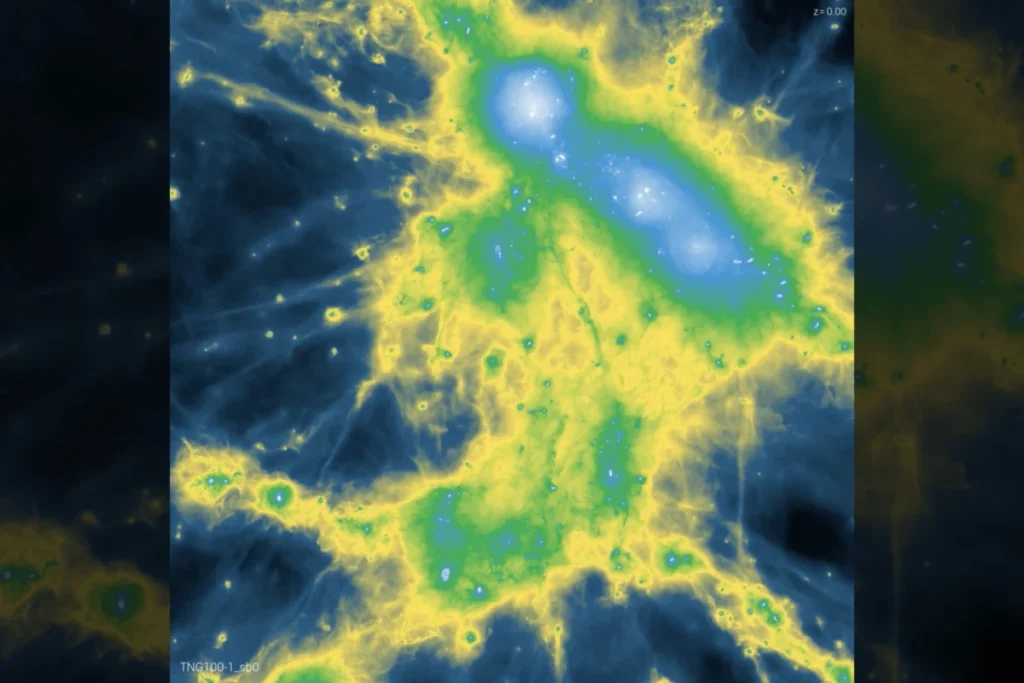
As CHIME and other radio telescopes like the Square Kilometre Array (SKA) continue to populate the FRB catalog, the precision of these "matter maps" will only increase. Scientists hope to eventually use these signals to map the "Cosmic Web"—the vast network of dark matter filaments that serves as the scaffolding of the universe.
The study was a massive collaborative effort, involving researchers from MIT’s Kavli Institute for Astrophysics and Space Research, the University of British Columbia, McGill University, and several other international institutions. Funding and support were provided by the Canada Foundation for Innovation, the Natural Sciences and Engineering Research Council of Canada, and the U.S. National Science Foundation.
By bridging the gap between the invisible and the observable, the CHIME/FRB Collaboration has not only solved a 30-year-old puzzle but has also opened a new window into the violent, energetic processes that shape the cosmos. The "missing" matter was never truly gone; it was simply waiting for a signal bright enough, and a telescope sensitive enough, to reveal its presence in the dark.