Favre Leuba, a venerable Swiss watchmaking house with roots stretching back to 1737, occupies a unique space in the horological landscape. While its lineage places it among the oldest watch brands in existence, surpassed only by Blancpain, its journey through recent decades has been characterized by a series of strategic relaunches, each aimed at redefining its identity and recapturing its historical significance. This dynamic history, marked by periods of reinvention, means that Favre Leuba may not always command the immediate recognition among watch enthusiasts that more consistently visible heritage brands enjoy. However, a deeper dive into the company’s archives reveals a rich tapestry of innovation and a commitment to pushing the boundaries of watchmaking.
A Legacy Forged in Centuries: The Favre Leuba Chronology
The story of Favre Leuba begins in the picturesque Swiss Jura town of Le Locle, where Abraham Favre commenced his watchmaking endeavors in 1737. This foundational period laid the groundwork for a family legacy that would evolve over generations. By 1792, under the astute stewardship of Abraham’s son and two grandsons, the family business officially transitioned into A. Favre & Fils, signifying its growing stature and formal structure. The year 1815 marked a pivotal moment when the fourth generation of the Favre family joined forces with August Leuba. This collaboration gave birth to the iconic Favre-Leuba name, a brand that would soon become synonymous with pioneering advancements in timekeeping.

The subsequent century and a half witnessed a steady stream of significant horological achievements from Favre-Leuba. The brand distinguished itself with the development of complex mechanisms, including single-button chronographs that offered unprecedented ease of use for their time. Its commitment to exploration and precision was evident in its early forays into creating instruments like altimeters and barometers, catering to the needs of adventurers and scientists. Furthermore, Favre-Leuba engaged in notable collaborations, including a significant partnership with Jaeger-LeCoultre, a testament to its standing within the elite circles of Swiss watchmaking.
Navigating the Quartz Crisis and Subsequent Realignments
Like many esteemed Swiss watch manufacturers, Favre Leuba faced an existential threat with the advent of the Quartz Crisis in the latter half of the 20th century. The disruptive wave of affordable and accurate quartz timepieces severely impacted traditional mechanical watchmaking. This challenging era saw the conclusion of the Favre family’s direct involvement in the business, with the eighth generation being the last to lead the company. Ownership subsequently passed through several hands, including Benedom SA, LVMH, and Valentin SA.
A significant chapter in the brand’s recent history began in 2011 when Titan Company Limited acquired Favre Leuba. It was under this ownership that the innovative Raider Harpoon watch, which has garnered considerable attention, was developed. The Raider series itself was conceived as a modern interpretation of the brand’s cushion-cased watches from the late 1960s and early 1970s. These new iterations were characterized by an upscale in both case diameter and water resistance, aiming to blend vintage appeal with contemporary performance. The brand’s trajectory continued to evolve, with another ownership change occurring in 2023, ushering in a new era of relaunched collections, with one notable collection drawing inspiration from an earlier, formative period in Favre Leuba’s rich history.

The Raider Harpoon: A Unique Approach to Time Display
The author’s personal encounter with Favre Leuba’s innovative spirit occurred in 2018 at London’s SalonQP event, where the Raider Harpoon immediately captured his attention. What set this timepiece apart was its ingenious method of displaying time using a single hand. While other brands, such as Meistersinger, also employ single-hand time displays, the author’s previous experience with such watches had revealed a certain frustration with the inherent imprecision. The Raider Harpoon, however, presented a novel solution that mitigated this common drawback.
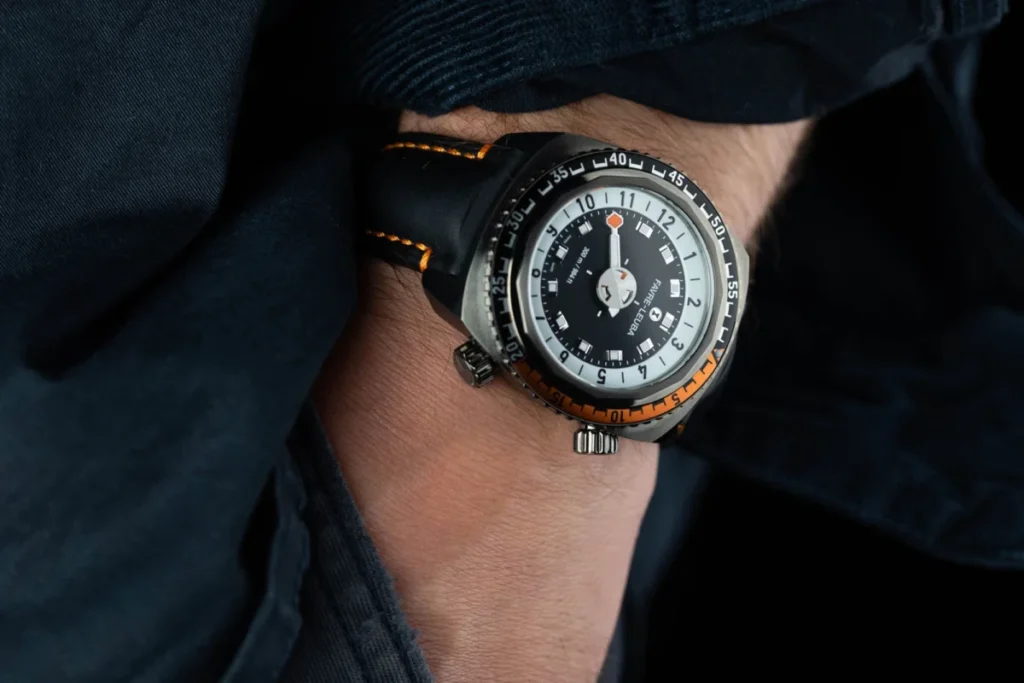
The genius of the Raider Harpoon’s display lies in its intricate mechanism. The minute hand completes a full 360-degree rotation within an hour, as is standard. However, the outer hour ring rotates at a slower pace, completing only 330 degrees in the same timeframe. This differential movement creates a dynamic and intuitive reading experience. When the 12 o’clock marker is perfectly aligned at the top of the dial and the minute hand points directly at it, indicating the top of the hour, an hour later, the 1 o’clock marker assumes the prime position at the apex. While this system necessitates a brief mental adjustment—requiring the wearer to first note the minute hand’s position and then identify the two hour markers it lies between—it ultimately offers a more integrated way of perceiving time. Once mastered, the simultaneous reading of hours and minutes becomes remarkably efficient, foregoing the separate scanning of two distinct indicators.
Evolution in Size and Appeal: From Novelty to Desired Object
Despite the initial fascination with the Raider Harpoon’s unique time display and overall aesthetic, the original 46mm diameter proved to be a significant deterrent for the author, effectively ending any immediate purchase considerations. A year later, however, Favre Leuba addressed this concern by introducing a more wearable 42mm version. This revised sizing transformed the watch from an intriguing novelty into a long-term object of desire, sparking a persistent hankering for ownership.

This year, the author finally acquired a New Old Stock (NOS) model of the Raider Harpoon in a striking black and orange colorway, complemented by a gunmetal PVD coating. The acquisition was driven by an irresistible price point, especially considering the original retail price was just under $4,000. The prospect of finally owning a watch desired for nearly a decade brought with it an inherent risk. Personal tastes evolve over time, and an eight-year anticipation period, especially without subsequent hands-on experience since the initial encounter, raises the bar for a watch to meet lofty expectations. The question loomed: could the Raider Harpoon live up to such a prolonged period of anticipation?
The Technical Heartbeat: Caliber FL301 and its Precision
The distinctive functionality of the Raider Harpoon is powered by a bespoke module meticulously integrated onto a Sellita SW200-1 automatic movement, collectively forming the FL301 caliber. This robust base movement provides the watch with a power reserve of approximately 38 to 40 hours and operates at a frequency of 28,800 vibrations per hour (bph). The smooth sweep of the seconds hand, a characteristic often admired in mechanical watches, is subtly presented in the Harpoon. It takes the form of a small central disc, marked by a diminutive, lumed arrow. The sole "regular" hand, the minute hand, is also relatively concise, extending only as far as the minute track markers.
A significant portion of the watch’s 42mm diameter is dedicated to visually prominent elements: the rotating hour ring, the fixed stepped bezel, and the rotating 120-click dive bezel. While an objective, component-by-component analysis might reveal individual design choices that seem less immediately intuitive, the author’s experience suggests that the overall coherence of the watch emerges upon extended wear. After a few days of experiencing the Raider Harpoon, the individual elements coalesce to form a well-balanced and aesthetically pleasing whole.

Ergonomics and Wearability: A Cushion Case’s Challenge
The introduction of the 42mm case size was indeed the catalyst that elevated the Raider Harpoon from an interesting concept to a coveted timepiece for the author. Nevertheless, it remains a substantial and weighty watch. Despite its manageable 42mm diameter, the cushion case design contributes to an impressive lug-to-lug measurement of 50mm. These dimensions push the boundaries of the author’s personal comfort zone, making immediate dismissal upon arrival unlikely.
The gunmetal PVD finish on this particular model plays a subtle role in visually diminishing the watch’s perceived size, particularly around the sharply downturned lugs. However, the primary concern regarding wearability for the author was its thickness, which hovers around 15mm. Achieving a comfortable fit and ensuring the watch remained securely in place without excessive movement or overhang proved to be a critical factor. While the black leather strap with orange stitching, as seen in the accompanying photographs, offers a visually appealing pairing, the author has found that a cut-to-size black rubber strap facilitates superior comfort and stability. This customized rubber strap, precisely fitted to the wearer’s wrist, provides the necessary friction to keep the substantial watch properly positioned.
Dive-Ready Functionality and Luminescent Brilliance
The design philosophy of the Raider Harpoon aligns with the established principles of serious dive watches, where the minute hand and a clear reference point are paramount for accurate timekeeping underwater. Favre-Leuba’s deliberate elimination of extraneous hands underscores this functional focus. With a formidable water resistance rating of 300 meters and a helium release valve operated by a secondary crown, the Raider Harpoon offers a level of protection far exceeding typical recreational diving needs.

Upon returning indoors from diving excursions or even after prolonged periods in darkness, the watch’s impressive lume output is consistently noticeable. The application of anti-reflective coating on both the internal and external surfaces of the crystal contributes to exceptional legibility. While this dual coating is highly effective, the author harbors a perennial concern regarding external coatings, which are inherently more susceptible to scratches and gradual wear over time.
Living with the Raider Harpoon: A Test of Time and Adaptation
The experience of living with the Favre Leuba Raider Harpoon necessitates a period of adaptation, particularly regarding its unique time display. As the author briefly noted, it takes a few days of consistent wear to train one’s focus onto the single minute hand and its position relative to the chapter ring. This requirement for focused attention contrasts with the author’s usual habit of frequently changing watches, often after only a day or two. The Raider Harpoon, therefore, subtly compels a shift in wearing habits.
Throughout his horological journey, the author has experienced a diverse array of complications, including moonphases, chronographs, jump hours, and GMTs. The allure of a watch that presents something distinctly different is always compelling. However, the true test of longevity lies not in the initial novelty but in the watch’s ability to sustain interest once the initial fascination, or "neophilia," subsides. For a timepiece to remain a permanent fixture in a collection, it must possess enduring qualities that transcend its unique features. Thus far, the Raider Harpoon’s carefully sculpted case angles and its evocative 1970s-inspired aesthetics appear to be ticking the right boxes, suggesting a promising future for this intriguingly designed timepiece.