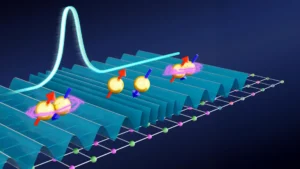
In a significant advancement for the field of condensed matter physics, researchers at the City College of New York (CCNY) have published a comprehensive roadmap detailing the burgeoning intersection of magnetism and light within atomically thin materials. This emerging area of quantum science focuses on systems only a few atoms thick, where the traditional boundaries between optical properties, electrical charge, and magnetic order dissolve, giving way to highly coupled quantum phenomena. Led by physicist Vinod M. Menon and his team at the Laboratory for Nano and Micro Photonics (LaNMP), the research highlights how these "van der Waals" magnetic materials could serve as the foundation for the next generation of quantum technologies, ranging from ultra-fast memory to transducers for the quantum internet.
The review, titled "Excitons in van der Waals magnetic materials" and published in the prestigious journal Nature Materials, synthesizes years of experimental progress and theoretical development. It posits that the ability to manipulate light-generated excitations, known as excitons, in tandem with magnetic waves, known as magnons, represents a paradigm shift in how engineers might design future optoelectronic devices. By moving away from systems where light and magnetism are treated as separate entities, the CCNY team argues that we are entering an era of integrated quantum control.
The Quantum Architecture of 2D Materials
To understand the significance of this research, one must first look at the unique architecture of van der Waals (vdW) materials. These are crystals composed of individual layers held together by weak van der Waals forces, similar to the way sheets of paper are stacked in a ream. Since the isolation of graphene in 2004, scientists have explored various 2D materials, but the discovery of intrinsic magnetism in these layers—first confirmed in 2017—opened a new frontier.
In these systems, the interaction between light and matter is governed by excitons. An exciton is a quasiparticle that forms when a photon strikes a semiconductor, energizing an electron and prompting it to jump to a higher energy state. This leaves behind a "hole"—a void with a positive charge. Due to electrostatic attraction, the electron and the hole remain bound together, traveling through the material as a single, electrically neutral unit. Because excitons are highly sensitive to their environment, they serve as perfect probes for the internal state of the material.
Parallel to this are magnons, which are collective excitations of the electron spins in a magnetic lattice. Rather than a single spin flipping, a magnon represents a wave of spin-precession traveling through the material. Historically, excitons and magnons were studied in different classes of materials. However, in vdW magnetic semiconductors, these two phenomena occupy the same physical space and often originate from the same electronic orbitals. This "shared origin" is the key to the breakthroughs discussed by Menon and his colleagues.
A Direct Approach to Magneto-Optics
For decades, the scientific community attempted to marry magnetism with semiconductors through "brute force" methods. One common strategy involved "doping" traditional semiconductors with magnetic impurities—essentially sprinkling magnetic atoms into a non-magnetic host. Another involved "proximity coupling," where a thin layer of a semiconductor was physically placed on top of a magnetic material, hoping the properties of one would leak into the other.
"Van der Waals magnetic semiconductors provide a much more elegant and direct approach," explained Pratap Chandra Adak, a postdoctoral researcher at CCNY and the lead author of the Review. "In these crystals, the magnetic moments and the excitons are inherently linked. They are not strangers meeting at an interface; they are born from the same quantum environment."
This intrinsic coupling means that an exciton is no longer just a passive observer. As Adak notes, the exciton can "sense" the underlying magnetic order. If the spins in the material are aligned (ferromagnetic) or alternating (antiferromagnetic), the exciton’s energy levels and its reaction to light will change accordingly. Furthermore, under specific conditions involving high-intensity light or tailored pulses, the excitons can actually exert a force back onto the magnetic system, potentially allowing for the optical switching of magnetic states—a "holy grail" for high-speed data storage.
Chronology of Discovery: From Graphene to Magnetic Excitons
The timeline of this field reflects the rapid acceleration of quantum material science over the last two decades:
- 2004: Andre Geim and Konstantin Novoselov isolate graphene, proving that stable 2D materials can exist.
- 2010-2014: Researchers identify other 2D materials like Molybdenum Disulfide ($MoS_2$), which possess strong excitonic properties but lack magnetism.
- 2017: A landmark year where two independent teams confirm intrinsic magnetism in 2D crystals (Chromium Triiodide and Chromium Germanium Telluride). This shattered the long-held belief that 2D magnets were too unstable to exist at measurable temperatures.
- 2020-2023: A flurry of papers, including those from Menon’s LaNMP, demonstrate that excitons in these 2D magnets are uniquely coupled to the magnetic lattice, leading to the observation of "exciton-magnon" sidebands and strong magneto-optical effects.
- 2024: The publication of the Nature Materials review provides the first unified framework for this field, signaling its transition from fundamental discovery to applied engineering.
Material Platforms: The Building Blocks of Tomorrow
The CCNY review highlights three specific material platforms that have become the workhorses of this research:
- Chromium Triiodide ($CrI_3$): This was the first material to show that magnetic states could be controlled by layer thickness and electric fields. It is a primary candidate for studying how excitons behave in "ferromagnetic" vs. "antiferromagnetic" environments.
- Nickel Phosphorus Trisulfide ($NiPS_3$): Known for its "zigzag" antiferromagnetic order, this material has shown incredibly narrow excitonic peaks, suggesting that light-matter interactions here are extremely precise. It is a favorite for researchers looking at "spin-correlated" physics.
- Chromium Sulfur Bromide ($CrSBr$): This material is particularly robust and maintains its magnetic properties at higher temperatures than many of its counterparts. It has demonstrated a remarkable ability to transport excitons over long distances, which is vital for building actual circuits.
Technical Data and Implications for Quantum Technology
The implications of being able to read and write magnetic information using light are profound. Current electronic devices rely on the movement of charge, which generates heat and limits speed. In contrast, "spintronics" (using electron spin) and "photonics" (using light) offer much higher efficiency.
High-Frequency Data Processing
Interactions between excitons and magnons occur at gigahertz (GHz) and even terahertz (THz) frequencies. This suggests that devices built from these materials could operate at speeds orders of magnitude faster than current silicon-based processors. The Review discusses how "exciton polaritons"—hybrid particles that are part-light and part-matter—can carry information through a crystal with the speed of light while maintaining the control offered by magnetic materials.
Quantum Transducers
One of the most anticipated applications is the quantum transducer. In a future quantum internet, different parts of the network will likely operate at different frequencies. For example, a quantum computer might process information using microwave-frequency superconducting qubits, but that information must be converted to optical frequencies to be sent over long-distance fiber-optic cables. Because vdW magnetic materials respond to both microwave-range magnetic waves (magnons) and optical-range light (excitons), they could serve as the "translator" between these two worlds.
All-Optical Logic and Memory
By using light to flip magnetic bits, engineers could create "magneto-photonic memory." This would allow for data storage that is non-volatile (it stays even when power is off) but can be read and written using low-energy laser pulses rather than power-hungry electric currents.
Analysis of Challenges and Future Directions
While the potential is vast, the CCNY team is transparent about the hurdles that remain. One primary challenge is the "temperature gap." Many of the most interesting magnetic effects in 2D materials currently require cryogenic temperatures, often near absolute zero, to remain stable. For consumer technology, researchers must find or engineer materials that exhibit these properties at or near room temperature.
Furthermore, there is a "theoretical bottleneck." Predicting how an exciton, a magnon, a phonon (lattice vibration), and a photon will all interact simultaneously in a 2D plane is a computational nightmare. "We need better theoretical models," Menon notes. "The goal of this article is to identify those gaps. We are moving from just detecting magnetism to actively exploring how magnetic order can control light-matter interactions. To do that, our math needs to catch up with our lab results."
The review also points toward the exciting potential of "moiré magnetic excitons." When two layers of 2D materials are stacked with a slight twist, they create a moiré pattern—a superlattice that can trap excitons in specific spots. Combining this "twisthronics" with magnetism could allow scientists to create "arrays" of quantum dots, each controlled by an underlying magnetic field.
Global Collaboration and Institutional Support
The work presented by CCNY is a testament to global scientific cooperation. Co-authors on the Nature Materials review represent a "who’s who" of international physics, including Florian Dirnberger (Technical University of Munich), Swagata Acharya (National Laboratory of the Rockies), Akashdeep Kamra (University of Kaiserslautern-Landau), and Xiaodong Xu (University of Washington).
The research at CCNY was supported by heavyweights in the scientific funding world, including the Defense Advanced Research Projects Agency (DARPA) and the Gordon and Betty Moore Foundation. DARPA’s involvement, in particular, underscores the strategic importance of this research for future sensing and communication technologies.
As the field of van der Waals magnetic materials moves out of its infancy, the roadmap provided by Professor Menon’s group will likely serve as the primary reference for the next decade of research. By bridging the gap between light and magnetism, these scientists are not just discovering new properties of matter—they are sketching the blueprints for the quantum machines of the mid-21st century.