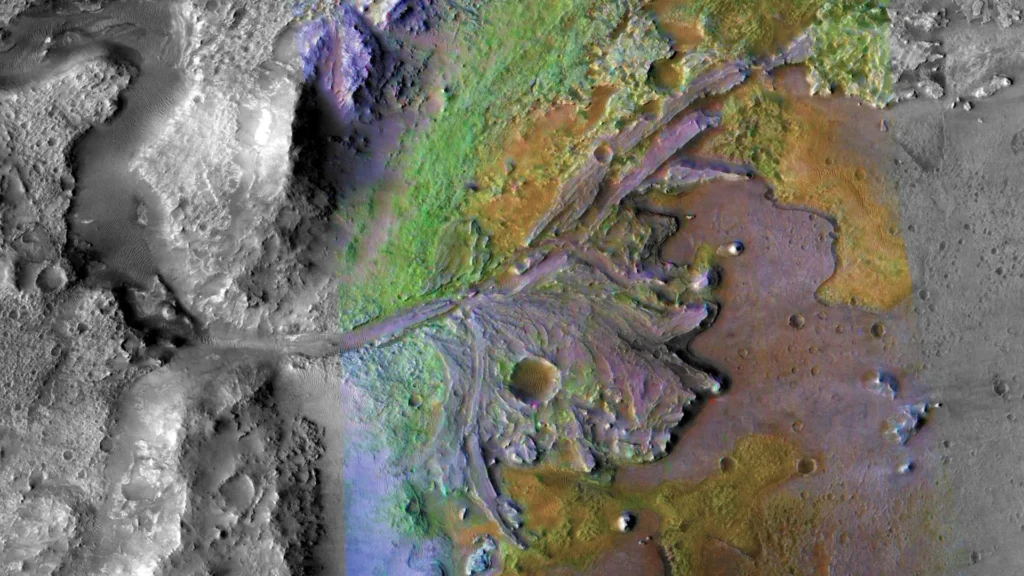
The enigmatic "Margin Unit" within Mars’ Jezero Crater, long theorized to be a straightforward record of an ancient lake, is now understood by scientists to hold a far more intricate narrative of water’s influence. Recent findings from NASA’s Perseverance rover, published in the journal Communications Earth & Environment, suggest a history involving not only ancient lakes but also significant interactions with groundwater and subsequent hydrothermal activity. This revelation challenges previous assumptions derived from orbital data and paints a dynamic picture of Jezero Crater’s watery past, with profound implications for understanding the Red Planet’s potential for past habitability.
Unveiling the Unexpected: From Sediments to Igneous Intrigue
Upon its arrival at the inner rim of Jezero Crater in September 2023, the Perseverance rover was expected to encounter sedimentary rocks. These formations, typically laid down in layers over extended periods, were anticipated along the ancient shoreline of what was once a vast Martian lake. On Earth, sedimentary rocks, particularly those composed of clay and silt, are highly valued by astrobiologists for their exceptional ability to preserve biosignatures—evidence of ancient microbial life. The presence of strong carbonate mineral signatures detected by Mars orbiters further fueled this expectation, as carbonates on Earth are commonly associated with shallow lakes and oceans, environments conducive to life.
However, Perseverance’s initial explorations within the Margin Unit yielded a significant surprise: igneous rocks. Unlike sedimentary rocks, igneous rocks are formed from the cooling of magma, either deep beneath the surface or from volcanic material solidifying at the surface. While seemingly less direct a recorder of surface water events, igneous rocks possess a unique advantage: their mineral composition can encapsulate detailed information about the ambient conditions at the time of their formation, offering an exceptionally precise geological archive.
The analysis of these igneous rocks within the Margin Unit has unveiled an unexpectedly complex hydrological history. Evidence gathered by Perseverance indicates that these rocks have been subjected to water interaction on at least three distinct occasions, with each episode leaving a unique chemical and physical imprint. This multi-stage alteration process suggests a far more dynamic and prolonged presence of water in Jezero Crater than previously envisioned.
SuperCam: A High-Tech Lens on Martian Hydrology
A significant portion of the groundbreaking evidence has been meticulously gathered by the SuperCam instrument, a sophisticated suite of sensors mounted on Perseverance’s mast. SuperCam’s capabilities are instrumental in deciphering the mineralogical composition of geological targets by analyzing the light they reflect. When mission scientists pinpoint a promising rock formation, SuperCam can engage its laser, firing it from a distance of up to 21 feet (6.5 meters). This laser creates a minuscule plasma plume, and the spectral analysis of this plasma provides a detailed chemical breakdown of the targeted rock. Through this advanced technique, Perseverance has meticulously examined over 185 bedrock targets across the Margin Unit, building a comprehensive dataset of its hydrological past.
"Before we arrived at the Margin Unit, the main hypothesis—derived from orbital observations—was that the carbonate seen from orbit formed from interaction with the lake that existed in Jezero Crater," explained Candice Bedford, a research scientist at Purdue University and the lead author of the study. "But now we know that this location became a sort of crossroads for aqueous systems. The Margin Unit findings are important because Jezero Crater sits inside one of the largest exposures of carbonate on Mars, so what we learn here reaches well beyond this crater." This statement highlights the far-reaching implications of the findings, suggesting that Jezero Crater may serve as a microcosm for understanding water’s role across a much broader Martian landscape.
A Chronology of Water: From Deep Magma to Surface Interaction
The investigation of the Margin Unit has spanned an elevation change of approximately 870 feet (265 meters), revealing distinct geological histories at different altitudes. In the higher elevations of the Margin Unit, Perseverance encountered coarse, crystalline rock rich in olivine, a mineral composed of magnesium and iron. These rocks exhibited minimal evidence of alteration by water. The research team concluded that this olivine-rich unit originated from a magma chamber deep within the Martian crust. The slow cooling process allowed for the development of large mineral grains. Subsequent erosion of the overlying material eventually exposed these ancient igneous rocks at the surface.
A stark contrast was observed in the lower elevations of the Margin Unit, closer to the ancient lakebed. Here, the olivine displayed significant signs of alteration. Its crystalline structure appeared fractured, with silica filling the interstitial spaces between the mineral grains. These alterations are of particular interest to scientists searching for signs of ancient habitability. On Earth, the reaction between water and olivine can generate hydrogen, a crucial energy source for certain types of microbes. Concurrently, these reactions can produce carbonates and silica, minerals that are adept at preserving fossilized traces of past microbial activity.
The Threefold Encounter: Groundwater, Lakes, and Hydrothermal Fluids
Researchers have been able to reconstruct the sequence of water-induced alterations within the Margin Unit, though the precise timing of each event remains a subject of ongoing investigation.
First Encounter: Carbonated Groundwater
The initial documented interaction involved groundwater rich in carbon dioxide. As this carbonated water percolated through the subsurface, it reacted with the olivine-rich bedrock. This reaction led to the formation of carbonate minerals within the fractures of the rock at lower elevations. Over vast geological timescales, the erosion of the surrounding, softer material would have left these carbonate-filled fractures standing out as prominent ridges, a geological feature that would have been visible from orbit.
Second Encounter: The Ancient Jezero Lake
A second phase of water activity is strongly suspected to be linked to the ancient lake that once filled Jezero Crater. The presence of silica within some Margin Unit rocks provides a key clue. "Turning olivine into carbonate can leave silica behind, and we see more of that silica in rocks that sat below the water line," stated Eleni Ravanis, a planetary scientist at the University of Hawaii at Manoa and a coauthor of the study. This suggests that as the lake waters interacted with the underlying rock, chemical processes occurred that favored silica precipitation, particularly in areas submerged by the lake. The distribution of silica, therefore, serves as a proxy for the lake’s extent and duration.
Third Encounter: Hydrothermal Activity
The third and latest identified episode of water interaction points to the circulation of heated water beneath the surface. At one specific site within the eastern Margin Unit, Perseverance identified mineral veins approximately 10 inches (25 centimeters) thick. These veins are composed of minerals such as calcium sulfate and fluorite. The presence of fluorite is particularly significant. Fluorite commonly forms in environments where hot water circulates through volcanic rock. Its discovery within the Margin Unit strongly indicates a later period of hydrothermal activity—hot, chemically active groundwater—in Jezero Crater, occurring after the earlier interactions with both groundwater and the ancient lake. This suggests that Jezero Crater was not a static hydrological environment but experienced dynamic changes in its water systems over millions of years.
Broader Implications for Martian Habitability and Climate Evolution
The comprehensive findings from the Margin Unit underscore a critical point: this geological formation was not shaped by a single, uniform lake environment. Instead, it served as a convergence point for multiple distinct water systems that progressively altered the same rocks at different junctures in Martian history. This complex interplay of water—ranging from infiltrating groundwater to expansive lakes and later hydrothermal flows—creates a far richer and more nuanced picture of Jezero Crater’s past.
"If there is one thing I have learned after 10 years working with Mars rovers, it is that Mars constantly throws surprises at you," Bedford remarked. "It is very rare that things are as we expect them to be from orbital data. I hope this work helps reshape how scientists view the history of water in Jezero Crater and across Mars. Ultimately, I hope it helps planetary scientists reconstruct the changing climate and habitability of early Mars."
The implication for the search for extraterrestrial life is profound. A multi-stage history of water suggests multiple opportunities for life to have emerged and persisted. Different types of water—from carbonated groundwater to potentially more nutrient-rich hydrothermal fluids—could have supported diverse microbial ecosystems. The preservation of biosignatures within these complex geological formations, especially within carbonate and silica-rich altered zones, becomes a more intricate but also more promising prospect.
Future Research and the Enduring Mystery of Mars
The Perseverance mission’s ongoing exploration of Jezero Crater continues to unravel the Red Planet’s ancient secrets. The data gathered from the Margin Unit will inform future mission planning and refine models of Martian geological and climatic evolution. Scientists will now focus on precisely dating these alteration events to establish a more concrete timeline for Jezero’s hydrological history. Further analysis of the mineral composition and isotopic signatures within these rocks could provide additional clues about the chemical composition of the water at each stage, offering insights into the potential habitability of these ancient Martian environments.
The discovery that Jezero Crater’s Margin Unit is a complex nexus of past water activity, rather than a simple lakebed deposit, emphasizes the dynamic nature of planetary evolution. It serves as a powerful reminder that Mars, though seemingly a frozen and arid world today, once harbored a much more active and potentially life-supporting hydrological system. The ongoing work of the Perseverance rover promises to continue challenging our assumptions and deepening our understanding of our planetary neighbor.