Quantum entanglement captures one of the strangest differences between everyday physics and the quantum world. In an entangled system, particles such as photons become linked so deeply that their properties cannot be fully described independently; instead, the system must be treated as a unified whole. This phenomenon, which Albert Einstein famously dismissed as "spooky action at a distance," serves as the bedrock for the next generation of technological innovation. While the philosophical implications of entanglement have been debated for nearly a century, modern physics has shifted toward the practical: how to create, manipulate, and, crucially, measure these states to build a functional quantum internet.
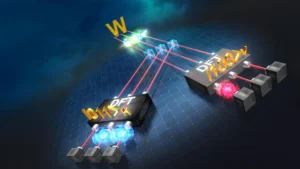
Researchers at Kyoto University and Hiroshima University have recently announced a significant milestone in this pursuit. Their work, led by Professor Shigeki Takeuchi, addresses a long-standing gap in quantum measurement theory and practice. For the first time, scientists have successfully demonstrated an "entangled measurement" for the W state, a specific and highly robust form of multi-photon entanglement. This achievement comes more than 25 years after similar methods were developed for the Greenberger-Horne-Zeilinger (GHZ) state, marking a pivotal moment in the timeline of quantum information science.
The Evolution of Entanglement: From Paradox to Paradigm
The journey toward this breakthrough began in 1935, when Albert Einstein, Boris Podolsky, and Nathan Rosen published a paper questioning the completeness of quantum mechanics. They argued that if quantum mechanics were correct, it would imply a violation of "local realism"—the idea that objects have definite properties regardless of whether they are measured and that information cannot travel faster than light. Einstein’s skepticism regarding entanglement (the EPR Paradox) eventually led to John Bell’s 1964 theorem, which provided a way to experimentally test these claims.
By the 1980s and 1990s, experiments by Alain Aspect and others confirmed that entanglement was indeed a physical reality. However, as the field transitioned from basic physics to quantum engineering, scientists realized that not all entangled states are created equal. Two primary "classes" of multi-party entanglement emerged as particularly important: the GHZ state and the W state.
The GHZ state is often described as "maximally entangled." In a three-photon GHZ state, if one photon is measured or lost, the entanglement between the remaining two is completely destroyed. This makes it highly sensitive but also fragile. Conversely, the W state is characterized by its resilience. In a three-photon W state, if one photon is lost, the remaining two particles retain a significant degree of entanglement. This robustness makes the W state an ideal candidate for quantum communication networks and distributed quantum computing, where environmental noise and signal loss are constant threats.
The Measurement Bottleneck: Tomography vs. One-Shot Identification
To utilize these states in technology, scientists must be able to verify that they have successfully produced them. Traditionally, this has been achieved through a process known as quantum state tomography. Much like a medical CT scan creates a 3D image of a body from multiple 2D X-rays, quantum tomography reconstructs the full state of a system by taking thousands of individual measurements from different angles.
While effective for two-particle systems, tomography suffers from what mathematicians call the "curse of dimensionality." As the number of photons in a system increases, the amount of data required to reconstruct the state grows exponentially. For a system with only a handful of photons, the time and computational power needed for tomography become prohibitive. This bottleneck has long hindered the scaling of multi-photon quantum systems.
The alternative is an "entangled measurement." This approach does not attempt to reconstruct the entire state piece by piece. Instead, it uses a specialized quantum circuit to identify the state in a "one-shot" fashion. While the theoretical framework for such a measurement for GHZ states was proposed in the late 1990s, the W state proved far more elusive. The complex mathematical structure of the W state made it difficult to design a physical circuit that could distinguish it from other states efficiently—until now.
A Breakthrough Rooted in Symmetry and the Fourier Transform
The research team at Kyoto and Hiroshima Universities overcame this hurdle by identifying a unique mathematical property of the W state: cyclic shift symmetry. In a system possessing this symmetry, the arrangement of the photons can be shifted in a repeating cycle (e.g., photon A moves to B, B to C, and C to A) while the underlying quantum pattern remains unchanged.
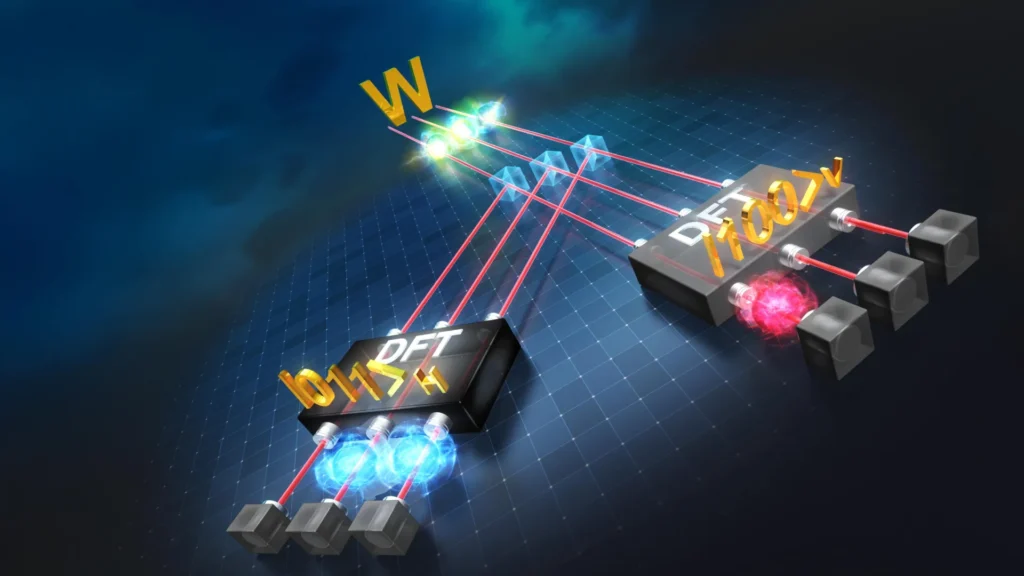
Leveraging this symmetry, the team designed a photonic quantum circuit centered on the Quantum Fourier Transform (QFT). The QFT is a quantum version of the classical Fourier transform, a mathematical tool used in everything from JPEG compression to radio signal processing. In the quantum realm, the QFT can reorganize information across multiple qubits or photons, revealing hidden patterns and correlations that are otherwise invisible.
By passing three individual photons through this QFT-based circuit, the researchers were able to map the complex correlations of the W state onto specific, detectable outcomes. This allowed them to distinguish between different types of three-photon W states with high precision. To implement this in the lab, the team utilized high-stability optical circuits. These circuits were engineered to maintain their alignment and phase stability over long periods, eliminating the need for the active, high-frequency adjustments that often plague optical experiments.
Experimental Results and the Quest for Fidelity
The experimental demonstration involved generating three photons with carefully selected polarization states—the direction in which the light waves vibrate. When these photons entered the device, the circuit performed the entangled measurement, providing a result that indicated whether the photons were in the desired W state.
A critical metric in this experiment was "fidelity." In quantum mechanics, fidelity measures the closeness of the experimental state to the ideal theoretical state. The team reported that their device could reliably identify W states, confirming that the theoretical circuit they designed could be translated into a functional physical apparatus.
"More than 25 years after the initial proposal concerning the entangled measurement for GHZ states, we have finally obtained the entangled measurement for the W state as well," stated Professor Shigeki Takeuchi, the corresponding author of the study. He emphasized that the "genuine experimental demonstration" for 3-photon W states serves as a proof of concept that can, in principle, be scaled to systems involving even larger numbers of photons.
Implications for the Future of Quantum Technology
The ability to perform one-shot entangled measurements on W states opens several new avenues for the "Second Quantum Revolution."
1. Enhanced Quantum Teleportation
One of the most immediate applications is in quantum teleportation. In this process, the state of a quantum particle is transferred from one location to another using a shared entangled pair and classical communication. While "teleportation" in the sci-fi sense remains impossible, the teleportation of information is a reality. By using W states and the new measurement technique, scientists could potentially teleport more complex quantum information across multi-node networks more reliably than with GHZ states.
2. Robust Quantum Communication
In a global quantum internet, information will need to be sent over long distances via fiber optics or satellite links. Photons are frequently lost during transmission. Because W states maintain entanglement even when a photon is lost, they are superior for creating "quantum repeaters"—devices that extend the range of quantum signals. The new measurement method provides the necessary tool to verify and process these signals at each node of the network.
3. Measurement-Based Quantum Computing
Unlike the standard gate-based model of quantum computing (used by companies like IBM and Google), measurement-based quantum computing starts with a highly entangled "cluster state" and performs computations by making sequential measurements. The Kyoto-Hiroshima breakthrough provides a new methodology for performing these measurements, potentially leading to more efficient architectures for specialized quantum processors.
Scaling Up: On-Chip Integration and Larger Systems
The research team is already looking toward the next phase of their work. While the current experiment used a three-photon system, the theoretical framework is applicable to W states containing any number of particles. The challenge now lies in the physical scaling of the hardware.
To make this technology practical for commercial or industrial use, the researchers plan to transition from large-scale laboratory optical setups to on-chip photonic quantum circuits. By etching these quantum circuits onto silicon or other semiconductor chips, the technology can be made significantly more compact, stable, and cost-effective. This "lab-on-a-chip" approach is seen as the most viable path toward integrating quantum components into existing telecommunications infrastructure.
"In order to accelerate the research and development of quantum technologies, it is crucial to deepen our understanding of basic concepts to come up with innovative ideas," Takeuchi noted. This sentiment reflects a broader trend in the scientific community: while the race to build a 1,000-qubit computer makes headlines, the foundational work in measurement and state verification is what will ultimately determine the reliability and scalability of those machines.
Conclusion
The work of the Kyoto and Hiroshima University researchers fills a significant 25-year gap in the field of quantum optics. By moving beyond the limitations of quantum tomography and successfully harnessing the cyclic symmetry of W states, the team has provided a new set of tools for the quantum engineer’s toolkit. As the world moves closer to a functional quantum internet, the ability to efficiently measure and verify complex entangled states will be the difference between a theoretical curiosity and a world-changing technology. This breakthrough ensures that the W state—once the difficult-to-measure cousin of the GHZ state—is now ready to take center stage in the future of quantum information transfer.