The European Organization for Nuclear Research (CERN) has reported a significant finding that could potentially reshape our understanding of the fundamental laws governing the universe. Data analyzed from the Large Hadron Collider beauty (LHCb) experiment reveals a four-standard deviation discrepancy in the decay of a specific subatomic particle, known as the beauty quark, when compared to the predictions of the Standard Model of particle physics. This development, published in the journal Physical Review Letters, marks one of the most compelling "tensions" observed in modern physics, suggesting that undiscovered particles or forces may be influencing the behavior of matter at the quantum level.
For decades, the Standard Model has served as the bedrock of particle physics, successfully predicting the existence of the Higgs boson and describing three of the four fundamental forces: electromagnetism, the weak nuclear force, and the strong nuclear force. However, the model remains incomplete. It offers no explanation for dark matter, which constitutes the majority of the universe’s mass, nor does it account for the staggering imbalance between matter and antimatter or the integration of gravity at the quantum scale. The recent results from the LHCb collaboration provide a potential "crack" in this established framework, offering a glimpse into what physicists call "New Physics."
The Anatomy of the Beauty Quark Decay
The focus of this investigation is the decay of a B meson—a particle containing a "beauty" or "bottom" quark—into a K* (K-star) meson and a pair of muons. In the realm of particle physics, the beauty quark is a third-generation elementary particle. Because of its relatively high mass compared to the up and down quarks found in protons and neutrons, it is particularly sensitive to the influence of heavier, as-yet-undiscovered particles.
In the Standard Model, the decay of a B meson into a K meson and two muons ($B to K^mu^+mu^-$) is an extremely rare event. It does not occur directly but rather through "higher-order" processes involving quantum loops. In these loops, virtual particles—particles that exist for a fleeting moment according to the Heisenberg uncertainty principle—appear and disappear, subtly influencing the final outcome of the decay. If new, undiscovered particles exist, they would theoretically enter these quantum loops, altering the angular distribution and the rate of the decay products in a way that deviates from Standard Model predictions.
The LHCb analysis specifically examined the angular distribution of the decay products—the directions in which the K* meson and the muons fly apart. The data showed that these angles do not align with the mathematical expectations of the Standard Model. This specific measurement yielded a four-sigma discrepancy, a statistical threshold that indicates a 99.997 percent confidence level that the result is not a random fluctuation.
Statistical Significance and the Search for Five Sigma
In the high-stakes world of experimental physics, the "sigma" ($sigma$) value represents the standard deviation of a result. A three-sigma result is often considered "evidence" of a phenomenon, but it is not until a five-sigma threshold is reached that the scientific community declares an official "discovery." A five-sigma result implies a one-in-3.5-million chance that the observation is a fluke.
While the current four-sigma result is not yet a definitive discovery, its persistence is what has the scientific community on high alert. "A four-sigma result corresponds to a p-value of about 3 in 100,000," explained Eluned Smith, an assistant professor of physics at MIT and a lead researcher in the analysis. "If the Standard Model were completely correct, the probability of observing a discrepancy this large by chance would be extremely small."
The robustness of this finding is further bolstered by the fact that the analysis was conducted independently by two separate teams within the LHCb collaboration. One of these teams was led by Smith at the MIT Laboratory for Nuclear Science. By employing independent methodologies and cross-verifying results, the researchers minimized the risk of systematic errors or biases influencing the outcome.
A Chronology of the Flavor Anomaly
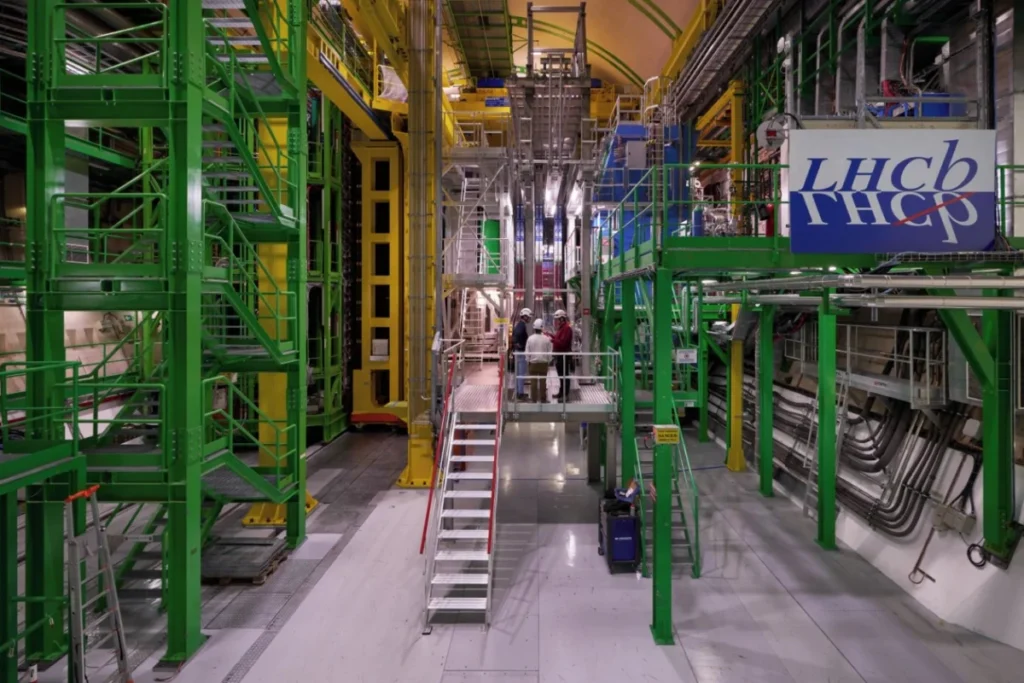
The search for discrepancies in beauty quark decays, often referred to as "flavor anomalies," has a decade-long history at CERN. The LHCb experiment, situated in a cavern 100 meters underground near the French-Swiss border, was specifically designed to study the physics of "flavor"—the properties that distinguish different types of quarks.
- 2010–2012: During the LHC’s Run 1, early data began to hint at slight deviations in B meson decays. While the statistical significance was low, the pattern caught the attention of theorists.
- 2013–2015: Subsequent analyses of Run 1 data revealed the first major "tensions" in the angular distribution of $B to K^*mu^+mu^-$. These results hovered around the three-sigma mark.
- 2017–2019: As the LHC entered Run 2 with higher collision energies and more data, the LHCb collaboration reported further anomalies, including measurements of "Lepton Flavor Universality," which suggested that B mesons might decay into muons and electrons at different rates—a violation of a core Standard Model principle.
- 2021–2023: While some previous anomalies were later reconciled with the Standard Model through more precise theoretical calculations of hadronic effects, the angular distribution discrepancy in $B to K^*mu^+mu^-$ has remained persistent and has now strengthened to the four-sigma level reported today.
Technical Innovations and the Role of MIT
The complexity of detecting these rare decays cannot be overstated. The LHCb detector is a "forward spectrometer," a massive 4,500-tonne instrument designed to capture the particles produced in collisions that fly close to the beam pipe. Because beauty quarks are produced in pairs and travel a short distance before decaying, the detector must have sub-millimeter precision to reconstruct their paths.
A critical component of this recent success is the implementation of advanced "trigger" systems. In particle physics, a trigger is a system that decides in real-time which collision events are worth saving and which are discarded. With billions of collisions occurring every second, only a fraction can be recorded for analysis.
Professor Eluned Smith and her team at MIT have been at the forefront of developing these selection systems. For the current Run 3 of the LHC, the experiment has moved to a fully software-based trigger. This allows researchers to apply complex AI algorithms to filter data instantly, ensuring that rare beauty-hadron decays are captured with much higher efficiency than in previous years.
Looking forward, Smith is leading efforts to integrate low-latency AI systems directly into the radiation-hardened electronics of the detector. This will be vital for the "Upgrade II" of the LHCb, planned for the end of the decade, which aims to operate at luminosities (collision rates) five times higher than the current system.
Theoretical Implications: New Forces or Better Math?
The scientific community remains divided on whether the four-sigma discrepancy points to a new fundamental force—such as a "Z-prime" boson or a "leptoquark"—or if it highlights a misunderstanding of the "strong interaction" dynamics.
The strong nuclear force, governed by Quantum Chromodynamics (QCD), binds quarks together inside mesons and protons. Calculating the effects of the strong force in these decays is notoriously difficult. Some theorists argue that "hadronic uncertainties"—the messy, non-perturbative effects of gluons and quarks interacting—could be larger than previously estimated, potentially mimicking the signal of new physics.
However, the fact that similar tensions have been observed across multiple different decay modes—all involving the transition of a b-quark to an s-quark (strange quark)—suggests a coherent pattern. If a new particle like a leptoquark exists, it could explain why these specific decays are behaving unexpectedly while other parts of the Standard Model remain perfectly accurate.
The Global Impact and Future Outlook
The implications of confirming "New Physics" would be transformative. It could provide the first concrete evidence of a "Dark Sector" of particles that interact with our visible world only through rare, high-energy processes. This, in turn, could lead to a solution for the dark matter mystery that has puzzled astronomers for nearly a century.
The international physics community is now looking toward the data from LHC’s Run 3, which began in 2022 and will continue through 2025. This run is expected to double the existing dataset for the LHCb experiment. With more data, the statistical error bars will shrink. If the four-sigma discrepancy is indeed a manifestation of new physics, the signal should grow toward the five-sigma "discovery" threshold. Conversely, if it is a statistical fluke, the discrepancy will likely fade back into the background of the Standard Model.
"Over the next several years, the combination of more data and improved theoretical calculations will determine whether this tension is real," Smith noted. "The LHCb has undergone major upgrades… the larger dataset will reduce statistical uncertainties and test whether the discrepancy strengthens or fades."
As researchers continue to probe the smallest scales of existence, the four-sigma result stands as a beacon of potential discovery. Whether it leads to a total rewrite of physics textbooks or a more nuanced understanding of the strong force, the work at CERN continues to push the boundaries of human knowledge, searching for the fundamental truths of the universe in the subtle, angular dance of the beauty quark.