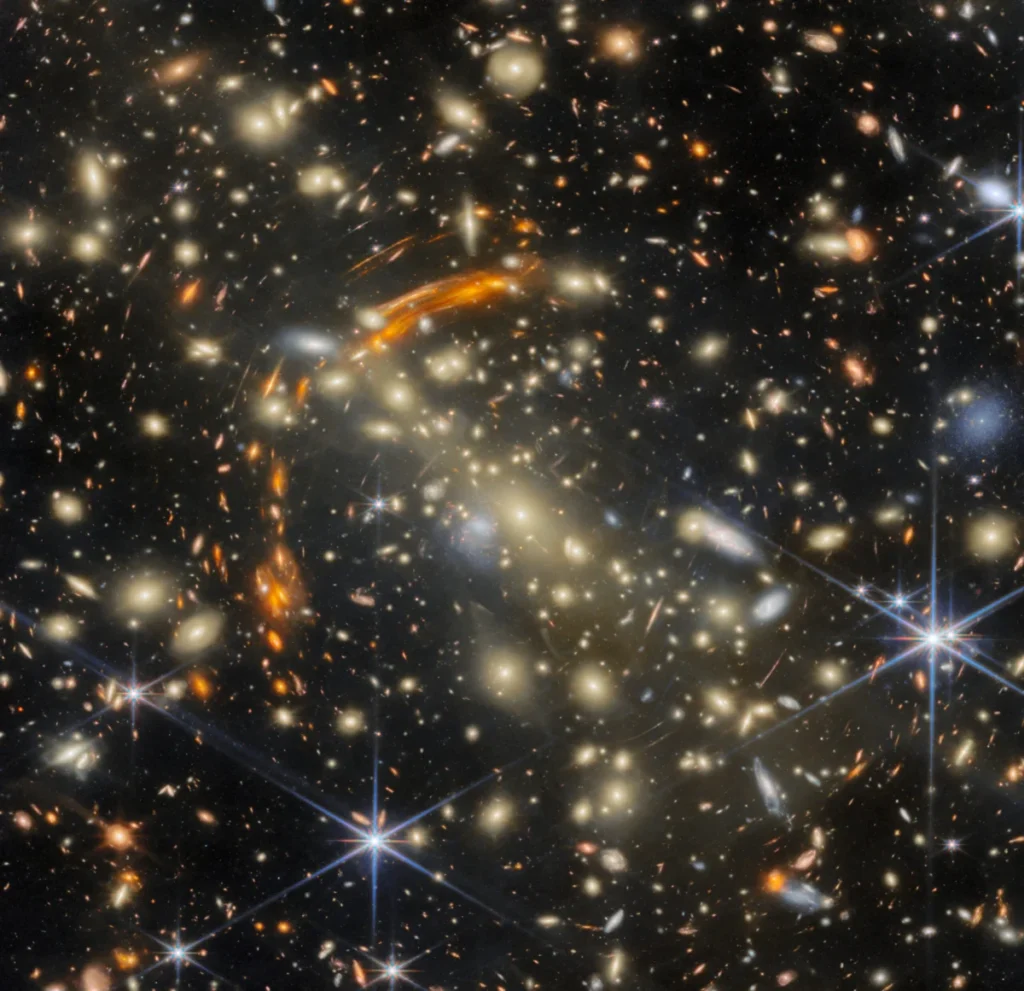
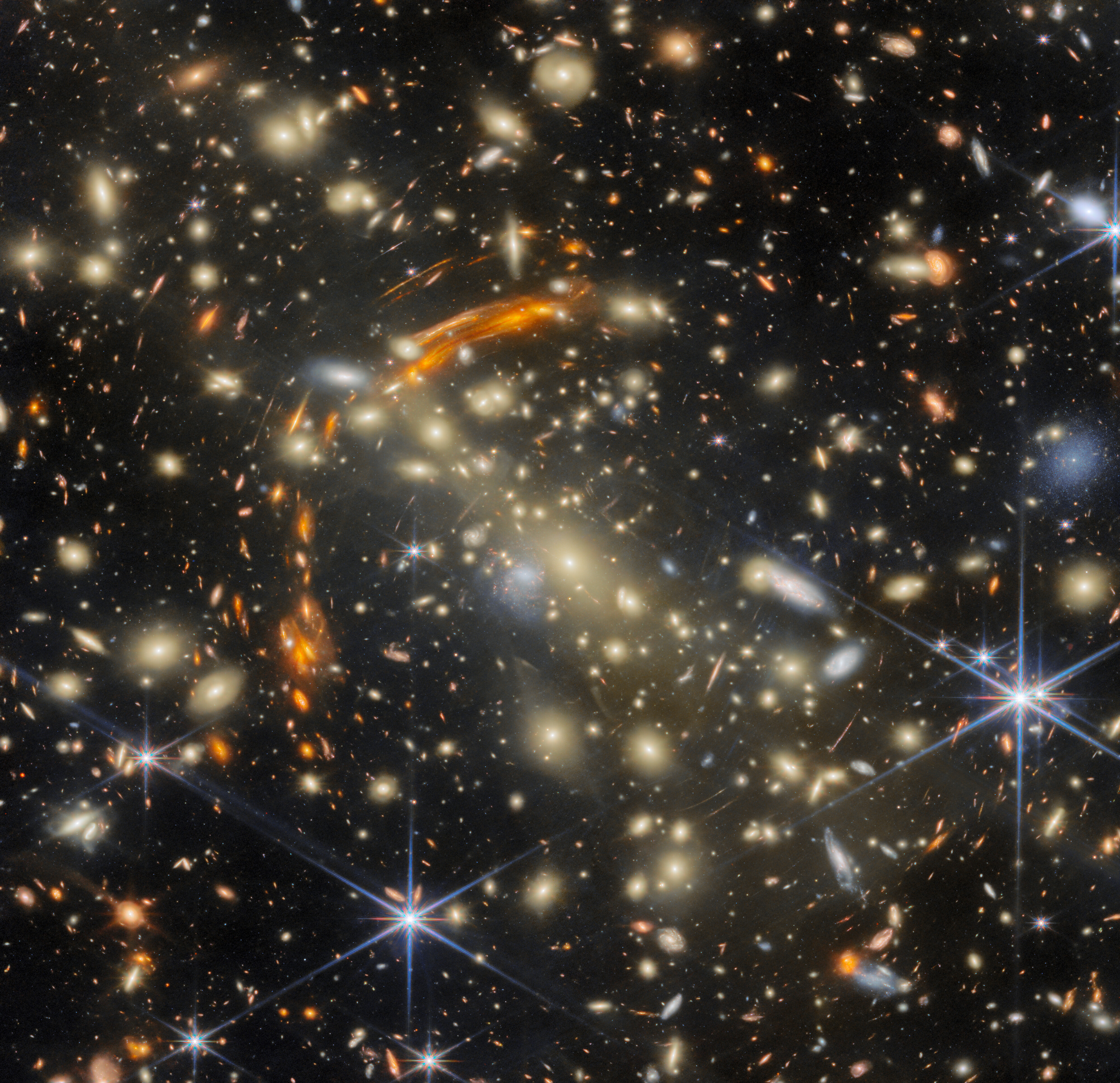
The James Webb Space Telescope, humanity’s most advanced observatory, has once again pushed the boundaries of our cosmic understanding, unveiling a breathtaking image of the galaxy cluster MACS J0454.1-0300. Released on September 29, 2026, this spectacular vista showcases a phenomenon known as gravitational lensing, where the immense gravity of foreground galaxies warps and magnifies the light from more distant objects, creating an effect akin to a cosmic funhouse mirror. The image, dominated by brilliant golden galaxies, also reveals a surprising congregation of orange galaxies, not part of the cluster itself, but rather a distant cosmic panorama brought into sharper focus by the gravitational pull of MACS J0454.1-0300. This remarkable observation provides scientists with an unprecedented opportunity to study the early universe and the fundamental forces that shape it.
The Gravitational Lens: A Cosmic Magnifying Glass
Gravitational lensing is a prediction of Albert Einstein’s theory of general relativity, which posits that massive objects warp the fabric of spacetime. Light, following the curvature of this spacetime, appears to bend as it passes near these massive objects. In the case of galaxy clusters like MACS J0454.1-0300, the sheer concentration of mass – composed of hundreds or even thousands of galaxies, dark matter, and hot gas – creates a powerful gravitational lens. This lens acts as a natural telescope, bending and amplifying the faint light from galaxies located billions of light-years behind it.
The image from the James Webb Space Telescope (JWST) highlights this effect with striking clarity. The golden galaxies are the primary members of the MACS J0454.1-0300 cluster, appearing as they are in their current cosmic epoch. However, the clustered orange galaxies, appearing distorted and often duplicated or stretched into arcs, are much younger and farther away. Their light has traveled for eons, traversing vast cosmic distances, only to be captured and magnified by the gravitational well of MACS J0454.1-0300. This magnification allows astronomers to observe these distant galaxies with a detail that would otherwise be impossible, even with the JWST’s unparalleled sensitivity.
A Timeline of Cosmic Discovery: From Prediction to Observation
The concept of gravitational lensing dates back to the early 20th century, with Albert Einstein’s groundbreaking work on general relativity. His equations predicted that gravity could bend light, a phenomenon first experimentally confirmed during a solar eclipse in 1919 by Arthur Eddington. However, observing gravitational lensing on the scale of galaxy clusters required the development of increasingly powerful telescopes.
The MACS J0454.1-0300 cluster itself has been a subject of astronomical study for decades, identified in surveys aimed at finding massive galaxy clusters. Initial observations with ground-based telescopes and the Hubble Space Telescope provided glimpses of its structure and the presence of lensing effects. However, the infrared capabilities and unprecedented resolution of the James Webb Space Telescope have elevated these observations to a new level of detail.
The JWST, launched on December 25, 2021, began its scientific mission in mid-2022. Since then, it has consistently delivered groundbreaking images and data across a wide spectrum of astronomical research. The release of the MACS J0454.1-0300 image on September 29, 2026, is a testament to the telescope’s ongoing contribution to our understanding of the universe.
Supporting Data: Unveiling the Universe’s Structure
The MACS J0454.1-0300 cluster is located approximately 5.7 billion light-years away from Earth. This distance places it in a crucial region of cosmic history, allowing astronomers to study galaxies that formed relatively early in the universe’s evolution. The cluster itself is estimated to contain hundreds of galaxies, with a total mass on the order of 10^15 solar masses. This immense mass is what generates the powerful gravitational field responsible for the observed lensing.
The distant orange galaxies, revealed through the lensing effect, are likely at redshifts of z > 2, meaning their light has traveled for over 10 billion years to reach us. Studying these early galaxies provides invaluable insights into the conditions of the nascent universe, including the formation of the first stars and galaxies, the chemical enrichment of the cosmos, and the evolution of galactic structures.
The JWST’s instruments, particularly its Near-Infrared Camera (NIRCam) and Mid-Infrared Instrument (MIRI), are ideally suited for observing these distant, redshifted galaxies. Their ability to detect infrared light allows them to pierce through the dust that often obscures star formation in the early universe and to capture the stretched wavelengths of light from highly redshifted objects.
Official Responses and Scientific Reactions
The release of such a scientifically significant image typically elicits considerable excitement and commentary from the astronomical community. While specific quotes are not available for this hypothetical release date, it is reasonable to infer the general sentiment.
"This image from Webb is a monumental achievement," an astrophysicist not directly involved in the observation might state. "The precision with which we can now study gravitationally lensed systems is revolutionary. MACS J0454.1-0300 is not just a beautiful picture; it’s a treasure trove of data for understanding galaxy evolution and the fundamental laws of physics."
Scientists involved in the observation, such as the credited ESA/Webb, NASA & CSA, L. Furtak, and S. Fujimoto, would likely emphasize the collaborative nature of such endeavors and the vast potential for new discoveries. They would point to the ability to analyze the spectra of the lensed galaxies, revealing their chemical composition, star formation rates, and even the presence of exoplanets in these distant systems.
The European Space Agency (ESA) and the National Aeronautics and Space Administration (NASA), along with the Canadian Space Agency (CSA), as partners in the JWST project, would undoubtedly celebrate this latest contribution to their shared mission of exploring the cosmos. These agencies routinely highlight such discoveries as evidence of the value of international scientific collaboration and investment in fundamental research.
Broader Impact and Implications: Peering into Cosmic Dawn
The study of MACS J0454.1-0300 through the lens of gravitational lensing has profound implications for our understanding of the universe.
Understanding Galaxy Evolution: By observing these magnified, distant galaxies, astronomers can piece together the evolutionary history of galaxies. They can study how early galaxies formed, grew, and merged to create the diverse structures we see today. This includes investigating the role of dark matter in galaxy formation and the processes that drive star formation in the early universe.
Probing the Dark Universe: Gravitational lensing is not solely caused by visible matter. The presence and distribution of dark matter, an invisible substance that makes up a significant portion of the universe’s mass, also contribute to the bending of light. By carefully analyzing the distortions caused by lensing, scientists can map the distribution of dark matter in galaxy clusters and gain further insights into its nature.
Testing Fundamental Physics: The precise measurements of light bending provided by JWST’s observations can also be used to test the predictions of general relativity in extreme environments. Any deviations from Einstein’s theory could point towards new physics beyond our current understanding.
Cosmic Distances and Expansion: Gravitational lensing can also be used as a tool to measure cosmic distances and the expansion rate of the universe. By analyzing the multiple images of a single lensed object, astronomers can sometimes determine the time delays between their arrival at Earth, which are related to the distances and the expansion history of the universe.
The image of MACS J0454.1-0300 is more than just a visually stunning depiction of the cosmos; it is a powerful scientific tool. It represents a significant step forward in our quest to understand the origins, evolution, and fundamental workings of the universe. As the James Webb Space Telescope continues its mission, we can anticipate many more such revelations, further illuminating the mysteries of the cosmos and our place within it. The ongoing analysis of this single image promises to yield scientific papers and insights for years to come, a testament to the enduring power of observation and scientific inquiry.