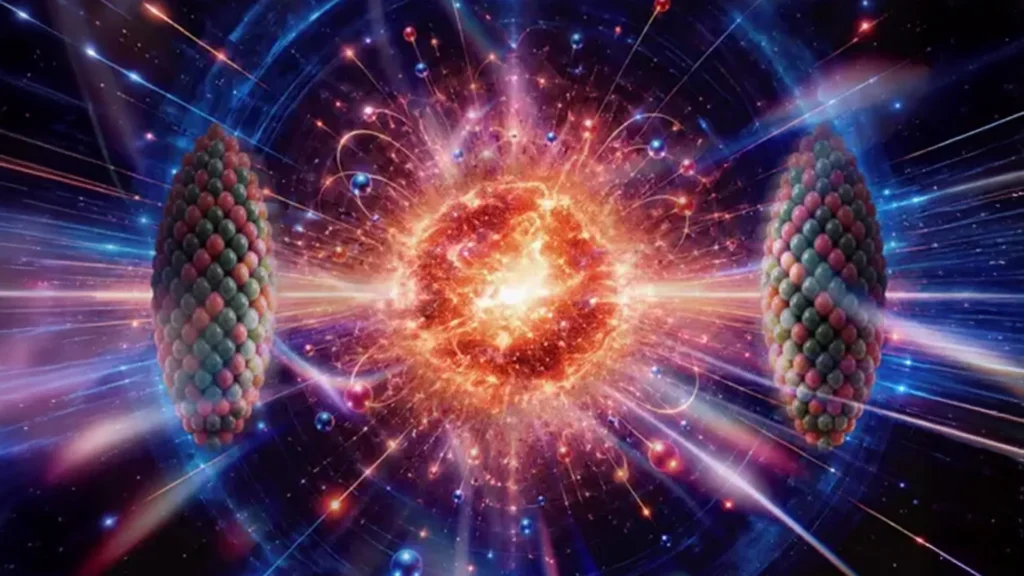
In the fleeting moments following the Big Bang, the universe existed as a primordial soup of subatomic particles known as quark-gluon plasma (QGP). Today, physicists recreate this exotic state of matter by smashing atomic nuclei together at nearly the speed of light in massive particle accelerators. While much of the scientific focus over the last two decades has remained on the plasma’s incredible temperature and its "perfect fluid" vorticity, a groundbreaking study from Fudan University has turned the spotlight toward a long-overlooked fundamental property: acceleration. Led by physicists Yu-Gang Ma and Xu-Guang Huang, the research reveals that the intense acceleration within these subatomic fireballs is not merely a byproduct of expansion but a critical thermodynamic control parameter that could reshape our understanding of quantum chromodynamics (QCD).
The study, which utilizes advanced computational models to map acceleration across a vast range of collision energies, suggests that the sheer force of this movement may influence the very phase transitions of matter. By treating acceleration with the same level of theoretical rigor as temperature and density, the Fudan team has proposed a new "acceleration axis" for the QCD phase diagram, potentially bridging the gap between relativistic hydrodynamics and non-inertial quantum effects.
The Frontier of Femtoscale Hydrodynamics
Quark-gluon plasma is often described as the most extreme fluid in the universe. When heavy ions, such as gold or lead nuclei, collide at the Relativistic Heavy Ion Collider (RHIC) or the Large Hadron Collider (LHC), they melt into a state where quarks and gluons—the fundamental building blocks of protons and neutrons—are no longer confined. This plasma exhibits a viscosity-to-entropy ratio so low that it behaves as an almost "perfect" liquid.
For years, the "swirl" of this liquid, known as vorticity, was the primary focus of hydrodynamic studies. In 2017, researchers at RHIC confirmed that QGP is the most vortical fluid ever observed, spinning at rates that dwarf the most violent tornadoes or Jupiter’s Great Red Spot. However, Ma and Huang argue that vorticity is only half of the story. In the realm of classical electromagnetism, electric and magnetic fields are inextricably linked; similarly, in relativistic hydrodynamics, vorticity and acceleration are two sides of the same coin.
"Acceleration is not merely a kinematic detail," Professor Huang noted during the presentation of the findings. "It may act as a thermodynamic control parameter of QCD matter." This assertion shifts the perspective of acceleration from a simple result of expansion to a fundamental force that dictates how quarks interact and how matter transitions from one state to another.
Methodology: Mapping the Fireball’s Evolution
To capture the complex dynamics of a subatomic collision, the Fudan University team employed a sophisticated "hybrid" simulation approach. They combined two established particle transport models: A Multi-Phase Transport (AMPT) and Ultra-relativistic Quantum Molecular Dynamics (UrQMD).
While these models traditionally track individual particles, the researchers integrated a Gaussian smearing method to smooth the data into continuous fields. This allowed them to visualize the plasma as a coherent fluid, calculating local energy density, momentum, and velocity at every point within the expanding fireball. By applying the relativistic Euler equation—a cornerstone of fluid mechanics—the team could isolate the "proper acceleration" experienced by the plasma.
The scope of the study was notably broad, covering collision energies from 3.5 GeV (typical of fixed-target experiments) to 2.76 TeV (the ultra-high energies achieved at the LHC). This range allowed the researchers to observe how acceleration patterns evolve as the velocity of the colliding nuclei approaches the absolute limit of the speed of light.
The Edge of Chaos: Peak Acceleration at the Boundary
One of the study’s most significant findings is the discovery of "acceleration hotspots" located at the outer edges of the plasma fireball. The simulations revealed that peak proper acceleration can reach several hundred MeV—a staggering figure when converted into conventional units, representing forces trillions of times stronger than Earth’s gravity.
According to the team’s analysis, these hotspots are the result of a unique environmental confluence at the plasma’s boundary. In this region, the internal pressure of the fireball drops precipitously as it meets the surrounding vacuum, creating a massive pressure gradient. Simultaneously, the enthalpy density (a measure of the system’s total heat content and pressure) remains low at the edge.
In the language of relativistic physics, acceleration is inversely proportional to enthalpy. Therefore, the combination of a sharp pressure drop and low enthalpy acts as a force multiplier, propelling the outer layers of the plasma outward with extreme intensity. The researchers found that this transverse acceleration consistently points outward, driving the rapid radial expansion that characterizes the "Little Bang" in collider experiments.
Evolution Across Collision Energies: Stopping vs. Transparency
The research provides a detailed chronology of how acceleration manifests during the lifetime of a collision. The behavior of the matter depends heavily on the energy of the initial impact:
- Low-Energy Regime (3.5 GeV – 19.6 GeV): At these energies, the colliding nuclei experience "nuclear stopping." The protons and neutrons physically impede one another, leading to a rapid buildup of density and a subsequent deceleration of up to 500 MeV as the initial longitudinal momentum is converted into heat and pressure.
- High-Energy Regime (200 GeV – 2.76 TeV): At ultrarelativistic speeds, the nuclei become "transparent" to one another, passing through each other almost instantaneously. This creates a vacuum-like "string" of energy between them that quickly manifests as plasma. In this scenario, the plasma experiences brief but incredibly intense acceleration pulses as it is pulled along the axis of the collision.
Interestingly, the study found that the peak acceleration at the boundary remains relatively stable regardless of the "impact parameter"—whether the nuclei hit head-on or graze each other in a peripheral collision. This suggests that the boundary effects of the plasma are a universal feature of QCD matter under extreme conditions.
The Unruh Effect and the New Phase Axis
Perhaps the most provocative implication of the Fudan study involves the Unruh effect. Proposed by physicist William Unruh in 1976, this quantum mechanical prediction suggests that an observer undergoing extreme acceleration will perceive the surrounding vacuum not as empty space, but as a warm bath of thermal radiation.
In the context of quark-gluon plasma, the accelerations of several hundred MeV measured by Ma and Huang are energetically comparable to the transition temperature of QCD itself (approximately 150-170 MeV). This means that the acceleration alone could be "hot" enough to influence the behavior of quarks and gluons.
"Just as temperature and density define the phase diagram of matter, acceleration may open a new axis of that diagram," Professor Huang stated. This "acceleration axis" could provide the key to understanding the chiral transition (where particles acquire mass) and the confinement transition (where quarks are locked into protons and neutrons). If acceleration mimics thermal effects, it could theoretically trigger these transitions even in conditions where the actual temperature is lower than expected.
Implications for the "Spin Puzzle" and Future Research
The findings also offer a potential solution to a persistent mystery in high-energy physics: the alignment of particle spins. Experiments at RHIC and the LHC have observed that certain particles, known as hyperons, emerge from collisions with a specific spin orientation. While vorticity explains much of this polarization, it does not account for all the observed data.
The Fudan team suggests that the intense acceleration gradients at the plasma’s edge could generate "spin-acceleration effects," a previously unexplored transport phenomenon. This would complement the effects of vorticity, providing a more complete picture of how angular momentum is distributed in the subatomic soup.
Looking forward, the researchers plan to refine their models by incorporating more realistic (dissipative) hydrodynamic evolution, which accounts for the plasma’s internal friction. The ultimate goal is to identify "experimental signatures"—specific patterns in particle debris—that can be measured by detectors like ALICE at the LHC or STAR at RHIC.
By connecting the abstract world of non-inertial quantum effects with the tangible data of particle colliders, the work of Ma and Huang opens a new chapter in nuclear physics. It suggests that to truly understand the birth of our universe, we must look not just at how hot the primordial plasma was, or how fast it swirled, but at the sheer, violent intensity of its acceleration. This "hidden dimension" may hold the secret to the fundamental forces that shaped the visible world.