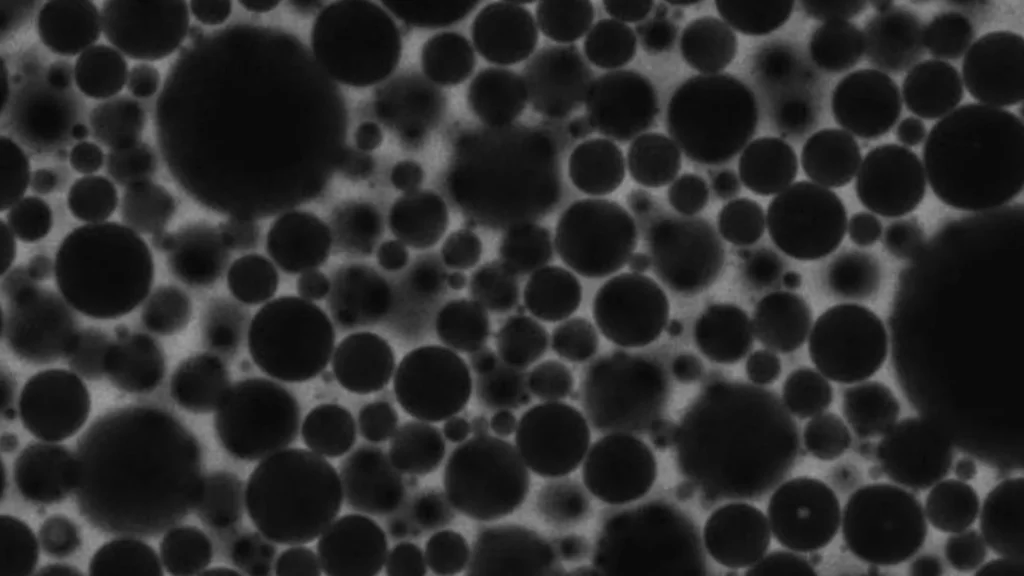
Foams, ubiquitous in everyday life as familiar substances like soap suds, the froth of a cappuccino, the stable structure of shaving cream, or the complex emulsions found in mayonnaise and whipped toppings, have long been a subject of scientific inquiry. For many years, the prevailing scientific consensus held that foams behaved fundamentally like glass. This analogy suggested that their microscopic components—the individual bubbles—were essentially locked into disordered but largely fixed positions, creating a rigid, albeit non-crystalline, internal structure that contributed to their macroscopic stability. This long-standing view, deeply embedded in materials science, is now being fundamentally challenged by groundbreaking new research.
Engineers at the University of Pennsylvania have published findings that dramatically reframe our understanding of these seemingly simple materials. Their research indicates that while foams outwardly maintain their characteristic shape and structure, their internal architecture is far from static. Instead, the myriad bubbles within a foam are in constant, dynamic motion. Even more remarkably, the complex mathematical principles that govern this ceaseless internal reorganization bear a striking resemblance to the sophisticated algorithms underpinning deep learning, the very technique that powers modern artificial intelligence systems.
This unexpected discovery, detailed in a recent publication in the Proceedings of the National Academy of Sciences, proposes a profound and unifying concept: that "learning," understood in a broad mathematical sense, may represent a shared organizational principle spanning a vast spectrum of systems—from the purely physical and chemical to the biological and computational. The implications of this work extend far beyond the immediate realm of foam physics. It could provide a crucial roadmap for future innovations in materials science, guiding the development of novel substances designed to adapt and respond autonomously to their surrounding environments. Furthermore, it offers a fresh perspective for scientists striving to comprehend the intricate dynamics of living structures, such as the internal scaffolding of cells, which must continually reorganize and adapt to sustain life.
Bubbles in Perpetual Motion: Defying Static Expectations
The study employed advanced computer simulations to meticulously track the individual movements of bubbles within a wet foam. Contrary to traditional expectations, which predicted that bubbles would eventually settle into stationary, low-energy configurations, the simulations revealed a persistent and surprising phenomenon: the bubbles never truly settled. Instead, they continuously wandered through a vast array of possible arrangements, a perpetual internal dance that defied the notion of a static, equilibrium state.
From a purely mathematical standpoint, this observed behavior exhibited a profound similarity to the operational mechanics of deep learning algorithms. In the training phase of an artificial intelligence system, the AI repeatedly adjusts its numerous parameters – the intricate numerical values that encapsulate its accumulated "knowledge" or understanding – rather than converging on a single, immutable final state. This iterative, non-convergent adjustment is crucial for the AI’s ability to learn and generalize. The Penn researchers found this iterative adjustment mirrored in the seemingly chaotic yet organized motion of foam bubbles.
John C. Crocker, a Professor in Chemical and Biomolecular Engineering (CBE) at the University of Pennsylvania and co-senior author of the paper, emphasized the significance of this observation. "Foams constantly reorganize themselves," Professor Crocker stated. "It’s striking that foams and modern AI systems appear to follow the same mathematical principles. Understanding why that happens is still an open question, but it could reshape how we think about adaptive materials and even living systems." This statement underscores the potential for a paradigm shift in how scientists approach various complex systems.
Challenging Decades of Foam Physics
To fully appreciate the impact of this new research, it is essential to understand the historical context of foam science. Foams, despite their delicate appearance, often behave like solids at the macroscopic, human scale. They typically retain their shape, can support loads, and even exhibit elasticity, springing back after being compressed. Think of the resilience of a memory foam mattress or the structural integrity of a meringue. However, at much smaller, microscopic scales, foams are classified as "two-phase" materials. They consist of a gas (the bubbles) dispersed within a liquid or solid continuous phase.
For generations, scientists have utilized foams as invaluable model systems for studying a wide range of other dense and dynamic materials. Their ease of creation and observation, combined with their surprisingly complex mechanical behavior, made them ideal candidates for understanding phenomena relevant to granular materials, colloids, and even living cells. The traditional theoretical framework for understanding foam dynamics drew heavily from concepts in statistical mechanics and thermodynamics. This framework often treated foam bubbles akin to rocks rolling across an "energy landscape." In this conceptual model, individual bubbles, or groups of bubbles, were presumed to move "downhill" into positions that required less energy to maintain. Once they reached these energetic minima—the "bottom of the valleys"—they were expected to settle and remain there, much like a boulder coming to rest in a valley. This theoretical construct largely explained why foams, once formed, appear stable and maintain their structure over time.
The Emergence of a Mismatch: Theory Versus Reality
The elegant simplicity of this traditional theory, however, began to show cracks when researchers delved deeper into the actual, empirical behavior of foams. When experimental data and more sophisticated observations became available, a significant mismatch emerged between theoretical predictions and observed reality. According to Professor Crocker, the earliest signs of these discrepancies began to appear nearly two decades ago. Despite these early indications, the scientific community lacked the appropriate mathematical tools and theoretical frameworks to fully explain the anomalous behavior they were witnessing.
"When we actually looked at the data, the behavior of foams didn’t match what the theory predicted," Crocker recalled. "We started seeing these discrepancies nearly 20 years ago, but we didn’t yet have the mathematical tools to describe what was really happening." This period highlights a crucial juncture in scientific discovery: the recognition of an empirical puzzle that existing paradigms cannot solve, necessitating a fundamental re-evaluation and the search for entirely new conceptual instruments. Solving this particular puzzle demanded an innovative approach—one capable of describing complex systems that exhibit continuous change and dynamic reorganization without ever settling into a single, static, or "fixed" arrangement.
Lessons from the World of Artificial Intelligence
The solution to this long-standing puzzle unexpectedly arrived from a seemingly unrelated field: artificial intelligence, specifically the realm of deep learning. Modern AI systems learn by iteratively and continuously adjusting countless numerical parameters during their training phase. Early attempts to optimize these systems often focused on driving them towards a single, "optimal" solution—a deep, singular minimum in the error landscape that perfectly matched their training data. The goal was to achieve the absolute best possible fit.
Deep learning, however, relies on sophisticated optimization methods, predominantly those related to a mathematical technique known as gradient descent. This method iteratively guides a system toward configurations that progressively reduce error, step by step, conceptually akin to a ball rolling downhill across a complex, multi-dimensional landscape. Over time, as AI research progressed, a critical insight emerged: pushing these models too aggressively into the absolute deepest possible solutions or error minima often led to problems. Systems that were perfectly fitted to their training data became overly specialized, fragile, and performed poorly when confronted with new, unseen information—a phenomenon known as "overfitting."
This realization prompted a shift in the philosophy of AI optimization. Researchers discovered that better generalization and robustness in AI models could be achieved not by seeking the single deepest valley, but by allowing the system to operate within "flatter parts of the landscape." In these flatter regions, numerous solutions perform similarly well, offering a degree of flexibility and adaptability.
Robert Riggleman, also a Professor in CBE and co-senior author of the paper, elaborated on this crucial insight. "The key insight was realizing that you don’t actually want to push the system into the deepest possible valley," Riggleman explained. "Keeping it in flatter parts of the landscape, where lots of solutions perform similarly well, turns out to be what allows these models to generalize." This shift from seeking absolute perfection to embracing robust variability proved transformative for AI development.
The Uncanny Convergence: Foams and AI Following the Same Rules
Armed with this refined understanding of deep learning dynamics and optimization landscapes, the University of Pennsylvania team revisited their extensive foam data. The similarity, once viewed through this new lens, became strikingly clear and undeniable. Foam bubbles, much like the parameters in a well-trained deep learning model, do not settle into deep, singular, stable positions. Instead, they persist in a state of continuous motion, navigating within broad regions of their phase space where a multitude of configurations are equally viable and energetically favorable.
This ongoing, dynamic motion in foams directly parallels the operational modus operandi of modern AI systems during their learning processes. The very same mathematical principles and concepts that have been developed and refined to explain the efficacy and robustness of deep learning—particularly the notion of exploring "flat minima" for better generalization—also precisely capture and explain the intricate internal behavior that foams have been exhibiting all along, often unacknowledged or misunderstood by traditional theories.
Profound Implications for Materials Science, Biology, and Beyond
The findings from the University of Pennsylvania team are poised to generate significant ripple effects across multiple scientific disciplines. First and foremost, they raise fundamental new questions in a field that many scientists believed was already comprehensively understood. This alone—the act of challenging established paradigms and prompting a re-evaluation of basic principles—may be one of the study’s most important contributions. By demonstrating that foam bubbles are not merely frozen in glass-like states but instead engage in a dynamic, learning-algorithm-like dance, the research compels scientists to reconsider the underlying mechanics and behavior of other complex systems previously considered static or predictably stable.
In materials science, this discovery opens up an exciting frontier for the design and engineering of novel adaptive materials. Imagine materials that can inherently "learn" and respond to changes in their environment, self-healing minor damage, adjusting their rigidity or porosity in real-time, or even altering their optical properties based on external stimuli. The mathematical principles revealed in foam dynamics could provide the theoretical foundation for creating "intelligent" materials with unprecedented capabilities for sensing, adapting, and interacting with their surroundings.
The implications for biology are equally profound. Professor Crocker’s team is already turning its attention back to a system that initially sparked his interest in foams: the cytoskeleton. This intricate, dynamic microscopic framework exists inside nearly every living cell, providing structural support, facilitating cell division, enabling movement, and orchestrating intracellular transport. Like foam, the cytoskeleton is a highly dynamic structure that must continually reorganize and adapt to cellular needs while simultaneously preserving its overall structural integrity and function. The parallel mathematical principles observed between foams and AI could offer a revolutionary new framework for understanding how cells manage this constant, vital reorganization—how they "learn" to maintain homeostasis and respond to biological cues. This could shed light on processes from embryonic development to disease progression.
Furthermore, this research hints at a deeper, more universal connection between physical reality and computational processes. The question of "why the mathematics of deep learning accurately characterizes foams" remains a fascinating and open area of inquiry, as Crocker notes. It suggests that these powerful mathematical tools, initially developed for artificial intelligence, may have applications far outside their original computational context. This could lead to entirely new lines of scientific inquiry, fostering interdisciplinary collaboration between physicists, materials scientists, biologists, and computer scientists. It could even inform the development of new AI architectures inspired by natural, self-organizing physical systems.
The research was meticulously conducted at the University of Pennsylvania School of Engineering and Applied Science, benefiting from the generous support of the National Science Foundation Division of Materials Research (grants 1609525, 1720530). This funding was instrumental in enabling the sophisticated computer simulations and detailed analysis required for such a groundbreaking study. Additional co-authors who contributed significantly to this work include Amruthesh Thirumalaiswamy and Clary Rodríguez-Cruz, whose expertise and dedication were vital to the project’s success. This study not only offers a fresh perspective on a familiar material but also serves as a compelling reminder that the most profound scientific discoveries often emerge from unexpected connections across seemingly disparate fields.