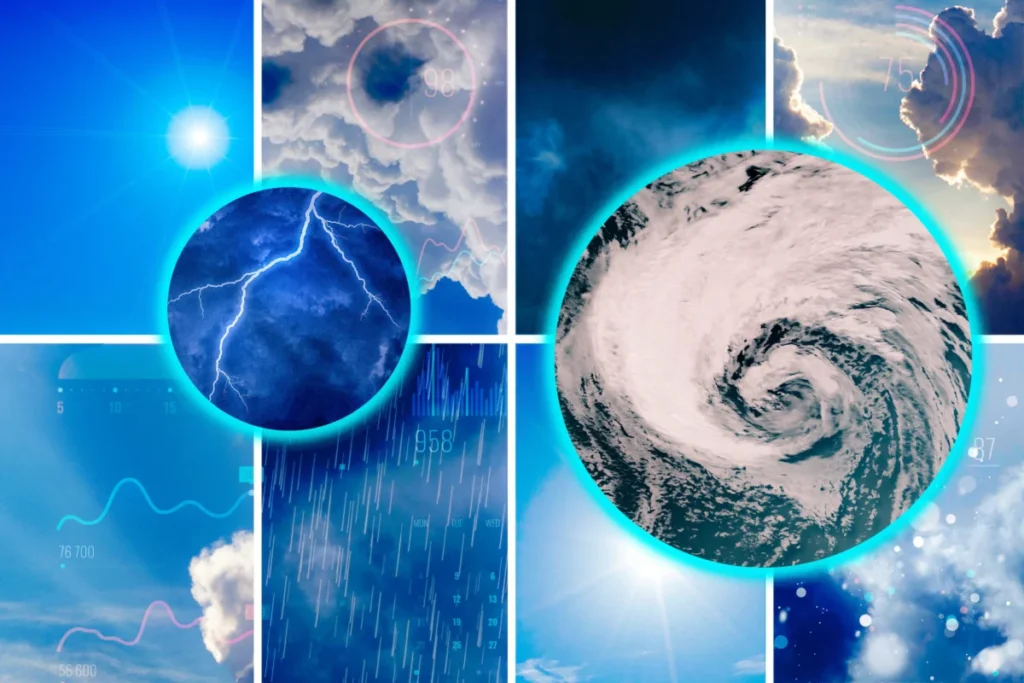
Can a city’s seawall stand up to a blockbuster storm? Will a region’s power grid hold against record-breaking heat? And can a town’s fire-fighting resources contain a major wildfire? These critical questions, once fraught with uncertainty due to the inherent unpredictability of extreme events, may soon find more definitive answers thanks to a groundbreaking new tool developed by engineers at the Massachusetts Institute of Technology (MIT). This innovative machine-learning algorithm generates plausible worst-case scenarios for extreme events, mapping their potential duration, intensity, and area of impact, crucially without relying on historical data of past extremes.
The core challenge in preparing for extreme events – whether natural disasters like hurricanes, heatwaves, and wildfires, or societal disruptions like financial market crashes – has always been their statistical rarity. By their very nature, these are outliers, sporadic occurrences that defy easy categorization within conventional historical records. Traditional risk assessment methods are largely retrospective, depending on past extreme events to characterize even more severe, hypothetical future scenarios. This backward-looking approach creates a significant blind spot, as the most devastating future events may be those that have simply never occurred within recorded history.
This is precisely the gap that the MIT team, led by Kai Chang SM ’25, a PhD student in the MIT Center for Computational Science and Engineering, and Themis Sapsis, the William I. Koch Professor of Mechanical and Ocean Engineering at MIT, has sought to fill. Their method, dubbed "Extreme Event Aware" or "η-learning," represents a paradigm shift in how communities, policymakers, and industries can anticipate and prepare for the unimaginable. Published on August 20 in the journal Nature Communications, their open-access paper details an approach that promises to enhance national and economic resilience in an increasingly volatile world.
The Inadequacy of Past Data in a Changing Climate
The urgency for such a tool has never been greater. The past few decades have witnessed a clear and alarming trend: extreme weather events are becoming more frequent, more intense, and more destructive. Scientific consensus, particularly highlighted by reports from the Intergovernmental Panel on Climate Change (IPCC), indicates that human-induced climate change is exacerbating these phenomena. Record-breaking heatwaves have crippled infrastructure and endangered public health across continents, while intensified storm systems have caused unprecedented flooding and devastation. Wildfires, fueled by prolonged droughts and hotter temperatures, rage with increasing ferocity and scale, obliterating communities and vast natural landscapes.
Consider the stark reality of recent years:
- Hurricane Katrina (2005): A Category 5 hurricane that made landfall as a Category 3, devastating New Orleans and the Gulf Coast, causing over 1,800 fatalities and an estimated $125 billion in damages. While a historic event, climate models suggest the potential for even stronger, slower-moving storms.
- California Wildfires (e.g., Camp Fire 2018, Dixie Fire 2021): These megafires have repeatedly set records for size, destruction, and loss of life, overwhelming firefighting resources and displacing hundreds of thousands. The conditions leading to such fires are becoming more common.
- European Heatwaves (e.g., 2003, 2022): Caused tens of thousands of deaths and placed immense strain on energy grids, transportation, and healthcare systems. Future heatwaves are projected to be even hotter and longer-lasting.
These events underscore a critical limitation in current risk assessment: how do you plan for a "once-in-a-century" event when the definition of a century is rapidly changing, and when the most extreme events of the past may no longer represent the upper bounds of what is possible? "An event like Hurricane Katrina is something that happens every 30 to 40 years," explains Professor Sapsis. "What will be the Katrina that happens every 100 years? How bad will it be? That’s exactly what we’re trying to quantify, to help planners prepare for plausible extreme scenarios." Current models, often trained on historical data, struggle to extrapolate beyond observed maxima, leaving planners vulnerable to "unprecedented" scenarios.
η-learning: Generating the Unprecedented from the Plausible
The η-learning algorithm breaks this dependency on historical extreme data by learning from more common, daily records and statistically inferring the characteristics of events far beyond anything previously observed. Instead of looking for past examples of extreme deviations, the machine-learning algorithm analyzes a region’s daily weather records and maps, which may or may not contain past extreme deviations.
"We are trying to model extreme, unprecedented events that no one has seen before, that are not in the dataset," says Kai Chang. The method takes a sophisticated statistical approach to learn the underlying dynamics of a system, effectively building a statistical understanding of plausible scenarios and then pushing those boundaries to project events of specified rarity (e.g., once every 100 years). This means it can generate detailed maps of an extreme storm’s likely duration, intensity, and area of impact, even if such a storm has never been recorded.
The technical elegance of η-learning lies in its ability to combine and learn statistics about the relationships between two types of data: point statistics and spatial maps. To illustrate its power, the researchers applied the method to generate maps of future extreme precipitation events over the continental United States. They utilized 25 years of hourly precipitation maps, aggregated into daily maps. From this comprehensive record, they first computed point statistics, which describe the frequency with which the maximum rainfall across a map reached a given level.
Crucially, the algorithm was then trained on paired low- and high-resolution spatial maps from only the first six months of this record. This training period contained few, if any, examples of the most extreme rainfall levels. Yet, from this limited, non-extreme dataset, the algorithm learned the intricate patterns and correlations between low-resolution weather phenomena and their detailed, high-resolution precipitation outcomes. By combining this learned spatial mapping with the broader point statistics that define overall rainfall extremes, the algorithm can generate plausible spatial patterns for events far more extreme than those it was trained on.
For example, if New York City’s most extreme recorded rainfall was 200 millimeters, planners might ask: what kind of storm would produce an unprecedented 300 millimeters? This event has never been recorded, yet it is plausible. Traditional methods would struggle, but η-learning can simulate where such a storm might hit, its geographical spread, and its intensity. "We want to predict maps of these worst-case scenarios," Sapsis emphasizes. "There is no method that does this efficiently to predict events that happen rarely."
A user can prompt the trained algorithm with a question such as, "What could a once-in-a-century storm look like in New York City?" The algorithm then generates thousands of possible realizations of statistically plausible storms, detailing characteristics such as the storm’s size, area of coverage, and intensity of rainfall. This provides a rich dataset for robust planning. "Someone can say, ‘I’m interested in building things to withstand the risk of an event that happens every 100 years,’" Chang explains. "What we can do then is produce thousands of possible realizations that will happen with this sort of rare frequency."
Broadening the Scope: Beyond Weather to Finance and Robotics
The versatility of the η-learning approach extends far beyond meteorological phenomena. The team foresees its application in diverse fields where extreme, rare events carry significant consequences. One particularly intriguing area is financial markets. "Financial market crashes are extreme events that are a complicated combination of things, involving many different sectors," Chang notes. "What is the interaction that leads to a market crash? That is something that this method could explore."
Imagine a tool that could generate plausible, yet unprecedented, financial Black Swan events, allowing regulators, banks, and investors to stress-test their systems against scenarios that have never occurred but remain statistically possible. This could revolutionize risk management and systemic stability. Similarly, in robotic navigation, understanding and predicting rare, extreme environmental conditions or system failures could lead to more robust and safer autonomous systems. The common thread is the need to model the behavior of complex systems under extreme, unobserved conditions. As long as relevant point statistics and spatial data are available, the method could be adapted to visualize other unprecedented events such as extreme floods, tsunamis, or even geopolitical disruptions.
Implications for National and Economic Resilience
The advent of η-learning carries profound implications for society’s ability to cope with an increasingly unpredictable future. Professor Sapsis underscores this by stating, "Extreme events have become a strategic concern, not just an environmental one – we’ve optimized global systems for efficiency, and the price of that efficiency is that there’s very little slack left anywhere. A single extreme event propagates through supply chains, energy markets, and food systems in weeks."
For Urban Planners and Policymakers: This tool offers an unprecedented ability to conduct forward-looking vulnerability assessments. Cities can simulate the impact of a "once-in-500-year" flood on their subway systems, a "once-in-200-year" heatwave on their power grids, or an "unprecedented" wildfire on their urban-wildland interface. This data can inform crucial decisions regarding infrastructure upgrades, land-use planning, building codes, and emergency evacuation routes. It shifts planning from a reactive stance, based on past failures, to a proactive one, preparing for future possibilities.
For the Insurance Industry: Insurers, who bear a significant portion of the financial burden from extreme events, will gain a more sophisticated understanding of catastrophic risk. This could lead to more accurate premium modeling, the development of new insurance products tailored to unprecedented risks, and better capital allocation to cover potential losses. The ability to quantify the probability of events that haven’t happened yet is invaluable for an industry built on risk assessment.
For Emergency Management and First Responders: Predicting the characteristics of extreme events — their potential scale, intensity, and duration — allows emergency services to optimize resource deployment, plan effective response strategies, and conduct more realistic training exercises. Understanding the plausible worst-case scenario for a wildfire, for instance, could dictate where additional firefighting assets are pre-positioned or where early evacuation orders are issued.
For Businesses and Supply Chains: In a globally interconnected economy, a localized extreme event can trigger cascading failures across international supply chains. The η-learning tool could help businesses identify critical vulnerabilities and build greater resilience into their operations, from diversifying sourcing to redesigning logistics networks.
The research received vital support, in part, from a Vannevar Bush Faculty Fellowship and the U.S. Air Force Office of Scientific Research, underscoring the strategic importance of this kind of predictive capability for national security and economic stability.
In essence, η-learning moves humanity closer to a future where preparation is not merely a response to history, but a proactive defense against the full spectrum of plausible, even if never-before-seen, extreme events. "Being able to put a probability on an event that hasn’t happened yet is now a question of national and economic resilience," concludes Professor Sapsis. This MIT innovation marks a significant leap forward in our capacity to understand, anticipate, and mitigate the most severe challenges of the 21st century.