Theoretical physicists from Goethe University Frankfurt and TU Wien have announced a landmark discovery in the field of general relativity, successfully deriving an exact mathematical formula to describe the "critical collapse" of spacetime into microscopic black holes. By employing an unconventional mathematical technique that involves calculating physical equations in an infinite number of dimensions, the research team has provided a definitive analytical framework for a phenomenon that has puzzled scientists since it was first observed in computer simulations over three decades ago. This breakthrough not only clarifies the formation of "spacetime crystals"—unstable, repeating patterns in the fabric of the universe—but also offers a new lens through which to view the early moments of the cosmos and the potential existence of primordial black holes.
The Mystery of Critical Collapse and Microscopic Black Holes
In the traditional understanding of astrophysics, black holes are the remnants of massive stars that have exhausted their nuclear fuel and collapsed under the weight of their own gravity. These "stellar-mass" black holes, along with the supermassive giants found at the centers of galaxies, represent the most extreme densities allowed by physics. However, Albert Einstein’s general theory of relativity does not specify a minimum mass for a black hole. Theoretically, if enough energy or matter is compressed into a sufficiently small volume, a black hole can form regardless of its initial size.
The process through which these tiny objects form is known as critical collapse. In this state, a physical system—such as a cloud of particles or a wave of energy—exists on a razor-thin edge between two outcomes: dispersing back into the void or collapsing into a singularity. This "tipping point" is highly sensitive; a negligible addition of energy can fundamentally alter the fate of the local spacetime.
While the existence of such states was predicted mathematically, they were first visualized in 1993 by physicist Matthew Choptuik. Using high-powered computer simulations, Choptuik discovered that at the threshold of black hole formation, spacetime does not simply curve; it organizes itself into a self-similar, repeating structure. This structure is what modern physicists now refer to as a "spacetime crystal." For thirty years, the exact mathematical laws governing this transition remained elusive, confined to the realm of numerical approximation rather than exact formulas.
The Spacetime Crystal: A Phase Transition of Gravity
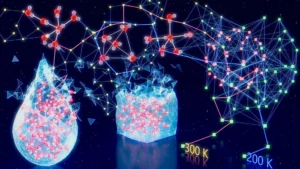
To explain the nature of this discovery, the researchers point to the familiar physics of phase transitions. Prof. Daniel Grumiller of TU Wien compares the phenomenon to the freezing of water. At exactly zero degrees Celsius, water molecules undergo a spontaneous reorganization, moving from a chaotic liquid state to a rigid, repeating geometric pattern known as an ice crystal.
In the context of general relativity, spacetime acts as the medium. According to Einstein, mass and energy curve spacetime. Under the extreme conditions of critical collapse, the curvature of spacetime itself begins to mimic the behavior of matter during a phase transition. The resulting "spacetime crystal" is an unstable intermediate state. It is a moment of perfect, albeit fleeting, balance. If the system loses a fraction of energy, the crystal dissolves, and the spacetime returns to its flat, "ordinary" state. If it gains even a microscopic amount of energy, the crystal geometry fails, and the region collapses into a black hole.
This "all-or-nothing" behavior is a hallmark of critical phenomena in physics. The Frankfurt and Vienna team has finally managed to write down the "recipe" for this transition, moving beyond the "trial and error" of computer simulations to the certainty of an analytical solution.
The Infinite Dimension Shortcut
The primary obstacle in solving the equations for critical collapse lies in the complexity of four-dimensional spacetime (three dimensions of space and one of time). The Einstein field equations, which describe how gravity works, are a set of ten interrelated differential equations that are notoriously difficult to solve exactly, especially in dynamic, non-linear scenarios like a collapsing star or wave.
To bypass this complexity, Christian Ecker, Daniel Grumiller, and Florian Ecker utilized a mathematical "detour." They began by performing their calculations in a hypothetical universe with an infinite number of dimensions.
"Our universe has four dimensions," explains Christian Ecker of the Institute for Theoretical Physics at Goethe University Frankfurt. "But in principle, nothing prevents us from writing down physical equations for a larger number of dimensions."
In a counterintuitive twist of mathematical physics, adding dimensions can actually simplify a problem. When the number of dimensions approaches infinity, many of the chaotic interactions that occur in lower dimensions "average out," allowing researchers to identify core patterns that are otherwise obscured. This technique, often used in thermodynamics and statistical mechanics (known as mean-field theory), allowed the team to derive an exact formula for the critical collapse.
Once the solution was found in infinite dimensions, the researchers were then able to translate the findings back into the context of our four-dimensional reality. This process revealed that the "infinite-dimensional" solution remained remarkably stable and accurate when applied to lower dimensions, providing a robust approximation that could be refined with further mathematical tools.
Chronology of Discovery: From 1915 to 2024
The journey toward understanding the spacetime crystal spans more than a century of theoretical physics:
- 1915: Albert Einstein publishes the General Theory of Relativity, establishing that gravity is the result of the curvature of spacetime.
- 1916: Karl Schwarzschild derives the first exact solution to Einstein’s equations, describing what we now call a black hole.
- 1960s-1970s: The "Golden Age of Black Hole Physics" sees researchers like Stephen Hawking and Roger Penrose define the laws of black hole thermodynamics and singularities.
- 1993: Matthew Choptuik uses numerical relativity to discover "critical phenomena" in gravitational collapse. He finds that the mass of the resulting black hole follows a power-law scaling, a discovery that shocks the physics community.
- 2000s-2010s: Physicists attempt to find an analytical "paper and pencil" derivation of Choptuik’s scaling laws, but the math remains too complex for 4D spacetime.
- 2024: Researchers from Frankfurt and Vienna publish their findings using the infinite-dimension approach, providing the first exact formula for the spacetime crystal and the critical collapse process.
Implications for the Early Universe and Dark Matter
The ability to describe microscopic black hole formation mathematically has profound implications for cosmology. Scientists believe that the conditions required for critical collapse—extreme density and high energy—were prevalent in the microseconds following the Big Bang.
During this era, the universe was a "primordial soup" of energy and particles. Fluctuations in density could have triggered critical collapses, leading to the creation of Primordial Black Holes (PBHs). Unlike stellar-mass black holes, PBHs could be as small as a grain of sand or as massive as a planet.
If PBHs exist, they are a leading candidate for dark matter—the invisible substance that makes up roughly 85% of the matter in the universe. Until now, the study of PBH formation relied heavily on simulations. The new analytical formula provided by the Frankfurt-Vienna team allows cosmologists to calculate the probability and mass distribution of these primordial objects with unprecedented precision.
Scientific Analysis: Precision and Universality
One of the most significant aspects of the new formula is its "universality." In physics, a universal law is one that applies regardless of the specific details of the system. Whether the collapse is triggered by a pulse of light (electromagnetic waves) or a concentration of particles (scalar fields), the underlying mathematical structure of the critical collapse remains the same.
"Our technique turns out to be remarkably stable," says Florian Ecker of TU Wien. "Depending on the desired precision, we can systematically improve our formulas using additional approximation methods."
This stability suggests that the infinite-dimension approach is not just a mathematical trick, but a fundamental insight into how gravity operates at its limits. By moving away from the "black box" of computer simulations, physicists can now see the "gears" of the universe turning. This clarity is essential for developing a theory of quantum gravity—the "Holy Grail" of modern physics that seeks to unite Einstein’s relativity with the laws of quantum mechanics.
Broader Impact on Theoretical Physics
The success of the infinite-dimension method in solving the problem of critical collapse is likely to encourage its application to other "unsolvable" problems in general relativity. For instance, the study of gravitational waves, the behavior of matter inside a neutron star, and the nature of singularities could all benefit from this mathematical detour.
Furthermore, the concept of the "spacetime crystal" adds a new layer to our understanding of the geometry of the universe. It suggests that spacetime is far more dynamic and "fluid" than previously thought, capable of organizing itself into complex, fleeting structures that represent the ultimate threshold of physical existence.
As the scientific community digests these findings, the focus will shift toward experimental verification. While observing a microscopic black hole formation in real-time is currently beyond our technological reach, astronomers may search for the "fingerprints" of these events in the Cosmic Microwave Background (CMB) radiation or through the detection of Hawking radiation from evaporating primordial black holes.
In the words of the research team, this discovery marks the end of a long mathematical drought. After thirty years of observing the "what" through computer screens, physicists finally have the "how" written down on paper. The derivation of the exact formula for critical collapse stands as a testament to the power of unconventional thinking in the pursuit of the universe’s deepest secrets.