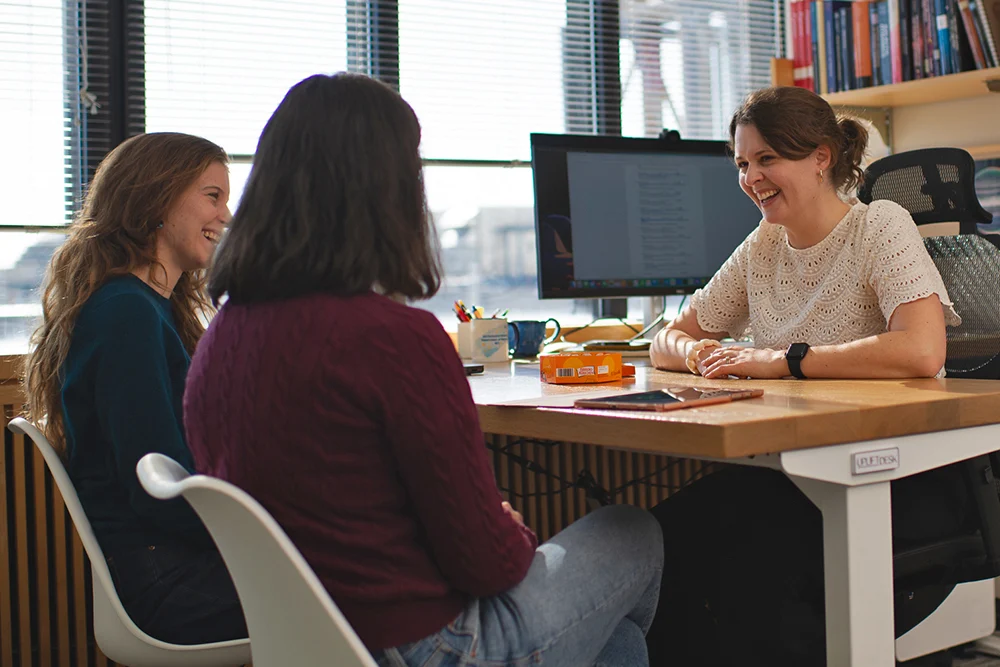
Professor Anna-Christina Eilers, a distinguished observational astrophysicist at the Massachusetts Institute of Technology (MIT), has been formally recognized for her transformative approach to graduate mentorship through the "Committed to Caring" (C2C) initiative. An assistant professor within the MIT Department of Physics and a member of the Kavli Institute for Astrophysics and Space Research, Eilers has cultivated a research environment that balances rigorous scientific inquiry with a profound commitment to the personal and professional well-being of her students. This recognition comes at a pivotal time in higher education, as academic institutions increasingly grapple with the necessity of fostering sustainable research cultures that prioritize mental health and community alongside technical achievement.
The Committed to Caring program, an initiative led by the MIT Office of Graduate Education (OGE), seeks to highlight faculty members who go beyond the standard requirements of advising. Nominated by their own students, recipients are selected based on their ability to model inclusive leadership, provide emotional and professional support, and advocate for the holistic development of graduate researchers. For Eilers, the honor reflects a philosophy where mentorship is not defined by grand pronouncements, but by a consistent series of small, intentional gestures that build trust and resilience within her research group.
The Science of the Early Universe: A Context for High-Stakes Research
To understand the impact of Eilers’ mentorship, one must consider the demanding nature of her field. As an observational astrophysicist, Eilers operates at the forefront of human knowledge regarding the "cosmic dawn"—the period roughly 13 billion years ago when the first stars and galaxies began to illuminate the dark, neutral hydrogen-filled universe. Her research focuses on the formation and growth of supermassive black holes, which reside at the centers of galaxies.
The questions Eilers tackles are among the most complex in modern physics: How did black holes grow to be millions or billions of times the mass of the sun so shortly after the Big Bang? What was the timeline of the epoch of reionization? To answer these, her team utilizes data from the world’s most advanced observatories, including the James Webb Space Telescope (JWST) and the Very Large Telescope (VLT). The high-stakes nature of this research—involving competitive grant cycles, intense data analysis, and the pressure of being first to publish in high-impact journals—can often lead to a high-stress environment for graduate students.
In this context, Eilers’ mentorship acts as a critical stabilizer. Her students report that while she maintains high expectations for scientific rigor, she ensures that the pressure of the field does not translate into personal burnout. By providing a structured yet empathetic environment, she allows her researchers to navigate the uncertainties of "frontier science" with greater confidence.
Chronology of Academic and Mentorship Excellence
The trajectory of Professor Eilers’ career provides insight into the origins of her mentorship style. Before joining the MIT faculty in 2021, Eilers completed her doctoral studies at the Max Planck Institute for Astronomy in Heidelberg, Germany, followed by a prestigious NASA Einstein Fellowship. Throughout her journey, she was influenced by mentors who demonstrated that scientific excellence and personal integrity are not mutually exclusive.
Since establishing her research group at MIT, Eilers has focused on institutionalizing these values. The chronology of her group’s development shows a steady move toward a "community-first" model.
- 2021-2022: Establishment of the Eilers Group at MIT; implementation of "open-door" feedback policies.
- 2023: Integration of collaborative traditions, such as the "traveler’s treat" exchange, to bridge the gap between individual research trips and group learning.
- 2024: Formal nomination and selection for the "Committed to Caring" honor, following a period of significant group output, including multiple high-profile publications in journals such as Nature and The Astrophysical Journal.
The Mechanics of "Everyday Mentorship"
The nominations submitted by Eilers’ students highlight a recurring theme: consistency. In many academic settings, graduate students struggle with "ghosting" or delayed feedback from busy advisors. In contrast, Eilers’ mentees emphasize her reliability. Two students noted in a joint nomination that she "always keeps an eye out" for them, providing a safety net that allows them to take the intellectual risks necessary for breakthrough research.
Her support manifests in several distinct ways:
- Granular Academic Support: Eilers is known for her meticulous review of drafts. Rather than providing vague critiques, she offers detailed, timely feedback that helps students refine their technical writing and argumentation.
- Advocacy in Collaboration: In the often-competitive world of international research collaborations, Eilers takes an active role in protecting her students’ interests. When obstacles arise in multi-institutional projects, she steps in to negotiate and identify solutions, preventing external friction from derailing a student’s progress.
- Celebrating Milestones: Recognizing that the "long game" of a PhD can be grueling, Eilers marks successes with communal celebrations. Bringing favorite desserts to group meetings upon the publication of a paper serves as a tangible acknowledgment of hard work, reinforcing a culture of shared achievement.
Supporting Data: The Importance of Mentorship in STEM
The significance of Eilers’ approach is underscored by broader data regarding graduate student mental health. A 2018 study published in Nature Biotechnology found that graduate students are more than six times as likely to experience depression and anxiety compared to the general population. The study identified the relationship with one’s principal investigator (PI) as a primary factor in student well-being.
Furthermore, data from the Council of Graduate Schools suggests that "supportive advising" is one of the top predictors of PhD completion rates. By fostering a sense of belonging and providing clear professional pathways, mentors like Eilers contribute directly to the retention of talent in the STEM pipeline. Her insistence on students finding hobbies outside of the lab—advice she gives to every incoming researcher—is a evidence-based strategy to combat "identity fusion," where a student’s self-worth becomes entirely tied to their research results.
Institutional Impact and the "Committed to Caring" Initiative
The Committed to Caring initiative at MIT serves as more than just an award ceremony; it is a repository of best practices. By honoring Eilers, MIT signals to the broader academic community that the "lone genius" trope—the idea that great science requires a cold, hyper-competitive environment—is outdated.
The program’s selection process is rigorous, requiring multiple nominations that demonstrate a faculty member’s sustained commitment to several "pillars of care," including diversity, work-life balance, and professional development. Eilers’ selection highlights her success in the "Mentoring and Advising" pillar, specifically her ability to create a "hidden curriculum" of professional norms that helps students navigate the complexities of academia.
Broader Implications for the Scientific Community
The Eilers Group’s tradition of sharing treats and insights after research visits serves as a microcosm of a larger shift in scientific culture. This practice transforms what is typically an isolating experience—traveling alone to a conference or observatory—into a collective asset. It encourages students to think of themselves as part of a larger intellectual ecosystem, where the success of one member enriches the whole.
As Professor Eilers continues her work investigating the earliest black holes in the universe, her legacy is being written not just in the pages of scientific journals, but in the careers of the scientists she trains. Her approach suggests that the next generation of astrophysicists will be characterized by a new kind of excellence: one that is as much about human connection and integrity as it is about cosmic discovery.
The implications of this mentorship model extend beyond the MIT Kavli Institute. As funding agencies like the National Science Foundation (NSF) and NASA place increasing emphasis on "broader impacts" and the training of a diverse workforce, the Eilers model provides a blueprint for how labs can meet these requirements while maintaining world-class research output.
In her own reflections on the honor, Eilers credits her own mentors for modeling the balance between scientific challenge and personal support. By passing these values down, she ensures that the "cosmic dawn" of her students’ careers is marked by the same clarity and light that she seeks in the furthest reaches of the universe. Through the steady application of care, Eilers proves that the conditions for excellence are best cultivated in an environment where every researcher feels seen, supported, and valued as a whole person.