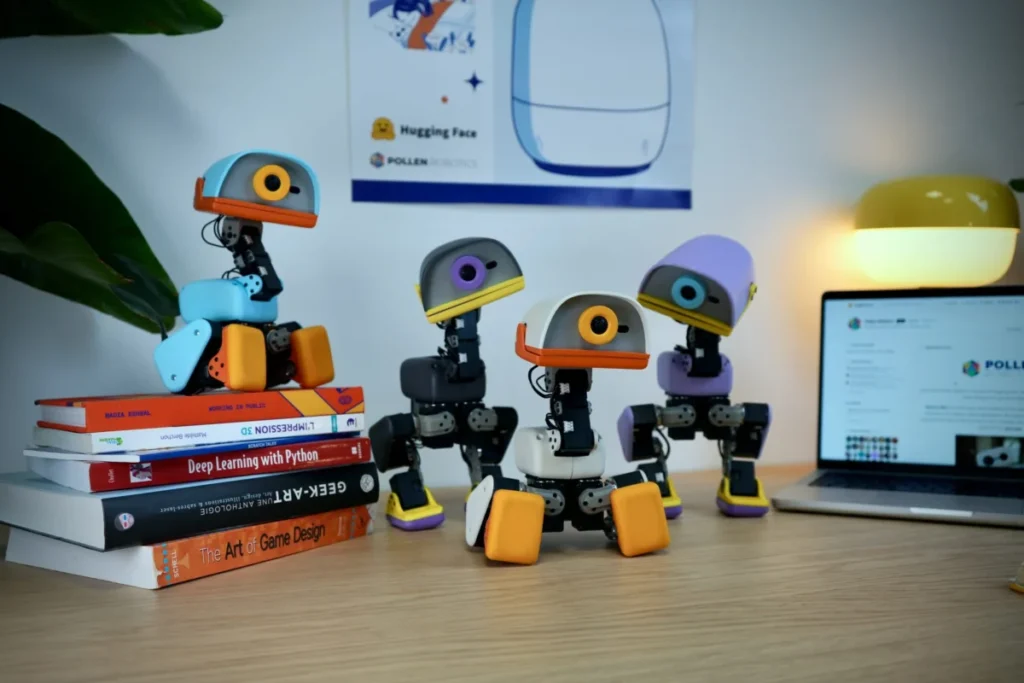
The intersection of robotics and artificial intelligence has reached a new milestone with the official introduction of Microduck, a compact, bipedal robot designed to democratize access to advanced machine learning techniques. Developed through a strategic partnership between the AI platform Hugging Face and the robotics firm Pollen Robotics, Microduck is positioned as an affordable, open-source platform specifically tailored for reinforcement learning (RL) experimentation. Priced at $400, the robot aims to bridge the gap between high-end research laboratories and the burgeoning community of DIY enthusiasts, educators, and independent developers.
The announcement marks a significant evolution in the field of small-scale robotics, offering a sophisticated yet accessible hardware solution for those looking to master the complexities of bipedal locomotion and autonomous behavior. By providing a fully open-source software development kit (SDK) and a transparent hardware design, the creators of Microduck are fostering an ecosystem where the community can contribute to the robot’s capabilities, potentially accelerating the development of consumer-grade robotics.
The Evolutionary Lineage of the Microduck
The journey toward the creation of Microduck began with the public fascination surrounding Disney’s BDX droids. These highly expressive, bipedal robots, developed by Disney Research, captured global attention for their lifelike movement and "charming" personalities. While the Disney technology remained proprietary, it sparked a movement within the maker community to replicate such fluid, expressive movement in a more accessible format.
This enthusiasm led to the creation of the Open Duck Mini, a community-driven project that sought to bring bipedal walking to the DIY space. Recognizing the potential of this movement, Hugging Face—a leader in open-source artificial intelligence—and Pollen Robotics—known for their sophisticated humanoid platforms like Reachy—collaborated to refine the concept. The result is Microduck: a commercialized, refined version of the open-source spirit that inspired the project. This lineage highlights a growing trend in the technology sector where professional-grade engineering meets grassroots innovation to produce tools that are both functional and educational.
Technical Specifications and Reinforcement Learning
At its core, Microduck is a laboratory for reinforcement learning. Unlike traditional robotics, where every movement is meticulously programmed by a human engineer, reinforcement learning allows a robot to learn tasks through trial and error. By rewarding "successful" behaviors (such as maintaining balance or moving forward) and penalizing "failures" (such as falling), the robot gradually develops its own unique gait and behavioral patterns.
This approach to robotics is what gives the Microduck its distinctive personality. The robot’s "pigeon-toed" walk and "bowlegged" skating maneuvers are not necessarily the result of human design but are rather the optimal solutions found by the AI models during training. This creates a bridge between the digital world of code and the physical world of movement, providing a tangible output for complex algorithmic calculations.

The technical framework of Microduck includes:
- Open Source SDK: The software is entirely accessible, allowing developers to modify the underlying code to suit their specific research needs.
- GitHub Integration: The repository is hosted on GitHub, ensuring that updates, bug fixes, and community-contributed features are shared globally.
- Trainable Voice: Each Microduck is equipped with the capability to generate its own "voice," adding an auditory layer to its interactive potential.
- Affordable Hardware: By utilizing cost-effective components and efficient manufacturing processes, the $400 price point makes it one of the most accessible bipedal platforms on the market.
The Design Philosophy: Why Charm Matters in Robotics
While the technical capabilities of Microduck are impressive, its physical design is equally intentional. In the field of Human-Robot Interaction (HRI), the "Uncanny Valley" refers to the discomfort humans feel when a robot looks almost—but not quite—human. Microduck avoids this by leaning into a stylized, non-threatening aesthetic.
The developers have noted that the robot’s "cute" proportions and clumsy movements serve a practical purpose. In the context of reinforcement learning, failure is an inevitability. A robot will fall hundreds of times before it learns to walk. When a large, industrial robot falls, it is a costly and intimidating event. When a Microduck falls, it is perceived as an endearing part of the learning process. This psychological shift is crucial for educational environments, as it encourages students and hobbyists to experiment without the fear of damaging expensive, intimidating machinery.
The Role of Hugging Face and Pollen Robotics
The collaboration between Hugging Face and Pollen Robotics represents a synergy between software and hardware expertise. Hugging Face, often described as the "GitHub of AI," provides the platform for hosting the machine learning models that power the robot’s brain. Their involvement ensures that Microduck is integrated into the wider AI ecosystem, allowing users to leverage existing tools in natural language processing (NLP) and computer vision.
Pollen Robotics brings years of experience in creating interactive robotic systems. Their expertise ensures that the Microduck hardware is robust enough to handle the rigors of RL training while remaining simple enough for assembly and modification. By combining these two strengths, the partnership has created a product that is greater than the sum of its parts, providing a holistic solution for the next generation of roboticists.
Future Developments: Language Processing and Domestic Utility
While the current iteration of Microduck focuses primarily on locomotion and basic interaction, the roadmap for the platform is ambitious. One of the most anticipated developments is the integration of natural language processing. Although not currently onboard, the hardware is "technically feasible" for such upgrades.
Representatives from the development team have expressed confidence that the community will take the lead in this area. "I expect the community to build it in a matter of weeks after the first users get their robots," a spokesperson noted regarding voice command integration. This community-first approach means that the Microduck you buy today could significantly increase in capability through software updates and community plugins.

Beyond simple interaction, there is potential for the robot to perform basic household tasks. While it won’t be washing dishes anytime soon, its ability to navigate environments and manipulate small objects suggests a future where these robots could assist with minor chores, such as tidying up lightweight debris or acting as mobile monitoring units.
Market Implications and the Democratization of Robotics
The launch of Microduck is part of a broader trend toward the democratization of robotics. Historically, bipedal robots were the exclusive domain of well-funded university labs and military contractors, with price tags often exceeding tens of thousands of dollars. The emergence of platforms like Microduck, alongside other affordable walking robots, suggests a shift in the market.
As the cost of entry drops, the barrier to innovation is lowered. This allows a more diverse group of people—including students in underfunded schools and independent inventors—to contribute to the field of robotics. The long-term implication is a faster rate of innovation, as more "minds" are working on solving the fundamental challenges of robotic balance, navigation, and interaction.
Chronology and Pre-order Information
The development of the Microduck has followed a rapid timeline:
- Late 2023: Disney debuts the BDX droids, sparking interest in expressive bipedalism.
- Early 2024: The Open Duck Mini project is launched by the DIY community.
- Mid 2024: Hugging Face and Pollen Robotics announce their partnership to professionalize the platform.
- Late 2024: Pre-orders for Microduck officially open to the public.
- Target Delivery: First units are scheduled for delivery before Christmas 2026.
Potential users and researchers can find more information and secure their units at the official Pollen Robotics website. As the delivery date approaches, the developers plan to release more documentation and tutorials to help users hit the ground running when their "squad" of ducks arrives.
Conclusion
Microduck represents a significant step forward in making advanced robotics accessible to the masses. By prioritizing open-source principles and focusing on the educational potential of reinforcement learning, Pollen Robotics and Hugging Face are not just selling a toy; they are providing a gateway into the future of artificial intelligence and physical automation. While the "macro charm" of these micro-robots is undeniable, their true value lies in the complex, autonomous future they are helping to build, one waddling step at a time. For the robotics community, the message is clear: the excuses for not experimenting with walking robots are rapidly disappearing.