The common material found in the core of a standard pencil is revealing a hidden, sophisticated world of quantum mechanics that challenges long-held assumptions in condensed matter physics. In a landmark study published today in the journal Nature, a research team led by the Massachusetts Institute of Technology (MIT) has identified that a specific microscopic arrangement of natural graphite can host multiple, distinct superconducting states. This discovery is particularly significant because while superconductivity—a state where electrons move with zero electrical resistance—has been observed in thousands of materials, the presence of multiple superconducting phases within a single, chemically simple material is an exceedingly rare phenomenon.
The researchers, headed by Long Ju, the Lawrence C. and Sarah W. Biedenharn Associate Professor of Physics at MIT, focused their investigation on rhombohedral graphene. This material is an atomically thin exfoliation of graphite, consisting of four or five layers of carbon atoms arranged in a precise, staircase-like lattice. Unlike the more common Bernal-stacked graphite found in most industrial applications, the rhombohedral configuration provides a unique electronic environment that allows for the emergence of unconventional physical properties. Perhaps most strikingly, the team found that several of these superconducting states not only survive in the presence of powerful magnetic fields but actually grow stronger—a behavior that contradicts the standard understanding of how superconductivity interacts with magnetism.
The Architecture of Rhombohedral Graphene
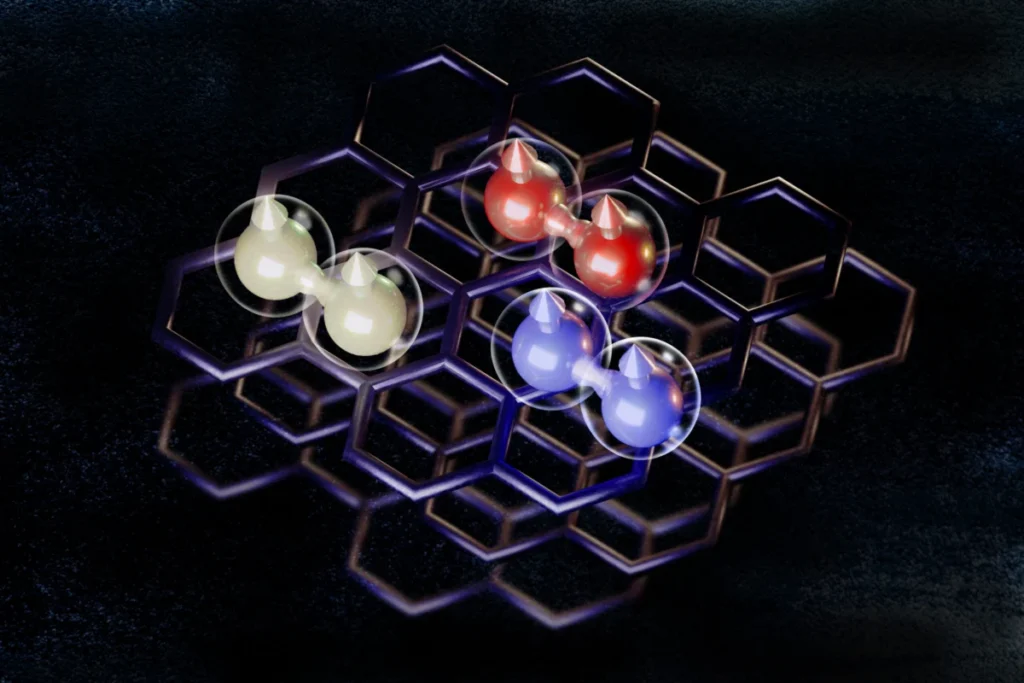
To understand the magnitude of this discovery, one must first look at the material’s fundamental structure. Graphene is a single layer of carbon atoms arranged in a hexagonal, honeycomb-like lattice. When these layers are stacked, they form graphite. In the most common form of graphite, the layers are stacked in an alternating ABA pattern. However, rhombohedral graphite utilizes an ABC pattern, where each layer is slightly offset from the one below it, resembling a series of steps.
This specific "staircase" geometry is naturally occurring but rare, making up only a small fraction of natural graphite. To isolate it, the researchers employed the "Scotch tape method"—a Nobel Prize-winning technique involving the mechanical exfoliation of graphite flakes until they reach atomic thinness. By meticulously searching through these exfoliated samples, the MIT team identified flakes with the telltale rhombohedral signature.
"People might assume that this is a simple, boring carbon material," says Professor Long Ju. "But we can control this material by tuning certain experimental ‘knobs,’ such as electrical voltages. This is how a simple physical material can exhibit so many different superconducting properties."
Experimental Methodology: Tuning the Quantum Knobs
The discovery was made possible by the researchers’ ability to manipulate the material’s electron density with extreme precision. In previous experiments, Ju’s group had "doped" rhombohedral graphene by adding electrons, which led to the discovery of a rare "chiral" form of superconductivity. In this latest study, they decided to explore the opposite end of the spectrum: removing electrons, a process known as "hole-doping."
Working in collaboration with Dominik Zumbuhl’s group at the University of Basel in Switzerland, the team placed the rhombohedral graphene samples in a specialized laboratory environment capable of reaching ultracold temperatures—near absolute zero—and generating intense magnetic fields. By applying varying electrical voltages to the material, the researchers could "tune" the number of charge carriers (holes) within the lattice.
As they progressively lowered the electron density, they monitored the material’s electrical resistance. At specific, critical densities, the resistance plummeted to zero, signaling the onset of superconductivity. Through this systematic approach, the team identified four distinct superconducting states emerging from the same thin flake of carbon.
Defying Magnetism: The 9 Tesla Revelation
The most profound aspect of the study involves the material’s relationship with magnetic fields. In conventional superconductors, magnetic fields are the enemy of zero-resistance flow. Superconductivity relies on "Cooper pairs"—pairs of electrons that bond together to move through a lattice. Typically, these electrons have opposite spins (one "up" and one "down"). A magnetic field exerts a force on these spins, attempting to align them in the same direction. If the field is strong enough, it breaks the Cooper pairs apart, destroying the superconducting state.
However, the MIT-led team observed that three of the four discovered states in rhombohedral graphene persisted in magnetic fields as high as 9 Tesla. To put this in perspective, 9 Tesla is approximately 180,000 times stronger than the Earth’s magnetic field.
Even more baffling to the researchers was the discovery that at certain densities, a perpendicular magnetic field actually enhanced the superconductivity. The material’s transition temperature—the point at which it becomes a superconductor—rose from 55 millikelvin to roughly 90 millikelvin when the field was applied. Furthermore, the material was able to carry 50 to 60 percent more electrical current before the superconducting state collapsed.
"From a fundamental physics point of view, it’s very exotic that a magnetic field doesn’t kill superconductivity, and instead it boosts it," Ju noted. "We have provided a lot of experimental results and provided the nutrition that people can absorb to try to think about what’s going on here."
Theoretical Implications: Aligned Spin Cooper Pairs
The persistence of superconductivity under high magnetic fields suggests that the electrons in rhombohedral graphene are not pairing in the traditional "opposite-spin" fashion. Instead, the researchers propose that the electrons may be forming "triplet" pairs, where their spins are already aligned in the same direction.
In such a scenario, an external magnetic field would pull on the electron spins, but because they are already aligned, the field would not necessarily force them out of their bonded state. Instead, it might actually stabilize the pairing, explaining why the superconductivity becomes more robust as the magnetic field increases. If confirmed, this would categorize rhombohedral graphene as an unconventional superconductor, placing it in a rare class of materials that include certain heavy-fermion systems and potentially some high-temperature superconductors.
A Timeline of Graphene Discovery
The discovery of multiple superconducting states in natural graphite is the latest chapter in a two-decade-long exploration of carbon’s 2D forms:
- 2004: Andre Geim and Konstantin Novoselov at the University of Manchester successfully isolate graphene using adhesive tape, proving that stable 2D materials can exist.
- 2018: Pablo Jarillo-Herrero’s group at MIT discovers "magic-angle" twisted bilayer graphene, showing that rotating two layers of graphene by 1.1 degrees creates a moiré pattern that induces superconductivity.
- 2021-2023: Researchers begin looking beyond twisted layers toward naturally occurring stacks. Long Ju’s group identifies electronic correlations and fractional electron charges in rhombohedral graphene.
- 2024: The current study reveals that rhombohedral graphene hosts four distinct superconducting phases, including states that are boosted by magnetic fields.
This timeline highlights a shift in the field. While much of the early 2020s focused on "twistronics"—the art of manually stacking and rotating layers—the current discovery proves that nature has already provided complex quantum platforms within the "boring" structure of common graphite.
Broader Impact and Future Directions
The implications of this research extend far beyond the laboratory. Understanding unconventional superconductivity is a primary goal for the development of future technologies, including:
- Quantum Computing: Materials that host triplet pairing are prime candidates for topological superconductivity, which could be used to create "Majorana fermions." these particles are essential for building fault-tolerant quantum computers that are resistant to environmental noise.
- High-Field Magnets: Superconductors that thrive in high magnetic fields could revolutionize the design of medical imaging (MRI) machines and particle accelerators, potentially leading to more compact and powerful devices.
- Power Electronics: While the current findings occur at millikelvin temperatures, the fundamental physics discovered in graphene provides a blueprint for designing new materials that might exhibit similar "magnetic-boosted" superconductivity at much higher temperatures.
Junseok Seo, a graduate student in Ju’s group and co-first author of the study, emphasized the creative aspect of the work: "We’re not only dealing with what nature gives us, but we’re applying additional controls to change it to something that nature does not give us, but that can exist in the same material."
Institutional Support and Collaboration
The study was a massive international effort, reflecting the complexity of the experiments. Along with MIT and the University of Basel, contributors included researchers from Florida State University, the University of Florida at Gainesville, and the National Institute for Materials Science (NIMS) in Japan, which provided the high-quality hexagonal boron nitride used to encapsulate the graphene samples.
The research received significant funding from the U.S. Office of Naval Research, the National Science Foundation, and the Sloan Foundation. Device fabrication was performed in part at MIT.nano, the university’s advanced facility for nanoscale research.
As theorists scramble to model the exact microscopic mechanisms that allow rhombohedral graphene to defy magnetic suppression, the experimentalists are already looking toward the next "knob" to turn. The discovery serves as a potent reminder that even the most mundane materials can harbor extraordinary secrets when viewed through the lens of modern quantum physics.