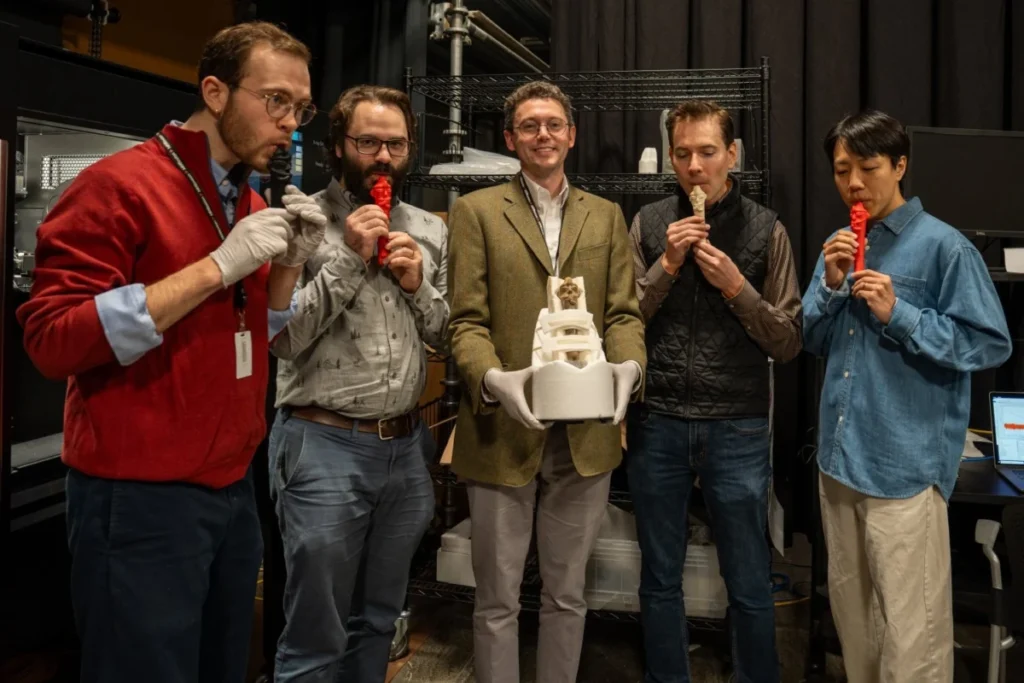
What if the echoes of history could be heard not just in hushed museum halls, but through the vibrant resonance of playable instruments? This ambitious vision is rapidly becoming a reality at the Massachusetts Institute of Technology (MIT), where a groundbreaking collaborative research project is meticulously recreating ancient and historical musical instruments, allowing them to be played and experienced as their creators intended. This initiative, a synergy between MIT’s Center for Materials Research in Archeology and Ethnology (CMRAE) and the School of Humanities, Arts, and Social Sciences (SHASS), is transforming passive artifacts into active conduits of cultural heritage.
The genesis of this remarkable endeavor can be traced back to late 2024, when Benjamin Sabatini, a senior MIT postdoc, reached out to Professor Eran Egozy with a profound question: could accurate, playable replicas of ancient instruments be created? This query sparked a collaborative spirit that quickly expanded. Sabatini was introduced to Mark Rau, a newly appointed MIT professor specializing in music technology and electrical engineering, whose own passion for historical instruments resonated deeply with the project’s core concept. "My biggest qualm is often there are no accompanying audio examples," Rau stated, expressing a sentiment shared by many museum visitors. "I want to hear these instruments; I want to play these instruments."
Their shared enthusiasm led them to Jared Katz, the Pappalardo Curator of Musical Instruments at the Museum of Fine Arts, Boston (MFA). Katz, an expert in ancient musical practices, had long harbored a desire to employ advanced imaging techniques like CT scanning to unravel the construction mysteries of historical instruments. His own research had already pioneered the 3D scanning and printing of playable replicas, making the MFA an ideal partner. The museum’s extensive collection, initiated in 1917 and now boasting over 1,450 instruments from across six continents, with some dating back as far as 1550 BCE, provided an unparalleled trove of potential subjects. Katz’s specialization in ancient practices and his existing expertise in creating playable replicas formed a crucial cornerstone for the project.
The collaborative proposal quickly garnered support. Rau and Sabatini successfully secured funding from the MIT Human Insight Collaborative (MITHIC), with Katz’s enthusiastic backing. The core research team, a multidisciplinary ensemble, now includes Nate Steele, program associate in the MFA’s Department of Musical Instruments, and MIT postdoc Jin Woo Lee. This dedicated group convenes regularly at the MFA, meticulously scanning and acoustically analyzing the instruments.
The Technological Symphony: From Scan to Sound
At the heart of this project lies an innovative application of advanced technology. The team utilizes a state-of-the-art CT scanner from Lumafield, a company founded by MIT alumni, to capture both the internal and external dimensions of each instrument with extraordinary precision. These detailed scans are then integrated with non-destructive vibration and acoustic testing, alongside sophisticated numerical simulations. This comprehensive approach allows for the digital reconstruction of the instruments’ sonic characteristics, aiming to replicate their original sound with remarkable accuracy.
"For example, if we’re trying to recreate a violin, we can use an impact hammer – a very small hammer with a transducer in it – so we’re imparting a known force signal into the instrument, and then measure the resulting [surface] vibrations with a laser Doppler vibrometer," explained Professor Rau, highlighting the meticulous process of capturing an instrument’s dynamic response. This method allows researchers to understand how different parts of an instrument vibrate and contribute to its unique timbre, a crucial step in achieving sonic fidelity.
From Digital Blueprint to Tangible Melody
The journey from digital data to a playable replica involves several sophisticated stages. Once the detailed 3D digital models are established, they serve as blueprints for 3D-printed copies. These prints are then ingeniously transformed into plaster mold negatives. The next critical step involves casting these molds using slip, a process demonstrated effectively with a Paracas whistle – a ceramic artifact from Peru dating between 600-175 BCE. This technique allows for the physical recreation of ceramic instruments, preserving their material integrity and form.
The team has already showcased a playable replica of the Paracas whistle at the MITHIC Annual Event in November, offering attendees a rare opportunity to hear a sound unheard for millennia. For instruments crafted from wood, the project plans to collaborate with local luthiers and utilize reclaimed old-growth wood, ensuring historical authenticity in both material and craftsmanship. This commitment to material sourcing underscores the project’s dedication to not just sonic but also material accuracy.
Unveiling Cultural Narratives Through Materials and Sound
Benjamin Sabatini, an integral member of CMRAE, emphasizes the profound humanistic implications of this research. From a materials science and archaeological perspective, the project aims to delve deeper into the cultures that produced these instruments. "From our perspective, we want to understand the people who made these instruments through both the materials that they’re made of, but also the sound that they have," Sabatini articulated. This dual focus on material composition and acoustic properties offers a unique lens through which to explore ancient societies, their craftsmanship, their artistic expressions, and their sonic landscapes.
Under Sabatini’s guidance, a team of Undergraduate Research Opportunities Program (UROP) students, including Irene Dong and Mouhammad Seck, have been instrumental in reproducing several ancient and historical clay instruments in the CMRAE archaeology lab. The Paracas whistle, a testament to their efforts, has already captivated audiences.
To date, the team has meticulously scanned approximately 30 instruments from the MFA’s vast collection. Their ambitious goal is to scan at least 100 instruments over the project’s duration, creating a comprehensive digital archive that will support future scholarly research and public engagement. The data derived from these scans are used not only to reconstruct the instruments physically but also within software environments, ensuring that both their form and their sound are faithfully represented.
"They’re both visually beautiful and striking objects, but they are meant to be heard," remarked Katz, underscoring the intrinsic purpose of these artifacts. His vision for this research extends beyond mere replication: "My hope for this research is to provide us with a way to protect the original instrument while still allowing them to be heard and experienced in the way they were intended to be experienced." This sentiment highlights the dual benefit of the project: preserving irreplaceable historical objects while making their cultural significance accessible through sound.
Fostering Interdisciplinary Connections and Community Engagement
The potential for outreach and community engagement is a significant aspect of this project, a goal explicitly outlined in its proposal. Katz envisions these playable replicas as powerful tools for connection: "It shows how powerful it can be when art and science come together to create new understandings and to help us reactivate these instruments in exciting ways." This collaborative spirit, bridging artistic and scientific disciplines, promises to unlock new avenues for understanding and appreciating historical music.
The project has also proven to be a powerful draw for students, igniting their passion for interdisciplinary exploration. Victoria Pham, a second-year undergraduate in materials science and engineering, is working with Sabatini as a UROP student. "I was drawn to this project because I love history," she explained. "I love wandering through the halls of the MFA and immersing myself in the descriptions of paintings and artifacts. I find learning about ancient peoples to be fascinating, especially in how their legacy affects us today."
Pham’s current work involves the non-destructive acoustic investigation of a Veracruz poly-glabular flute, dating to 500-900 CE, through finite element modeling. She finds the experience deeply rewarding: "My work is fulfilling because I was able to learn new software and problem-solve to improve my model, which was very satisfying." Her enthusiasm for the emerging field of music technology is palpable: "Contributing to the new, budding field of music technology scratches an itch in my brain, and I hope that my work inspires others to get interested in archaeology, material science, or music technology."
Alexander Mazurenko, a second-year undergraduate majoring in music and mathematics, has also been a dedicated participant. His involvement began last summer and continued through MIT’s Independent Activities Period in January. Mazurenko views his contribution as a vital part of his interdisciplinary education: "The opportunity to participate in this UROP with Professor Rau was the perfect chance to begin to work in the intersection of my passions." The academic output from Pham and Mazurenko, including their work presented at upcoming conferences and expected academic papers, will further solidify the project’s contributions to scholarship.
A Legacy of Sound for Future Generations
The collaborative research project between MIT and the Museum of Fine Arts, Boston, represents a significant leap forward in the study and appreciation of historical musical instruments. By merging cutting-edge technology with a deep respect for cultural heritage, the team is not only recreating lost sounds but also forging new connections between the past and the present. As more instruments are scanned, analyzed, and replicated, the project promises to enrich our understanding of human history, artistry, and the universal language of music, ensuring that these ancient voices can resonate for generations to come. The meticulous process of capturing and recreating these instruments highlights a growing trend in cultural preservation, where digital and physical reconstruction work hand-in-hand to safeguard and share humanity’s most precious artistic legacies.