For decades, the scientific community has operated under a relatively straightforward "origin story" for black holes: when a massive star reaches the end of its life, it exhausts its nuclear fuel and undergoes a catastrophic collapse. This process typically culminates in a supernova—a brilliant explosion that ejects the star’s outer layers into space—while the remaining core collapses under its own gravity into an unimaginably dense point known as a black hole. While this stellar-death model accounts for the vast majority of black holes observed in the universe, new data from the world’s most sensitive gravitational-wave detectors suggests that a significant portion of the black hole population has a far more complex and violent ancestry.
A groundbreaking study led by researchers at the Massachusetts Institute of Technology (MIT) has revealed that approximately 14 percent of merging black holes may be "second-generation" entities. These are not the direct remnants of dying stars but are instead the products of previous black hole mergers. This process, known as hierarchical merging, suggests a cosmic cycle where black holes act as the building blocks for even larger, more massive black holes, challenging the traditional limits of stellar evolution and providing a new lens through which to view the growth of the universe’s most mysterious objects.
The Paradigm of Hierarchical Merging
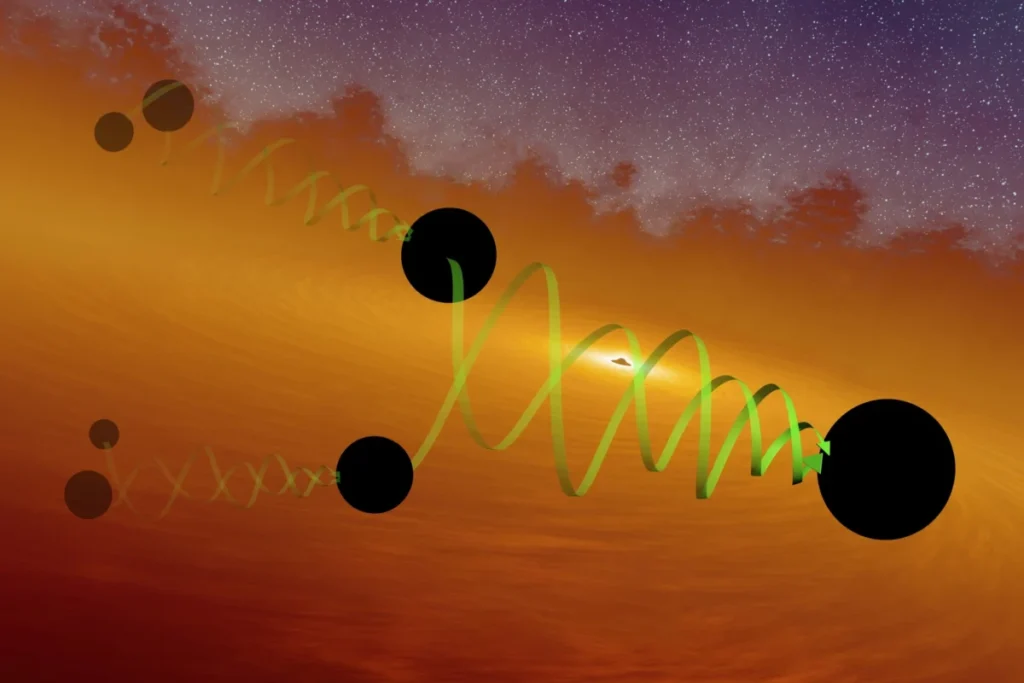
The concept of hierarchical merging rests on the idea that the universe is a dynamic, recycling machine. In the traditional model, a black hole is a terminal state—the "end" of a star’s life. However, in dense stellar environments, such as globular clusters or the chaotic centers of galaxies, black holes are not isolated. Instead, they exist in close proximity to one another, often "whizzing around" in high-speed orbital dances.
When two first-generation black holes—those born directly from stars—spiral into one another and merge, they create a new, larger black hole. Under the right conditions, this new "second-generation" black hole can remain in its crowded neighborhood, eventually capturing another partner to merge once again. This "black-holes-birthing-black-holes" pathway creates a lineage of cosmic collisions that can theoretically continue indefinitely, leading to the formation of increasingly massive objects that could not have been formed by a single star alone.
"We’re finding that, for some of these merging black holes, it’s not their first rodeo," explains Cailin Plunkett, the study’s first author and a graduate student in MIT’s Department of Physics. "Overall in the universe, black holes are merging all the time. The question of how often they were repeatedly merging was pretty uncertain. Now we’re seeing a relatively consistent picture where there’s a decent percentage of black holes that are coming from this repeated pathway."
Identifying the Fingerprints: Spin and Mass
To distinguish a second-generation black hole from a first-generation one, the MIT team looked for specific physical signatures: mass and spin.
When a massive star collapses, it loses a significant amount of its angular momentum during the supernova explosion. Consequently, the resulting first-generation black hole is expected to have very little spin. In contrast, the merger of two black holes is a violent, high-energy event that imparts immense rotational energy to the resulting product. According to Salvatore Vitale, associate professor of physics at MIT and co-author of the study, a black hole born from a merger would be "spinning very fast, at about 70 percent of its maximum possible spin."
Another tell-tale sign is a "lopsided" pairing. In many detected mergers, one black hole in the binary pair is significantly more massive and possesses a much higher spin than its companion. Such an imbalance strongly suggests that the larger, faster-spinning partner is a second-generation black hole that has already undergone at least one prior merger.
Analyzing the Gravitational-Wave Catalog
The MIT researchers reached their conclusions by conducting a comprehensive analysis of the LIGO-Virgo-KAGRA Gravitational Wave Transient Catalog 4.0 (GWTC-4.0). This catalog contains data from the fourth observing run of the global network of gravitational-wave observatories, which include the two LIGO detectors in the United States, the Virgo detector in Italy, and the KAGRA detector in Japan.
These observatories do not "see" black holes through light; instead, they detect gravitational waves—minuscule ripples in the fabric of space-time caused by the acceleration of massive objects. By analyzing 155 pairs of binary black holes, the team moved beyond individual case studies to look for broader population trends.
Specifically, they focused on two signals detected in 2024, labeled GW241011 and GW241110. Both events showcased black holes with spins and masses that deviated significantly from what would be expected of first-generation remnants. Inspired by these outliers, Plunkett and Vitale developed a sophisticated analytic model to search the entire catalog for a characteristic pattern of orbital "wobbles," known as precession.
The Physics of the Orbital Wobble
Precession occurs when the spins of the merging black holes are not aligned with the plane of their orbit. Imagine two spinning tops circling each other on a table; if their axes are tilted, the entire orbital plane begins to wobble and shift. This "wobble" leaves a distinct imprint on the gravitational waves emitted during the final moments before the merger.
By applying their model to the GWTC-4.0 data, the researchers found that roughly 14 percent of the detected mergers exhibited the degree of precession and mass imbalance characteristic of a first-generation and second-generation black hole pairing. Furthermore, the study identified specific mass "tiers." While first-generation black holes often clustered around 10 and 30 solar masses, the second-generation candidates frequently appeared in the 20 and 40 solar mass ranges, or even higher.
Breaking the "Mass Gap"
The discovery of second-generation black holes helps solve one of the most persistent puzzles in modern astrophysics: the "mass gap."
Current stellar evolution theory predicts a limit on how large a black hole can be when formed from a supernova. For stars of a certain size, the explosion is so violent—a phenomenon known as a pair-instability supernova—that the star is completely obliterated, leaving behind no black hole at all. This creates a "gap" in black hole masses, specifically in the range of 45 to 120 solar masses.
"Stellar evolution theory predicts you shouldn’t be able to form black holes in that mass range at all from just a supernova," Plunkett notes. "Yet we have seen black holes that are that massive. And the question is: Where did they come from?"
The MIT study provides a compelling answer. If black holes are merging hierarchically, they can easily bypass the limits imposed by stellar death. By combining the masses of smaller black holes, the universe can create "impossible" giants that fall squarely within the predicted mass gap.
Broader Implications and Future Research
The realization that hierarchical merging is a significant pathway for black hole formation has profound implications for our understanding of the cosmic environment. It confirms that certain regions of the universe, such as the dense centers of galaxies, are essentially "black hole factories" where the density of matter allows for repeated interactions.
This research also sets the stage for the next decade of gravitational-wave astronomy. As detector sensitivity improves, scientists expect to observe black hole mergers from much further back in the universe’s history. Salvatore Vitale suggests that within ten years, technological advancements will allow researchers to see these events "irrespective of where they happen in the universe."
The study, supported by the National Science Foundation and the Brinson Foundation, was co-authored by Thomas Callister of Williams College and Michael Zevin of the Adler Planetarium and Northwestern University. Their findings, published this week in Physical Review Letters, mark a shift in how astronomers categorize the inhabitants of the dark universe.
By proving that 14 percent of black holes have a "previous life," the MIT team has added a new layer of complexity to the life cycle of the cosmos. No longer just the remains of dead stars, black holes are now understood to be active participants in an ongoing process of growth and evolution, merging and re-merging to shape the gravitational landscape of the universe. This discovery not only validates the predictive power of gravitational-wave science but also invites a re-evaluation of the origins of the supermassive black holes that sit at the hearts of galaxies, suggesting that they, too, may be the ultimate products of a long and violent hierarchical lineage.