Recent astrophysical research led by the Massachusetts Institute of Technology (MIT) has fundamentally challenged the traditional "textbook" narrative of black hole origins, suggesting that a significant portion of these celestial enigmas are not the direct result of dying stars but are instead the products of previous cosmic collisions. According to a study published this week in Physical Review Letters, approximately 14 percent of merging black holes detected in the universe may be "second-generation" entities—objects formed when two smaller black holes merged earlier in cosmic history. This process, known as hierarchical merging, indicates that the universe is a far more recycled environment than previously understood, where black holes act as both the end products of stellar evolution and the building blocks for even more massive structures.
For decades, the scientific consensus regarding black hole formation was relatively straightforward: when a massive star exhausts its nuclear fuel, it undergoes a cataclysmic supernova explosion. While the outer layers are blasted into space, the remaining core collapses under its own gravity into a singularity—a region of infinite density known as a black hole. However, as gravitational-wave observatories such as LIGO (Laser Interferometer Gravitational-Wave Observatory) in the United States, Virgo in Italy, and KAGRA in Japan have increased their sensitivity, they have begun to detect black holes that do not fit this singular narrative. By analyzing a massive dataset of 155 pairs of binary black holes, the MIT-led team has provided the most robust evidence to date that hierarchical merging is a primary driver of black hole growth.
The Mechanics of Hierarchical Merging and the Significance of Spin
The primary differentiator between a "first-generation" (1G) black hole and a "second-generation" (2G) black hole lies in two physical characteristics: mass and spin. When a single star collapses, the resulting black hole typically possesses very little spin. This is because the star loses a tremendous amount of its angular momentum during the supernova phase, as its outer layers are ejected with great force. Consequently, 1G black holes are expected to be relatively "quiet" in terms of their rotation.
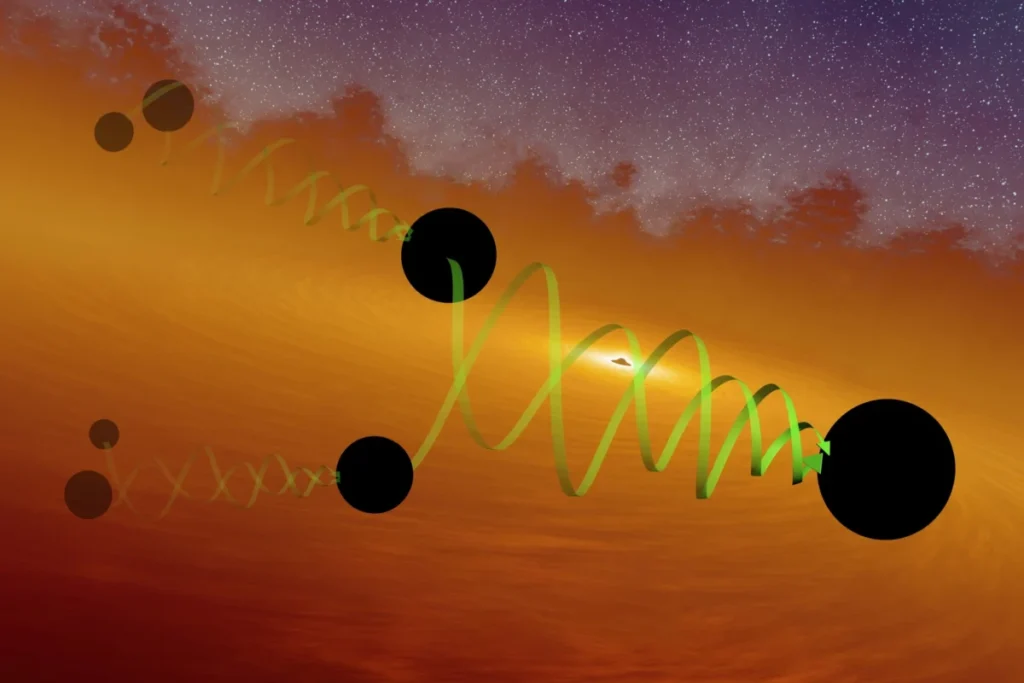
In contrast, when two black holes merge, the physics of the collision dictates a different outcome. As the two bodies spiral toward one another, their orbital angular momentum is converted into the intrinsic spin of the newly formed, larger black hole. According to Salvatore Vitale, associate professor of physics at MIT and co-author of the study, these second-generation black holes should be spinning at approximately 70 percent of their maximum possible speed.
This disparity in spin provides a "smoking gun" for astrophysicists. When gravitational-wave detectors pick up a signal from a merging pair where one or both objects exhibit high spin and unusually high mass, it strongly suggests that the object has already undergone at least one prior merger. "We’re finding that, for some of these merging black holes, it’s not their first rodeo," says Cailin Plunkett, the study’s first author and a graduate student in MIT’s Department of Physics. This "repeated pathway" suggests a cosmic cycle where black holes are constantly capturing and consuming one another in a process that could theoretically continue indefinitely in the right environments.
Identifying the "Orbital Wobble"
To identify these second-generation black holes, the research team developed a sophisticated model to analyze data from the LIGO-Virgo-KAGRA Gravitational Wave Transient Catalog 4.0 (GWTC-4.0). This catalog includes detections from the fourth observing run of the global network of detectors. Instead of examining individual events in isolation, the researchers looked for a characteristic pattern known as "precession" or orbital wobbling.
When two black holes orbit each other in a flat plane and their spins are aligned perpendicular to that plane, the orbit remains stable. However, if a black hole is a second-generation product with a high, misaligned spin, it introduces a gravitational imbalance. This causes the entire orbital plane to wobble or precess, much like a spinning top that begins to tilt as it slows down. By creating an analytic model that captures the specific types of wobbles expected from 1G-2G or 2G-2G mergers, the MIT team was able to scan the entire catalog for matches.
The analysis highlighted two specific signals detected in 2024, labeled GW241011 and GW241110. In both cases, the gravitational waves revealed a lopsided duo where one black hole was significantly more massive and faster-spinning than its partner. When these signals were integrated into the broader study of 155 binary pairs, the 14 percent figure emerged, suggesting that hierarchical merging is not a rare anomaly but a consistent feature of the universe’s evolution.
Solving the "Mass Gap" Mystery
One of the most compelling aspects of the hierarchical merging theory is its ability to explain black holes that shouldn’t exist according to standard stellar evolution. Theoretical models of supernovae predict a "mass gap" between approximately 50 and 120 solar masses. Scientists believe that when very massive stars reach the end of their lives, they undergo a "pair-instability supernova." This explosion is so violent and energetic that it completely disrupts the star, leaving behind no remnant core—and thus, no black hole.
However, gravitational-wave detectors have repeatedly found black holes within and above this forbidden mass range. The MIT study found that while 10 and 30 solar mass black holes are common products of standard supernovae, the detected black holes in the 40, 60, and 80 solar mass range are much more likely to be hierarchical products.
"Stellar evolution theory predicts you shouldn’t be able to form black holes in that mass range at all from just a supernova," Plunkett explains. "Yet we have seen black holes that are that massive. The question is: Where did they come from?" The data suggests the answer lies in the accumulation of mass through successive mergers. A 20-solar-mass black hole merging with another 20-solar-mass black hole creates a 40-solar-mass entity, which can then merge again to enter the "forbidden" mass territory.
The Role of Dense Stellar Environments
For hierarchical merging to occur, the environment must be incredibly crowded. In the vast emptiness of interstellar space, the chances of two black holes wandering near enough to capture each other are infinitesimal. Therefore, these findings imply that a significant portion of the mergers detected by LIGO and its peers are taking place in "stellar nurseries" or dense clusters.
Globular clusters—spherical collections of hundreds of thousands of stars—and the active galactic nuclei (AGN) at the centers of galaxies are the most likely candidates for these merger factories. In these regions, stars are packed so tightly that their remnants are forced into close proximity. "You might have a ton of stars whizzing around each other, and if some are massive and explode, they become black holes," says Plunkett. "The black holes continue to whizz around and can capture each other and merge."
This environmental context is crucial for understanding the history of the universe. If 14 percent of black holes are second-generation, it suggests that these dense clusters are more active and efficient at "processing" black holes than previously modeled. It also provides a roadmap for future observations, allowing scientists to pinpoint where in the universe these high-mass, high-spin objects are most likely to be found.
Chronology of Discovery and Future Implications
The journey to this discovery began in 2015 with the first-ever detection of gravitational waves (GW150914), which proved that binary black holes exist and can merge. Since then, the field has moved from proving existence to performing "population studies."
- 2015-2017: Initial detections confirm the existence of binary black hole systems.
- 2019: The detection of GW190521 provides the first clear evidence of a black hole in the "mass gap" (85 solar masses), sparking intense debate over hierarchical merging.
- 2021-2023: The LVK collaboration releases expanded catalogs (GWTC-2 and GWTC-3), showing a diverse range of masses and spins.
- 2024: Detections of GW241011 and GW241110 provide specific examples of lopsided, high-spin mergers.
- Present: The MIT study synthesizes this decade of data to establish the 14 percent hierarchical merger rate.
The implications of this research extend far beyond the classification of black holes. By understanding the frequency of hierarchical mergers, scientists can better calibrate their models of how galaxies form and how gravity behaves in extreme environments. Furthermore, this research sets the stage for next-generation detectors like the Einstein Telescope in Europe and Cosmic Explorer in the United States. These future facilities will be sensitive enough to detect mergers from the "cosmic dawn," potentially allowing researchers to track the very first generation of black holes as they began the hierarchical process billions of years ago.
The work of Plunkett, Vitale, and their colleagues—supported by the National Science Foundation and the Brinson Foundation—marks a pivot point in gravitational-wave astronomy. It moves the conversation from "what is a black hole?" to "what has this black hole been through?" In doing so, it reveals a universe that is constantly reshaping itself, where the death of a star is often just the first chapter in a long and violent biography.