MIT researchers have demonstrated a low-cost design of specialized electronic nozzles, called triaxial electrospray emitters, that could be used to manufacture time-release drug-delivery particles or self-healing materials efficiently and at scale. This breakthrough, detailed in the latest issue of Virtual and Physical Prototyping, represents a significant leap forward in microfabrication, promising to democratize advanced material creation and drug delivery systems.
A New Era of Precision Manufacturing
The core innovation lies in the triaxial electrospray emitters, which leverage electricity to precisely dispense three distinct liquids from microscopic nozzles. This process generates a steady stream of fluid with three separate layers, which then coalesce into multilayered droplets. These droplets can subsequently solidify, forming microparticles with intricate, layered structures. The potential applications are vast, ranging from highly targeted drug delivery systems to novel self-healing materials.
For instance, imagine a complex drug delivery scenario: an array of these triaxial emitters could produce nanoparticles with a three-layer design. The outermost layer might be engineered to slowly degrade in the harsh environment of the stomach, revealing a second material. This intermediary layer would then meticulously control the release of a core material, which would deliver potent medicine to a specific, targeted area within the intestines. This level of precision could dramatically improve therapeutic efficacy and reduce side effects.
Historically, the development of miniaturized electrospray emitter arrays has been hampered by the need for expensive and time-consuming microfabrication processes, typically conducted within highly controlled semiconductor cleanrooms. These stringent requirements have limited the widespread adoption and scalability of such technologies.
3D Printing: The Key to Accessibility and Scale
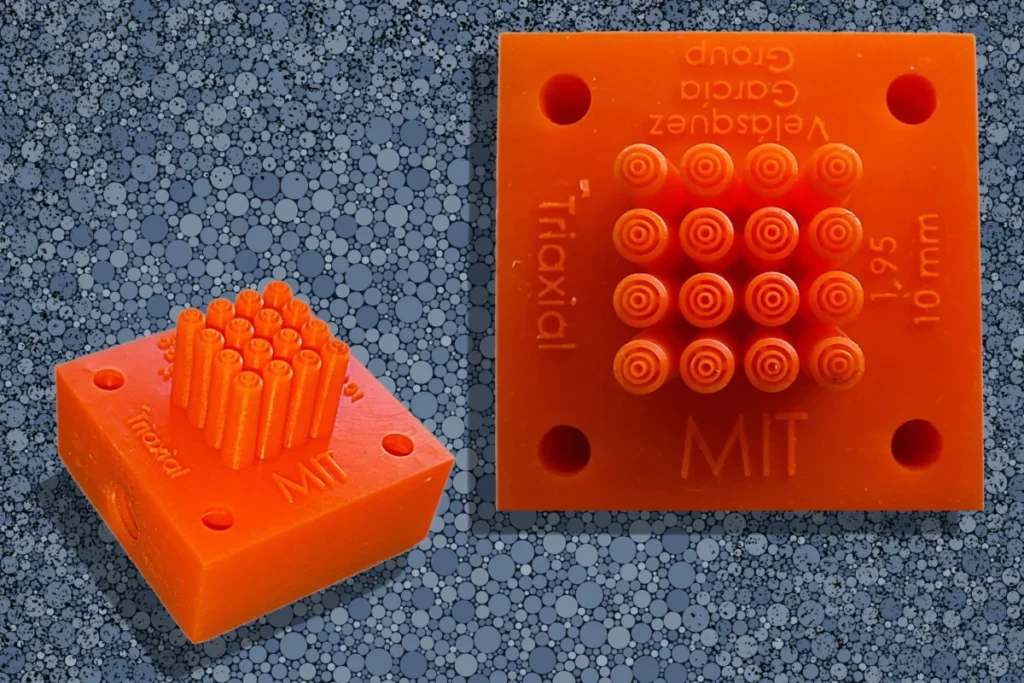
To overcome these limitations, the MIT research team has ingeniously employed 3D printing. They have successfully fabricated arrays of triaxial electrospray emitters, each featuring 16 nozzles packed into an area of approximately one square centimeter. Each of these 3D-printed devices incorporates an intricate network of three-dimensional microchannels. These channels are crucial for uniformly supplying the three distinct liquids to their respective nozzles, ensuring consistent droplet formation.
This one-step fabrication process is remarkably efficient, taking only a few hours to produce these complex emitter arrays. This starkly contrasts with the weeks or even months required for traditional cleanroom fabrication methods.
Uniformity and Throughput: Critical for Advanced Applications
When subjected to rigorous testing, the 3D-printed arrays consistently generated uniform, three-layered droplets at an impressive scale. This uniformity is paramount for the high-throughput manufacturing of layered microparticles. Such particles are essential for a wide array of advanced applications, including biosensors capable of detecting specific chemical substances with high sensitivity and artificial cells designed to aid in tissue regeneration processes.
"We couldn’t make a device like this in a semiconductor cleanroom. This is only possible because they are 3D-printed," stated Luis Fernando Velásquez-García, a principal research scientist at MIT’s Microsystems Technology Laboratories (MTL) and the senior author of the paper detailing this significant advance. He further emphasized the potential impact: "The particles these devices generate, whether they are used for a self-healing composite or to deliver medicine, can have a big impact in many applications. We want to democratize this technology so the benefits can touch many more people."
Velásquez-García was joined on the research paper by lead author Bryan Ivan Quintanar-Abarca from the Technological Institute of Monterrey in Mexico, highlighting the collaborative nature of this groundbreaking work.
The Precision of Electrospray
Electrospray technology itself is a well-established method for generating extremely fine droplets. It works by applying a high voltage to a liquid as it exits a nozzle, creating a charged stream that breaks down into a steady flow of microscopic droplets.
The triaxial design takes this a step further by incorporating three concentric nozzles. These nozzles are engineered to emit three immiscible, or non-mixable, liquids simultaneously. The result is the formation of layered droplets, which can then be solidified into compound microparticles with distinct, segregated layers.
Consider the application in biosensing. A triaxial electrospray emitter could be used to create a biosensing particle that encapsulates three different chemical markers, each confined to its specific layer. This layered structure could enable more sophisticated and multiplexed detection capabilities. Furthermore, electrospray emitters are known for their ability to produce smaller microdroplets at a significantly faster rate compared to many other existing techniques.
Miniaturization and the Quest for Uniformity
Miniaturization is a critical factor in the efficiency of electrospray devices. Smaller emitters require lower voltages to initiate droplet formation, leading to reduced energy consumption and greater control. However, the output of a single electrospray emitter, by its nature, is modest. Therefore, to achieve high-volume production without compromising the uniformity and quality of the generated particles, arrays of emitters are indispensable.
The challenge has always been to fabricate these multi-emitter electrospray devices. Traditional methods, confined to semiconductor cleanrooms, impose significant limitations on the shapes and sizes of the individual components within these arrays. Crucially, there are no prior reports in the open literature of miniaturized triaxial electrospray arrays, underscoring the novelty and originality of this MIT-led research.
"When you build a triaxial array, you need to find a way to create geometries that have many integrated parts and extremely fine structures in the smallest footprint possible. And you need to ensure the devices will work uniformly," explained Velásquez-García.
Vat Photopolymerization: Enabling Intricate Designs
To achieve these complex geometries, Velásquez-García and his collaborators turned to a highly precise 3D printing technique known as vat photopolymerization. This method utilizes light to selectively cure and solidify extremely thin layers of liquid resin, effectively building the device layer by layer.
This process allows for an unprecedented level of precision, enabling the researchers to print layers as thin as 25 micrometers – a fraction of the width of a human hair. This fine resolution is essential for creating the intricate internal microchannel structures required for a functional triaxial electrospray emitter.
Refining the Design for Optimal Performance
The resulting 3D-printed array, roughly the size of a U.S. penny, houses a sophisticated network of internal, coiled microchannels. These channels are meticulously designed to guide the three different liquids to the 16 nozzles. The helical nature of these microchannels serves a dual purpose: they help maintain a uniform spray of microdroplets across all nozzles while simultaneously keeping the overall device footprint as compact as possible.
"In a sense, the emitters in the array never learn they have company, or otherwise there would be cross-talking and causing interference between them. We achieved uniformity because of the work that went into our designs," Velásquez-García elaborated.
A significant engineering challenge was the fabrication of these extremely fine microchannels without the need for supporting structures, which could easily clog the delicate device. Furthermore, ensuring that all uncured resin was thoroughly removed before the array was put into operation was critical for its functionality and longevity. The microchannels are designed to precisely funnel the liquids to the concentric nozzles, which must be perfectly aligned to ensure consistent and stable emission of microdroplets.
"We were able to aggressively optimize the design because we could iterate in a much timelier manner. This ability to exquisitely refine designs is a key advantage of 3D printing," Velásquez-García noted.
Unlocking the Secrets of Droplet Stability
The researchers explored multiple architectural designs and carefully adjusted liquid flow rates to determine the optimal combination for maximizing the stability and consistency of the emitted microdroplets. Surprisingly, their experiments revealed that the viscosity of the middle liquid plays the most critical role in achieving droplet stability. This is because the middle liquid’s viscosity is instrumental in preserving the distinct thickness of each layer within the droplet.
Moreover, the team discovered that by precisely manipulating flow rates and applied voltages, they could tailor the thickness of each microdroplet layer with remarkable accuracy. This capability opens the door for scientists to design drug-delivery particles with specifically engineered layers, ensuring that medication is released at precisely the intended time and rate.
"By making such intricate devices more practical, we can empower others to pursue entrepreneurial and scientific advances," Velásquez-García stated with optimism.
The Road Ahead: Further Innovation and Broader Impact
Looking to the future, the MIT researchers are committed to further refining their fabrication processes and device designs. Their goals include achieving even smaller dimensions for the emitters and integrating conductive or dielectric materials into the devices. These advancements are expected to pave the way for the development of even more sophisticated and capable electrospray emitter arrays.
This pioneering research was supported, in part, by the Tecnológico de Monterrey – MIT Nanotechnology Program, underscoring the importance of international collaboration in pushing the boundaries of scientific discovery. The implications of this work extend far beyond the laboratory, promising to accelerate innovation in critical fields such as medicine, materials science, and advanced manufacturing. By making complex microfabrication technologies more accessible and affordable, this breakthrough has the potential to democratize innovation and bring about significant societal benefits.